 Universe Today
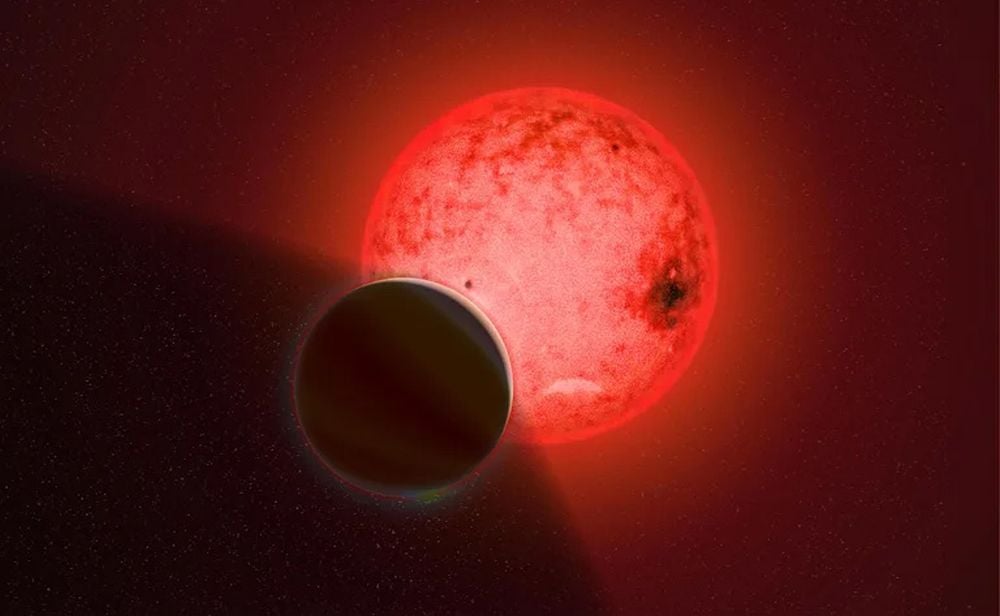
The nebular hypothesis states that stars and the planets that orbit them form from the same reservoir of material, called a solar nebula. It's the most commonly accepted explanation for how solar systems form. But despite its ability to explain many things about solar system formation, there are some outstanding questions.
The study of exoplanets and their stars poses a challenge for the nebular hypothesis. Planet-hunters have found massive gas giants as large as Jupiter—and even larger—orbiting very close to their low-mass stars. Some of these planets are closer to their small stars than Mercury is to the Sun. How giant planets form in these scenarios is something the nebular hypothesis struggles with.
The problem is that low-mass stars have low-mass protoplanetary disks, and these disks hold the material that planets form from. There's an incongruity between low-mass disks and high-mass gas giants. Disk scaling relations suggest that high-mass planets should form in high-mass disks.
One such gas giant on a tight orbit around a low-mass star is TOI-5295b. It orbits an M-dwarf star about 282 light-years away. It's a close-in planet with about 1.08 Jupiter masses that takes only 1.6 days to complete an orbit. A team of astronomers discovered it in 2023 with data from NASA's Transiting Exoplanets Survey Satellite (TESS) and confirmed it with various observation from other telescopes and instruments.
"TOI-5205b has one of the highest mass ratios for M-dwarf planets, with a mass ratio of almost 0.3%, as it orbits a host star that is just 0.392 ± 0.015 solar masses," the authors of that paper wrote. "The high mass of TOI-5205b stretches conventional theories of planet formation and disk scaling relations that cannot easily recreate the conditions required to form such planets."
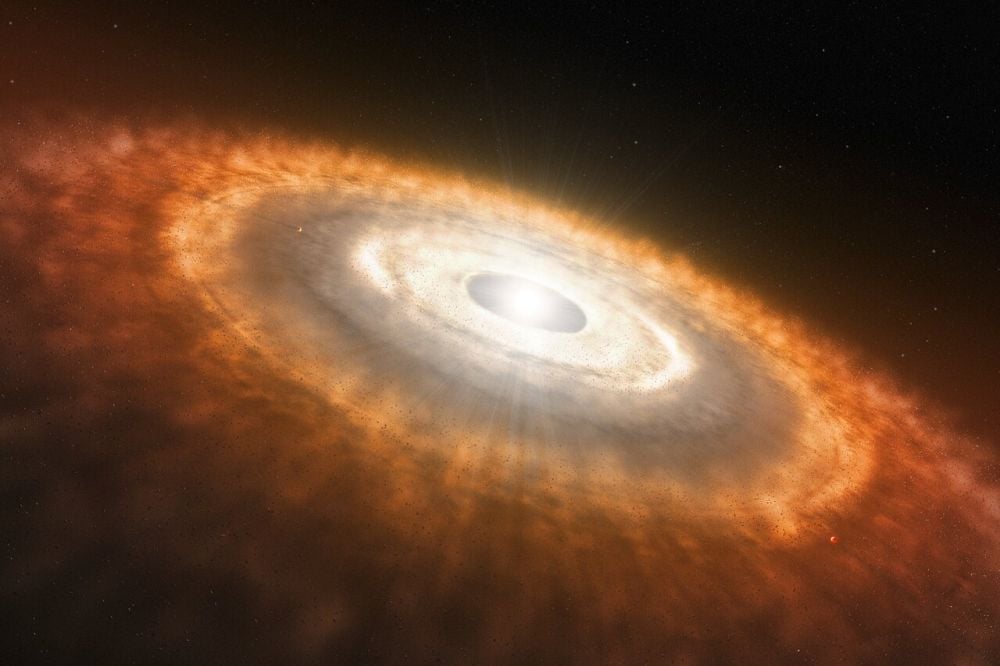 An artist's illustration of a protoplanetary disk. Disk scaling relations show that massive gas giants should form around high-mass stars because those stars also have more massive disks. But not all exoplanet/star combinations adhere to that. Image Credit: ESO/L. Calçada
Now many of the same researchers have revisited TOI-5205b. They're leading a JWST observation program aimed at exoplanets like TOI-5205b called GEMS: Giant Exoplanets around M dwarf Stars. GEMS uses the JWST to study the atmospheres of these planets, and TOI-5205b is a prime target because its transit in front of its star is so deep.
The new research is titled "GEMS JWST: Transmission Spectroscopy of TOI-5205b Reveals Significant Stellar Contamination and a Metal-poor Atmosphere," and it's published in The Astronomical Journal. The lead author is Caleb Cañas. Cañas is a postdoctoral program fellow at NASA's Goddard Space Flight Center.
"Recent discoveries of transiting giant exoplanets (Rp ≳ 8 R⊕) around M dwarfs present an opportunity to investigate their atmospheric compositions and explore how such massive planets form around low-mass stars contrary to the prediction from formation models," the researchers write. Their paper presents the first transmission spectra from TOI-5205b. The JWST captured three spectra from the planet's atmosphere as the planet transited in front of its star three times.
Those spectra held some surprises. TOI-5205b's atmosphere has a lower concentration of metals, or elements heavier than hydrogen and helium, than gas giants like Jupiter in our Solar System. Its atmosphere also has a lower metallicity than its star. This makes it different than any other massive planet ever studied.
The exoplanet's atmosphere also holds methane and hydrogen sulphide, which isn't necessarily shocking, but is still important.
"Characterizing the interiors of giant planets is a crucial step in improving our understanding of their formation history," the researchers explain. "A key property of a giant planet is the bulk metallicity."
After gathering the spectra from the exoplanet, the researchers turned to atmospheric models to try to understand what the spectra were telling them about the exoplanet's bulk metallicity. Those models showed them that TOI-5205b's entire composition is nearly 100 times richer in metals than its atmosphere.
“We observed much lower metallicity than our models predicted for the planet’s bulk composition, which is calculated from measurements of a planet’s mass and radius. This suggests that its heavy elements migrated inward during formation and now its interior and atmosphere are not mixing,” Kanodia explained. “In summary, these results suggest a very carbon-rich, oxygen-poor planetary atmosphere.”
When compared to our Solar System's gas giants, this is a very strange situation, even though both Jupiter and Saturn show the same lack of atmospheric mixing. A carbon-rich and oxygen-poor chemistry suggests a very different composition than that of its host star. It might mean that the exoplanet formed in a region of the protoplanetary disk where carbon-bearing ices were plentiful but water-ices, the main source of oxygen, were not. It might mean that the exoplanet migrated as it formed, gathering different materials as it passed through different regions in the disk. That could also explain why it's on such a tight orbit. Or it could mean that it accreted very little rocky or icy material and accreted mostly gas.
Either way, it challenges the nebular hypothesis' prediction that a gas giant's composition closely reflects that of its host star.
The researchers do state some caveats in their results, though, mostly to do with the star's activity, which can introduce noise into transit spectra. "We caution that extensive stellar contamination and the nondetection of water may bias the atmospheric metallicity to lower values, and future observations through GO 7683 (JWST General Observing Program) will help corroborate or refute these findings," they write.
TOI-5205b is one of seven planets being studied in GEMS. Once the researchers have detailed data from all of them, they'll understand TOI-5205b in better context. They explain that GEMS will provide "... a sample of well-characterized warm Jupiter atmospheres that will (i) provide atmospheric and bulk metallicities to place TOI-5205b in greater context and (ii) allow for a comparison with hot Jupiters and solar system gas giants to investigate potential constraints on the formation of GEMS."

