 Universe Today
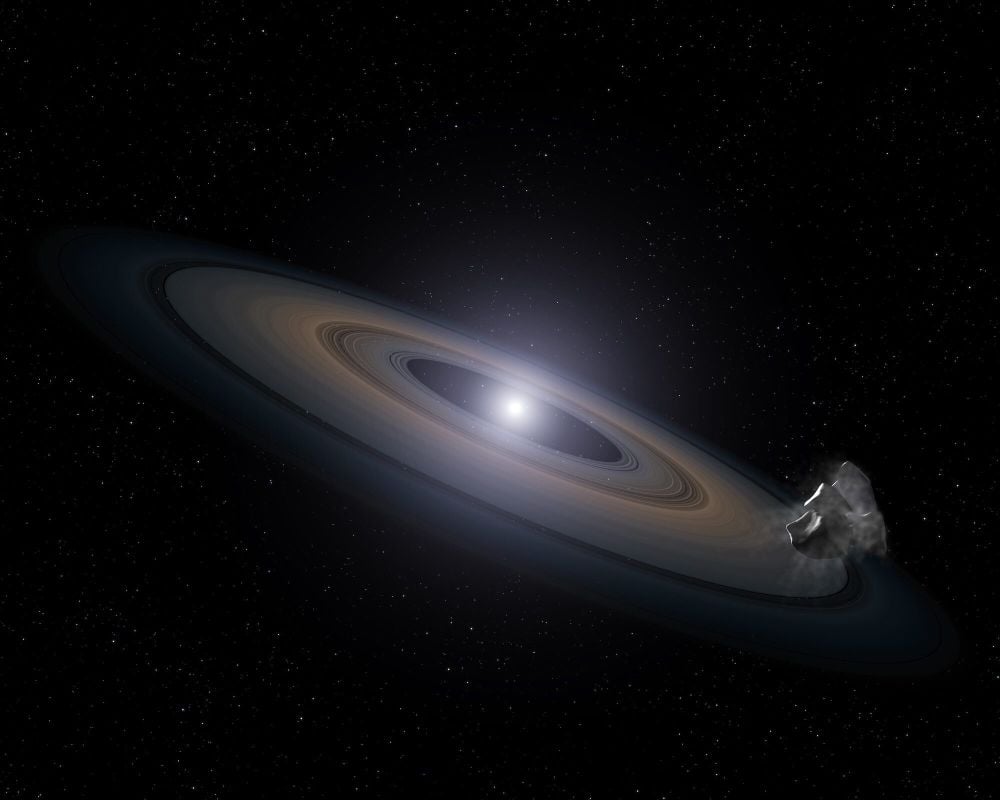
White dwarfs are what remain when a main sequence star like our Sun reaches its end. As it depletes its fuel, it swells and turns red, becoming a red giant. Then it becomes an asymptotic giant branch (AGB) star with powerful stellar winds. Those winds blow away its outer shell and create a planetary nebula. Then, all that remains of the star is a white dwarf, an extremely dense stellar remnant that radiates only remnant heat and is made of highly compressed matter.
There are billions of these stars in the Milky Way, though they're hard to see. But in recent years, astronomers have found more than 1,700 white dwarfs surrounded by metal debris. This material comes from planets that were destroyed when the star left the main sequence. The white dwarfs can suck this material in and break it down into its elements. Analyzing that debris can inform scientists about the planetary system the star used to host.
Astronomers want to understand how common this planetary debris is, and new research examines how widespread it is and how the white dwarf's magnetic field affects how its accreted and how easily it can be observed. The research is titled "The Effects of Magnetic Accretion on the Spatial Extent of White Dwarf Pollution," and the lead author is Dang Pham from Colorado University-Boulder. It will be published in The Astrophysical Journal and is currently available at arxiv.org.
"Many white dwarfs are polluted by metals, which are generally understood to be the accreted remnants of a planetary system," the authors write. "Modeling these systems typically assumes that the metal concentration is homogeneous throughout the white dwarf's atmosphere." But in this work, the researchers show how a white dwarf's magnetic fields can concentrate the debris, making detection more difficult.
The magnetic fields can affect how a white dwarf accretes metals in the material. The material initially gathers in small areas at the star's poles, where it's more easily hidden from observations.
“It’s actually a very similar process to auroras on Earth. The sun sends charged particles to the Earth, they follow the Earth’s magnetic field lines and then they make a spot on the Earth’s atmosphere, which is the aurora,” Pham said. “With the white dwarf, instead of materials coming from the sun, you get materials from the planetary system. But we’re basically calculating the size of auroras on the white dwarfs, which I think is a very cool thing.”
So far, astronomers have found two white dwarfs with polar accumulations of metal debris. The question is, how many more are there and how common is the phenomenon?
"Since both magnetism and debris disks of tidally disrupted bodies are common around white dwarfs, many previous studies have investigated the process of magnetic accretion onto white dwarfs," the authors write.
To deepen the understanding of white dwarf magnetic accretion, the researchers used models and simulations. "Specifically, we model the impact of magnetic fields on the accretion of metals, the metal spreading process in a white dwarf atmosphere, and the resulting observational signatures," they write.
After a white dwarf accretes metals from planetary systems, they can initially gather at the poles. But a white dwarf, despite being a dead star, isn't static. "Convection in the white dwarf’s photosphere will then transport the metals across the surface," the authors write. This creates both sinking and spreading, and the researchers modelled how it all works. Spreading can make more material visible on the white dwarf's surface, while sinking will hide it from view.
"The relative spreading and sinking timescales determine whether the metals become uniformly distributed or remain confined to localized patches," they write. They found that if there's misalignment between the white dwarf's spin poles and magnetic fields, then patchy white dwarfs can have pollution signatures that vary periodically. This explains some white dwarf observations, and it lets the astronomers place constraints on the area of the patches. "Measurements of the variability can thus constrain the pollution area and thereby jointly constrain the convective and accretion properties of the white dwarf," the authors explain.
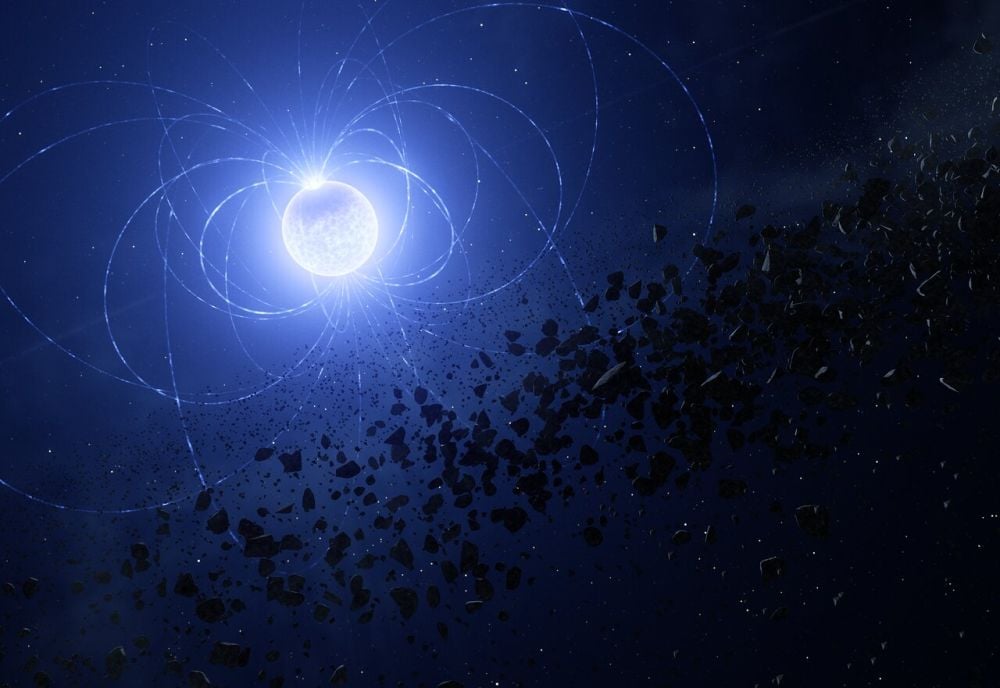 This artist's illustration shows WD 0816-310, a magnetic white dwarf well-known to astrophysicists. Its magnetic fields concentrated planetary metal debris onto its poles, creating observable patches with periodical variability. Image Credit: ESO/L. Calçada
This can also lead to underdetecting the debris amount. Because the metal is hiding in a small patch rather than spread over the whole surface, standard analyses (assuming uniform pollution) would underestimate how much material is actually falling into the white dwarf. The real accretion rate is higher than the inferred rate.
“This means that there may be significantly more pollution on white dwarfs than we have measured so far, and that the remnants of planetary systems may be even more common around these dead stars,” said study co-author Aster Taylor from the University of Michigan's Department of Astronomy. “And this is telling us that planetary systems are still pretty active even after the death of their host star.”
The team's calculations show that about 100 times more material is falling into white dwarfs than thought, though there's significant wiggle room in that number.
“At the very least, I think this says we have to update our calibrations about how many objects we expect to be out there and how we expect the dynamics to play out,” Taylor said. “What we’ve done sort of lets you squint at possible solutions, but, as of yet, there’s nothing definitive. I think it’s very much an open problem that we’ve introduced.”
Not all white dwarfs are magnetic: only about 10% to 20% are. Astrophysicists aren't sure why, but there are likely three reasons. The magnetic fields could be fossil fields from before it became a white dwarf, they could be from the crystallization of the white dwarf's core, or they could be from binary interactions. Each of these three origins shapes leaves their fingerprints on the white dwarf atmospheres, and understanding white dwarf accretion of planetary systems requires a better understanding of white dwarf atmospheres.
"Full three-dimensional models of the atmosphere of a magnetic white dwarf are necessary to better understand pollution processes and the impacts of magnetically-channeled accretion," the authors conclude.

