 Universe Today
The formation and evolution of individual stars in a galaxy shapes the evolution of the galaxy itself. Stars and stellar remnants make up the large majority of a galaxy's mass, so it's not surprising that the stellar population affects the evolution of galaxies. In the Milky Way's disk and bulge, stars and dead stars make up about 85% of the baryonic mass.
Astronomers work with a galaxy's initial mass function (IMF), which is a probability distribution of stars of different masses formed within a galaxy, to understand galaxies themselves. They want to understand how universal it is from galaxy to galaxy. The IMF is important because when a star forms, its initial mass determines its lifetime trajectory. So the IMF is an important link between stellar physics and the evolution of galaxies. But understanding the IMF requires observing lots of individual stars in a galaxy.
To make progress on understanding the IMF, astronomers need to be able to accurately observe individual stars in other galaxies. Not just the brightest or easiest to see, but a representative sample of the entire stellar population—including the dim ones—and that's not easy. Astronomers also need a way to determine which stars are actually binary stars.
From this perspective, the best candidates for targets are the closest galaxies, and our best space telescope, the JWST, is the best tool for observing them. This is why the Small Magellanic Cloud (SMC) is such an important observing target.
New research in Astronomy and Astrophysics tackles the problem of discerning binary stars in the SMC. It's titled "The Small Magellanic Cloud through the lens of the James Webb Space Telescope: Binaries and the mass function in the galaxy’s outskirts." The lead author is Maria Legnardi, a PhD student at the University of Padua in Italy.
The Small Magellanic Cloud is a desirable target, but not just because its close, only about 200,000 light years away. It also has low metallicity, which creates an opportunity to test how a galaxy's actual IMF compares to what our simulations have shown us. The SMC also has diffuse star-forming regions, making it harder to confuse metallicity with density, which can cloud our understanding of the IMF.
"The stellar initial mass function (IMF) and the fraction of binary systems are fundamental ingredients that govern the formation and evolution of galaxies," the authors write. One of the big questions in astrophysics is whether or not the the IMF is universal or if it's different from environment to environment. If it is different, what factors govern it?
"Dwarf galaxies such as the Small Magellanic Cloud (SMC), with their low metallicity and diffuse star-forming regions, offer critical laboratories to address this issue," authors explain. "Its proximity, low foreground extinction, and relatively low crowding compared to more massive galaxies enable us to resolve individual stars across a broad range of stellar masses, from low-mass main sequence (MS) stars to evolved giants."
The IMF and the fraction of binary stars in a galaxy influence how stellar systems evolve and how many supernovae explode. They also affect chemical enrichment and how many exotic objects like blue stragglers, X-ray binaries, and gravitational wave sources form. "Despite their importance, both the IMF and the binary fraction remain poorly constrained in external galaxies, particularly in the field populations of low-mass systems like the SMC," the authors write.
The researchers used the JWST's deep photometry of the stars in the SMC to determine the fraction of unresolved binary systems.
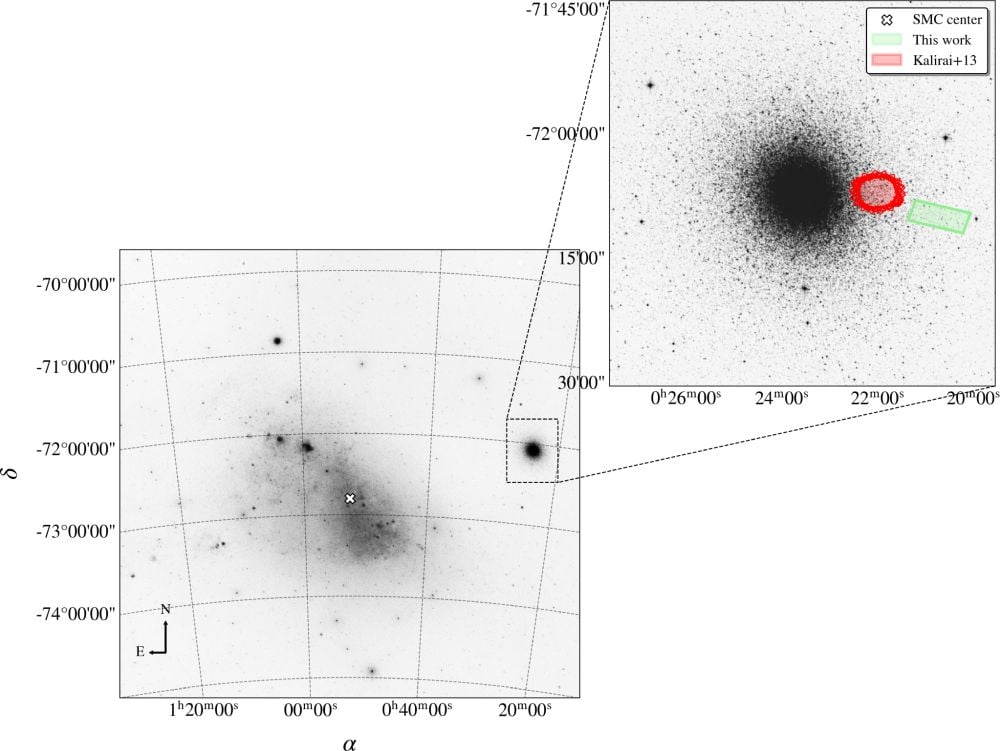 This figure shows the region studied in this work in a green rectangle. Though it's near 47 Tucanae, one of the Milky Way's globular clusters, the work actually examines stars on the outskirts of the SMC that are in the same line of sight. Red shows the footprint used in previous research. Image Credit: Legnardi et al. 2026. A&A.
Unresolved binaries can pollute the color-magnitude diagram (CMD) because they can look like single stars when both stars have similar masses. That in turn leads to a false understanding of the IMF. The JWST can't resolve individual stars in a binary, but that information can be extracted from the JWST's color-magnitude diagrams (CMDs).
The results show that about 14% of stars in the SMC field have a binary companion star at least 60% as massive as themselves. This is actually a lower limit, but that's the limitation of this method.
What's really important is how this result stacks up against IMF measurements in other galaxies. The 14% is statistically equivalent to what's found in the open clusters of the same age and metallicity as the Milky Way. It's also similar to the IMF in the Milky Way's field stars.
So despite the fact that the SMC's metallicity is five times lower than the Milky Way's, and despite the fact that the SMC's stellar density is much lower and its stars have a different formation history, the binary fraction of the SMC and the MW is the same.
"The binary fraction measured for the SMC field in this work is comparable to that observed in Galactic open clusters of similar ages," the authors write. "Furthermore, our result for the SMC field is consistent with the total binary fraction measured for Milky Way field stars of similar primary masses."
 This infrared image of the Small Magellanic Cloud is a composite image from the ESA's Herschel Observatory and NASA's Spitzer Space Telescope. Image Credit: ESA/NASA/JPL-Caltech/STScI. Licence: ESA Standard Licence
These results agree with a general trend in binary fractions. They tend to be higher in lower density environments, because there are less dynamic stellar interactions that could separate binary pairs. Conversely, in globular clusters where stellar density is higher, binary disruptions are more frequent, generating lower binary fractions. "This comparison suggests that the binary star formation and evolutionary processes in the low-density environment of the SMC resemble those in Galactic OCs and field populations, supporting the notion that environmental density and dynamical interactions play a key role in shaping binary fractions across different stellar systems," the authors explain.
The results also say something about how environmental factors can shape the IMF, and pose a challenge to the IMF's universality.
"This suggests that environmental conditions such as metallicity, temperature, and gas density influence the fragmentation of molecular clouds and the resulting stellar mass distribution," the authors write.
"Such variations challenge the universality of the IMF and have important consequences for the chemical evolution, feedback, and dynamical history of dwarf galaxies like the SMC," the researchers conclude.

