 Universe Today
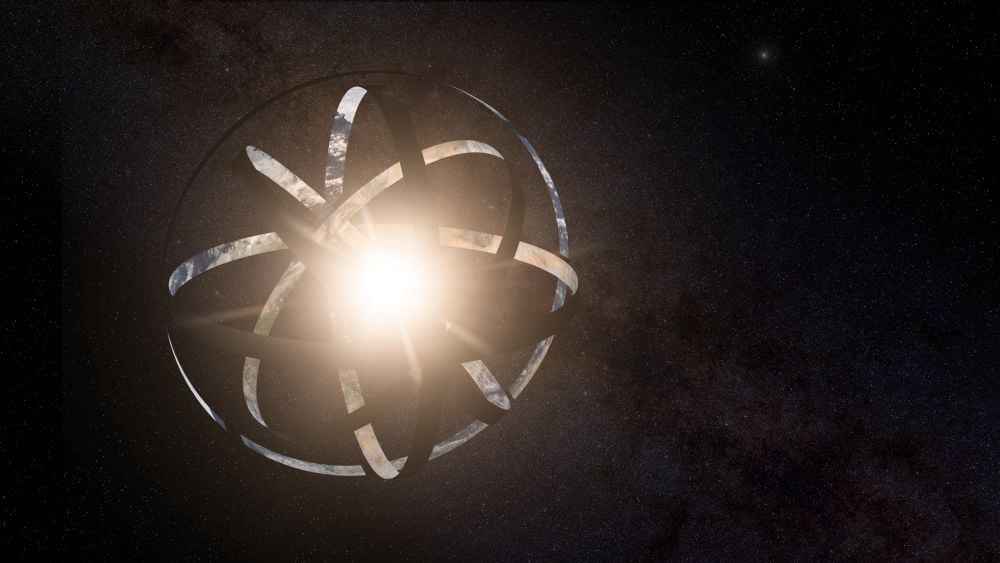
Human history is littered with expired civilizations, and scholars and archaeologists have made a determined effort to understand why and how civilizations collapse. They've found that symptoms like a growing wealth gap and distrust of the elites are precursors to civilizational collapse. But what about global technological civilizations like the one we live in now? How long can they last? What causes their collapse? How can they recover?
These are difficult questions to grapple with. Many of the variables and parameters involved are well beyond the horizon of our knowledge. Still, it's worth a try as a sort of thought experiment.
A new paper titled "Projections of Earth's Technosphere: Civilization Collapse-Recovery Dynamics and Detectability" explores some of these questions. The paper is available on arxiv.org and the lead author is Celia Blanco. Dr. Blanco is a researcher affiliated with the Centro de Astrobiología (CAB, CSIC-INTA) in Spain and the Blue Marble Space Institute of Science in Seattle, Washington.
"One of the most puzzling questions in astrobiology is whether intelligent civilizations exist elsewhere in the galaxy, and if so, why we have not yet detected them," the authors write. "This apparent contradiction, often referred to as the Fermi Paradox or the Great Silence, raises the question of why, in a galaxy billions of years old, we observe no clear signs of advanced extraterrestrial life."
The idea of the Great Filter applies to this thinking. The Great Filter is proposed as a barrier that prevents simple life from advancing and becoming technological civilizations that expand to other stars in a galaxy. There are many steps along that path, and the Great Filter idea says that at least one of the steps is extremely improbable. It can potentially explain the Great Silence.
This study doesn't directly address what a Great Filter might actually be, but it does examine collapse itself, how and why a collapse might happen, and how long recovery could take.
"How long a technological civilization remains active, and what determines whether it collapses or persists, is a central question for both projecting humanity’s future and assessing the prevalence of detectable intelligence in the galaxy," Blanco and her co-authors write.
To understand this issue, the researchers turned to simulations. They started with an "Earth-originating civilization" and modelled the collapse and recovery dynamics for ten plausible futures. In each case, they ran 200 simulation runs for 1,000 years. The authors say that outcomes were driven by the interplay between exposure to hazards, resource pressures, and types of governance.
The idea of a duty cycle is central to this work. "The duty cycle, defined as the fraction of its total lifespan that a civilization is technologically active, ranges from ∼0.38 to 1.00," the authors explain. A duty cycle of 1.00 indicates no collapse.
The ten scenarios the researchers work with are a fascinating look at the kinds of futures that may lie ahead for humanity, according to the researchers.
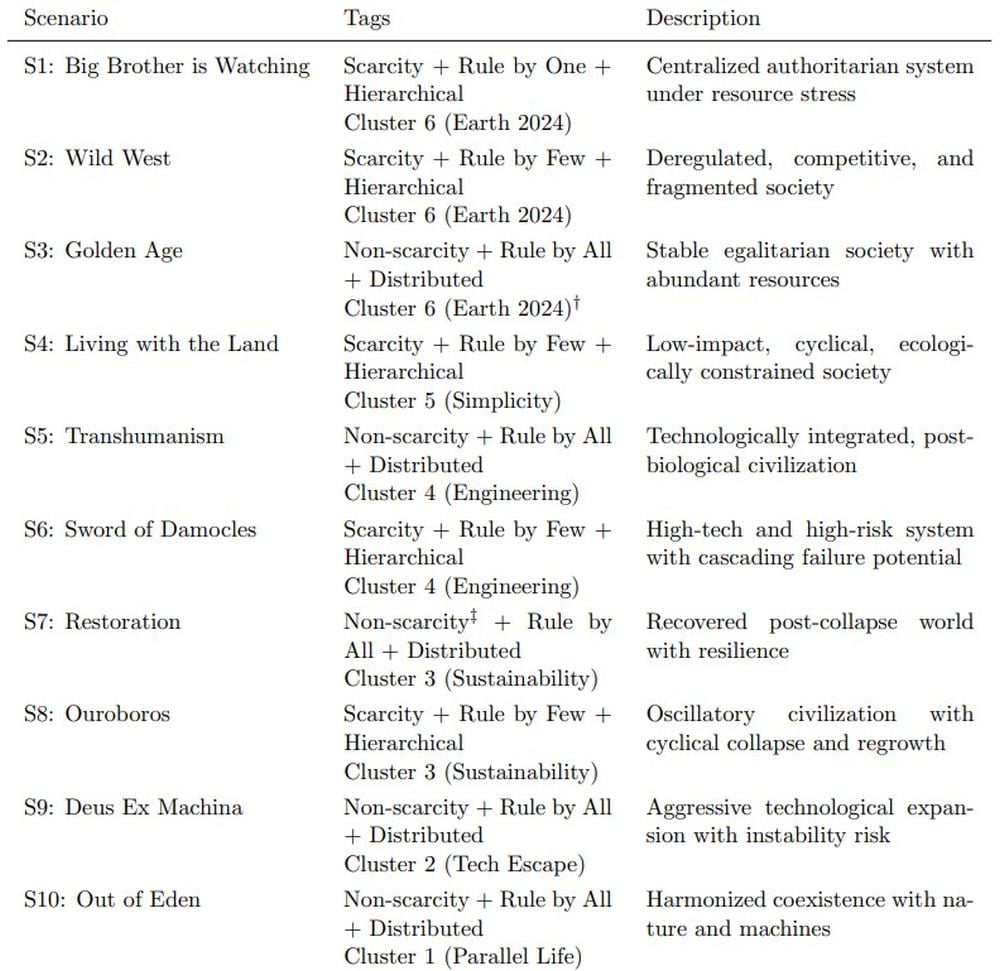 This table shows the 10 scenario descriptions and sociotechnical tags. Image Credit: Blanco et al. 2026.
In these scenarios, some factors are equal across all and some are not. Background hazards like an asteroid strike are spread equally, while others like the resource depletion rate are not. The overall interplay between all factors determines the outcome for each of the civilization types.
The figure below shows how technology and resource availability affect each type of society.
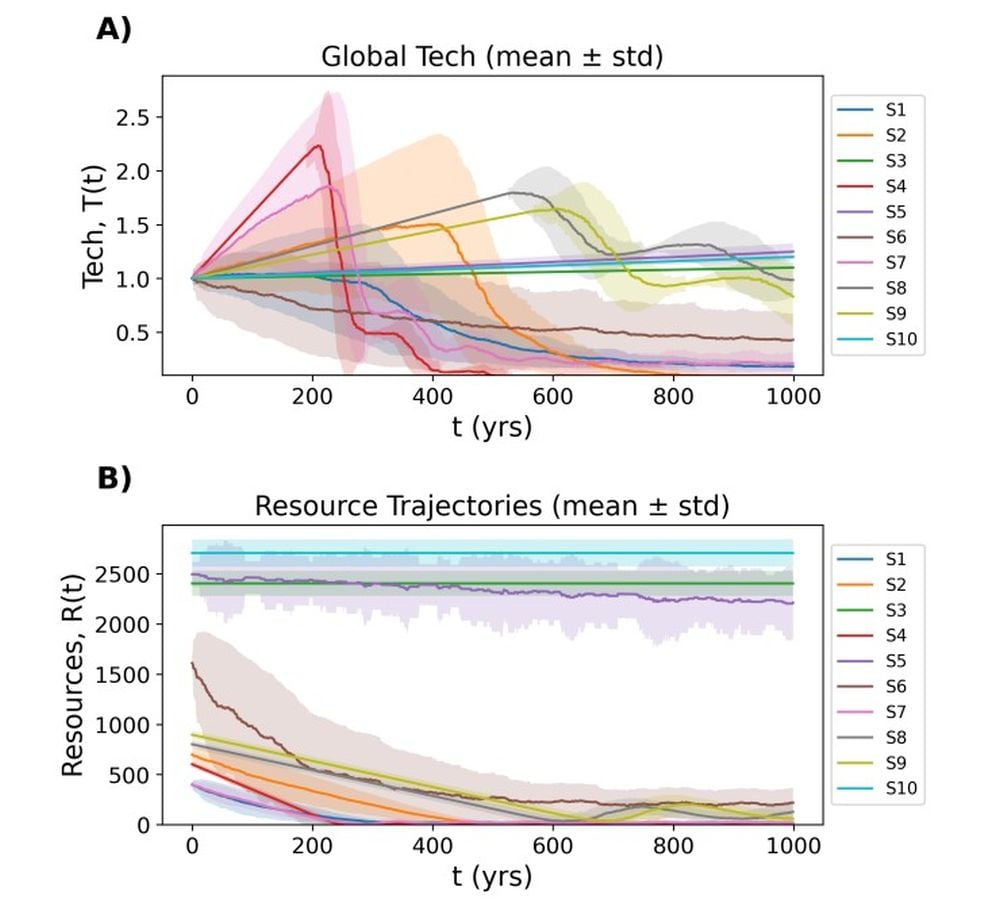 These panels show the resulting trajectories of global technology T(t) and available resources R(t), averaged across runs. "The Golden Age (S3) and Out of Eden (S10) show uninterrupted growth and resource stability throughout the 1000-year window," the authors write. "In stark contrast, scenarios such as Big Brother (S1) and Sword of Damocles (S6) suffer early collapses and high collapse frequencies. This leads to severe contractions in their technology and extended periods of inactivity. Image Credit: Blanco et al. 2026.
The simulations also revealed how each type of scenario would collapse. Some types never collapse, some collapse quickly, and some collapse and recover multiple times in the 1,000 year runs.
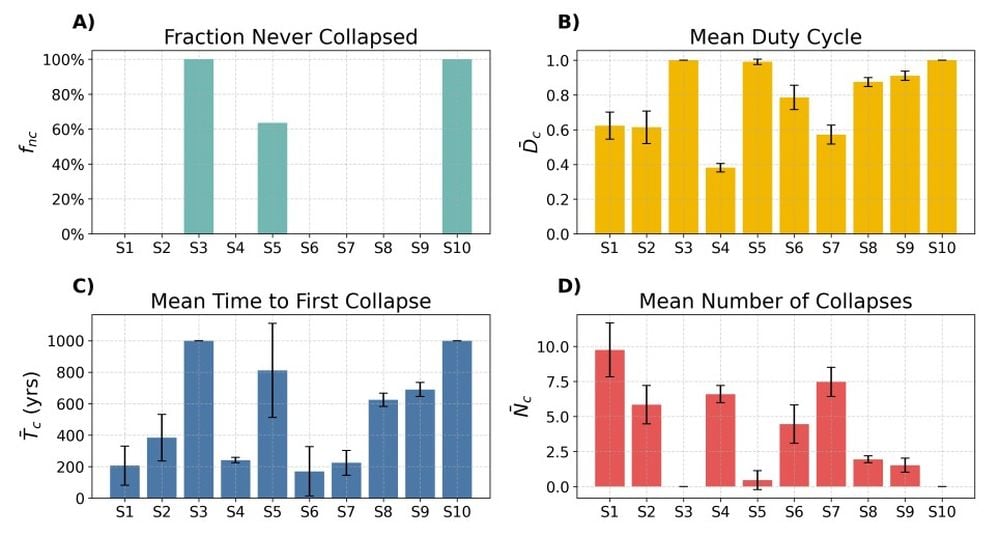 Each of the 10 scenarios was simulated for 200 runs, and these panels show the results. Golden Age and Eden never collapse, while Big Brother and Sword of Damocles collapse quickly. Some, like Big Brother and Restoration, suffer repeated collapses. Image Credit: Blanco et al. 2026.
The researchers used these results to understand what kind of technosignatures might be observable in each case. They focused on nitrogen dioxide, chlorfluorocarbon-11, chlorofluorocarbon-12, and carbon tetraflouride.
The Sword of Damocles stands out as the only scenario showing carbon tetrafluoride. It's also notable that Living with the Land, Transhumanism, Deus ex Machina and Out of Eden show no CFCs.
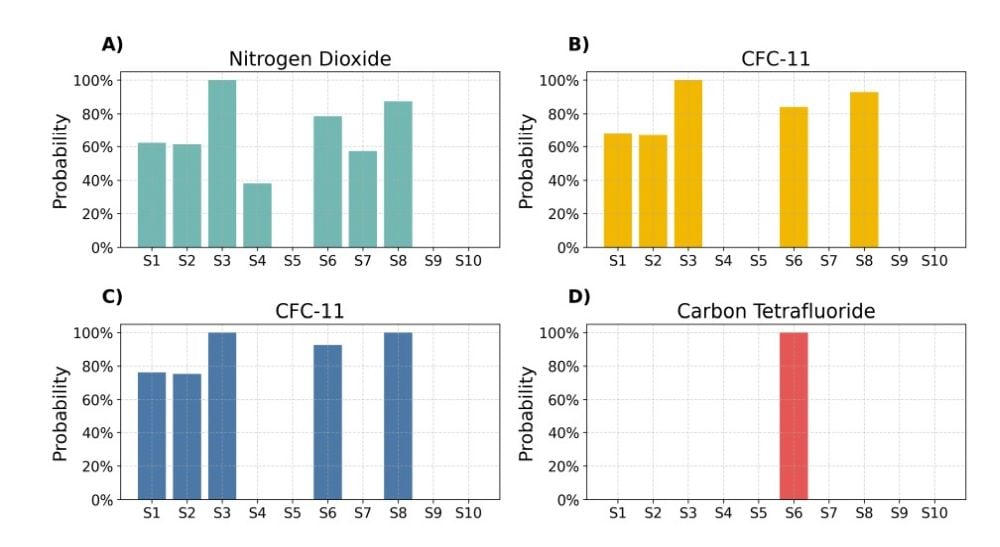 These panels show what types of chemical technosignatures may be detectable in the atmospheres of each type of civilization. Note that "C" is mislabelled and should read "CFC-12". Different civilation types produce different amounts of each type, and each chemical has a different lifetime, affecting overall results. Nitrogen dioxide only persists for hours or days in an Earth-like atmosphere, while carbon tetraflouride can last for 1,000 years or more. Image Credit: Blanco et al. 2026.
There are obviously some limitations to these simulations which the authors acknowledge and explain.
"Our modeling framework is grounded in Earth-originating scenario typologies, drawing from narrative futures methodologies informed by contemporary geopolitical, ecological, and technological trends," the researchers explain. "These projections embed assumptions about governance structures, resource constraints, and recovery dynamics that may not extend to non-terrestrial civilizations or to those that do not follow Earth-like developmental pathways."
That said, the results are interesting. It won't come as a shock that resource depletion plays a critical role, as does the post-collapse recovery fraction.
"Sensitivity analysis reveals that the resource depletion rate and the post-collapse recovery fraction are consistently the most impactful levers across scenarios, suggesting that reducing resource consumption may be at least as important as mitigating existential hazards for avoiding civilizational collapse," the authors write.
Two different viewpoints run into each other in this work. One viewpoint says that technological civilizations are unstable and prone to collapse. From this view, technological civilizations are one asteroid impact, one global pandemic, or one global nuclear conflagration away from extinction. A different viewpoint says that there's a point in their development in which technological civilizations become resistant to collapse. They've built technological defenses against catastrophic impacts, are resilient to a global pandemic, and have somehow left warfare behind.
"Both patterns emerge naturally in our simulations—not from differences in exogenous shocks, but from internal sociotechnical structure," the researchers conclude. "The long-term fate of a civilization, it appears, is less a matter of luck than of design."
Check out Fraser Cain's interview with one of the authors of this paper, Dr. Jacob Haqq-Misra, in this video.

