Universe Today
As we make our way through the latest solar maximum period, scholars and scientists are looking to similar events in the past to learn more about ancient bouts of solar activity. In particular, they want to know more about solar proton events (SPEs). These outbursts of high-energy particles get triggered by flares and coronal mass ejections.
While SPEs don't cause auroral displays, they are associated with space weather that does. If an outburst is strong enough, energized SPE protons can reach deeper into Earth's magnetosphere. There, they release their energy when they collide with atmospheric gases. That forms a carbon-14 compound that eventually settles into organic materials, such as trees. By measuring the carbon-14 content in buried trees, researchers at the Solar-Terrestrial Environment and Climate Unit of the Okinawa Institute of Science and Technology have been able to identify fluctuations in solar activity. These ultra-precise measurements allow them to study smaller fluctuations that are impossible to detect with conventional methods can now be seen, allowing detection of sub-extreme SPEs. Finding evidence of large outbursts is relatively easy, but when do scientists look for sub-extreme events?
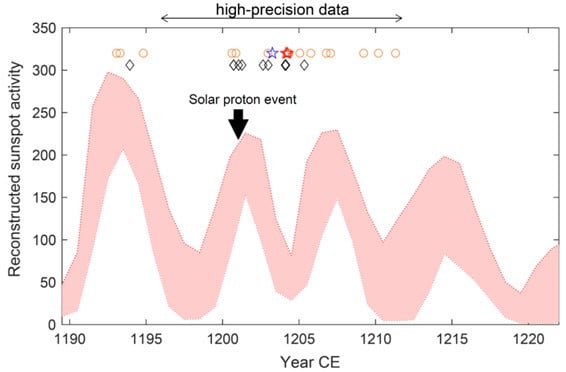 Reconstructed solar cycles based on carbon-14 records, relative to baseline activity level at y=0, overlaid with historical records. The orange circles denote the timing of aurora sightings, blue and red stars denote prolonged aurora events like those described in Meigetsuki, and black diamonds indicate the emergence of large sunspots. © Miyahara et al., 2026
The unit's Professor Hiroko Miyahara noted that past studies have focused on the more extremely powerful events, which are rare. “Our paper provides a basis for detecting sub-extreme SPEs — events that occur more frequently and are around 10-30% of the size of the most extreme cases, but still hazardous," he said. "Sub-extreme SPEs are more challenging to detect, but our method now allows us to efficiently identify them and better understand the conditions under which they are more likely to occur.”
Tracking SPEs Through Medieval Poetry
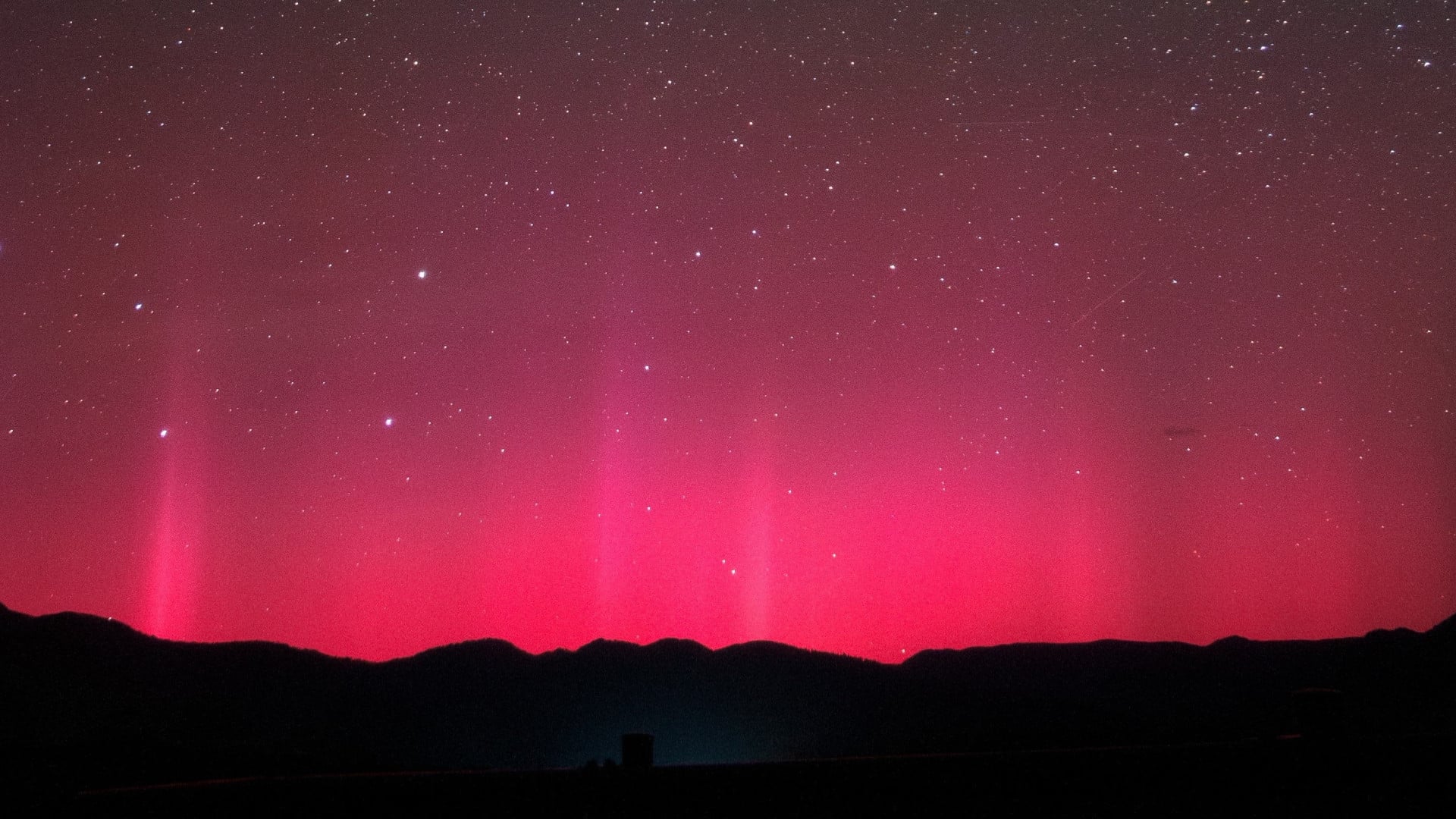
Because the extremely precise method is time-consuming, the team needed to first know when and where to look for evidence of past solar weather events. In the years 1200 to 1205 CE, Earth experienced one of the highest periods of solar outbursts during what's called the Medieval Solar Activity Maximum. During that time, people observed (and in some places, recorded) occurrences of the northern lights. Several recorded sightings come from observers in mid-latitude areas of China, Korea, and Japan, where aurorae aren't frequently seen. One good example comes from a work called Meigetsuki, the diary of Fujiwara no Sadaie. He was a courtier in the Japanese empire famous for his poetry. In his work, he notes the occurrence of low-latitude red aurorae in Kyoto. These occurred on February 21 and 23, 1204.
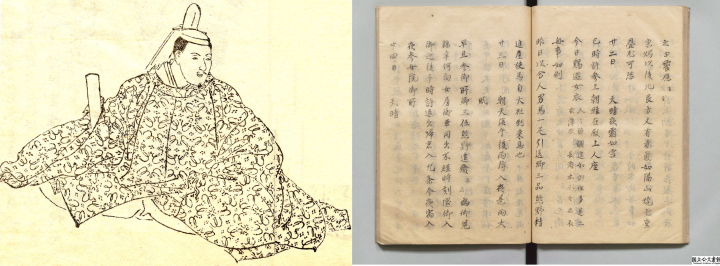 (Left) An Edo-period illustration of Japanese poet/courtier Fujiwara no Teika. (Right) A hand-copied version of Fujiwara no Teika’s diary, Meigetsuki, from the Edo period. The page shown includes references to “red lights in the northern sky” on the right-hand side. © (Left) Kikuchi Yosai (Public domain). (Right) National Archives of Japan (Public domain)
Another observer, Omuro Shoshoki, recorded the same event, which was an intense magnetic storm that lasted for several days. It's likely one of the oldest extreme space weather events of the time. Observers saw red and white stripes toward the north and northeast, the whole storm may have been associated with a large sunspot recorded in a Chinese document on February 21, 1204. There are also recordings of the sighting of aurorae in the following month in Meigetsuki as well as in a Chinese document, and a French document. Also in Meigetsuki, the writer describes aurorae that were seen over three nights.
Tracking Ancient Solar Outbursts
These ancient writings provided extremely important clues to when the outbursts occurred. The scientists then searched for and found carbon-14 spikes in buried asunaro wood in ancient forests that once thrived in northern Japan. Together with dendroclimatic studies — that is, a dating method based on comparing patterns of tree-ring growth associated with regional climate — the researchers placed this specific event sometime between winter 1200 CE and spring 1201 CE, a period during which observers in China also reported seeing a red, low-latitude aurora.
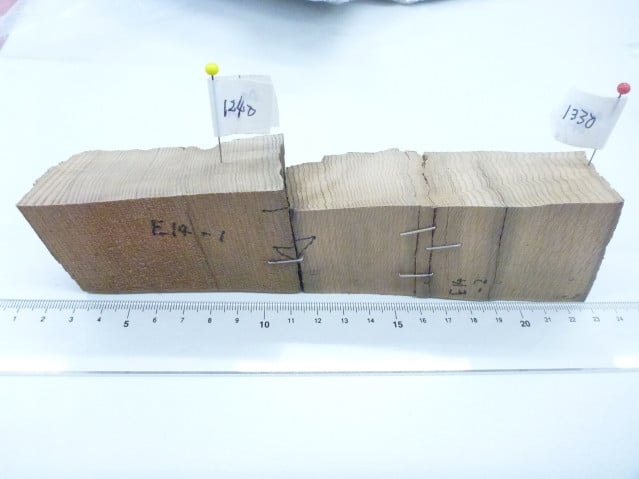 The asunaro cypress tree samples, unearthed at Shimokita Peninsula in northern Aomori Prefecture. The sample is provided by Tohoku University. © Hiroko Miyahara/OIST
When the team did a reconstruction of solar cycles of the time, they found that this particular SPE occurred at the maximum of that solar cycle. Further studies showed that cycles in that period of history were quite a bit shorter than what we experience in modern times and suggests extremely high solar activity. “The high-precision data not only allowed us to accurately date sub-extreme solar proton events, but it also lets us clearly reconstruct the solar cycles of the period,” said Miyahara. “Today, the Sun’s activity fluctuates over eleven-year-long cycles, but we’ve found that the cycle was just seven to eight years long back then, indicating a very active Sun. The SPE we have dated occurred at the peak of one of these cycles.”
Understanding Long-term Solar Activity
This study helps close gaps in the historical record of solar activity, giving scientists a longer-term view of our Sun's behavior. Understanding SPEs and other outbursts is important as humans resume lunar exploration and beyond. Using historical observations and carbon-14 dating of organic materials both help give a much more panoramic view of space weather outbursts. But as Miyahara emphasizes, precise carbon-14 measurements must be combined with other approaches.
“Historical literature provides a candidate time window, and dendroclimatology enables direct intercomparison between detected SPE and reports of sunspots and auroras recorded in literature. Integrated approaches like these are necessary to accurately reconstruct past solar activity, helping us better understand the characteristics of extreme space weather,” Miyahara pointed out. “For example, while the SPE we found occurred near the peak of the solar cycle, some of the prolonged low-latitude aurora recorded in the literature seems to fall near the minimum of our reconstructed solar cycle. This is unexpected, and we’re excited to look further into what solar conditions could cause this.”
For More Information
Medieval Japanese Poetry and Buried Trees Help Elucidate Volatile Space Weather