 Universe Today
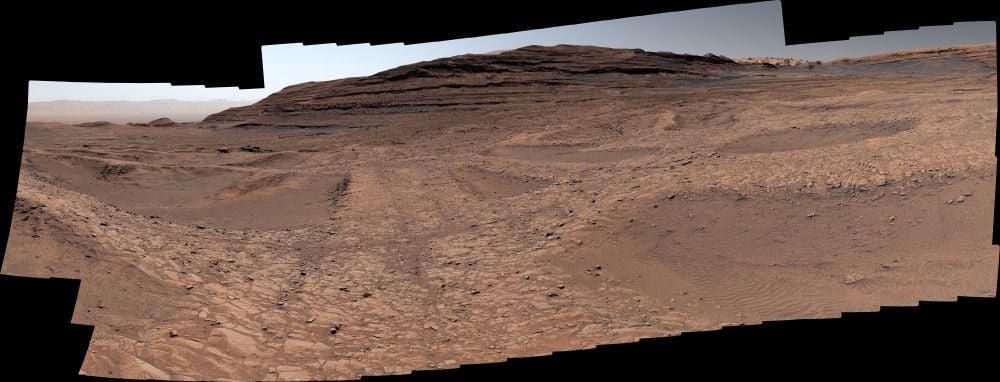
In this age of Mars rovers, questions about the planet's ancient past have shifted. A growing body of evidence supports the idea that Mars was once warm and wet. Now researchers are focused on the timeline of the red planet's watery past. Research efforts all come down to the ultimate question regarding the planet: Did it ever host life?
Powerful orbital cameras like NASA's HiRISE and the ESA's High Resolution Stereo Camera have documented numerous Martian surface features that indicate the ancient presence of water. There are sedimentary river deltas, dry river beds, and other landscape features that would be anomalies on a world that had never seen surface water.
Certain minerals form in the presence of water, too, and rovers have identified them in multiple regions.
In 2006, NASA's Mars Global Surveyor captured images of geologic formations called boxwork ridges. They're low ridges only 1 or 2 meters tall separated by sand-filled depressions. They form when mineral-rich groundwater flows through a network of underground fractures in the bedrock. Minerals precipitate out of the water, and after a long time has passed and some of the bedrock has eroded away, the network of mineral lines is exposed as ridges, and sand deposits build up in between them.
Boxwork ridges are called spiderwebs informally, because that's what they look like from above. (Author's note: The terminology can get a little confusing. Boxwork ridges and spiderwebs are the same thing. But Mars spiders, also known as araneiforms, are different features.)
On Earth, boxwork ridges are much smaller. They're usually only a few centimeters tall, and are only found in caves, or in the planet's very dry, sandy environments. They're also usually made of quartz, since quartz is made of oxygen and silicon, the two most common elements in Earth's crust.
Whatever minerals Mars boxwork ridges area made of, they likely have something to tell us about ancient life on Mars because as far as we know, they only form in the presence of liquid water. They're one of the puzzle pieces that scientists are trying to put in place to eventually reveal the complete picture of microbial life on the planet, how long it might have persisted, and if habitable surface conditions were episodic.
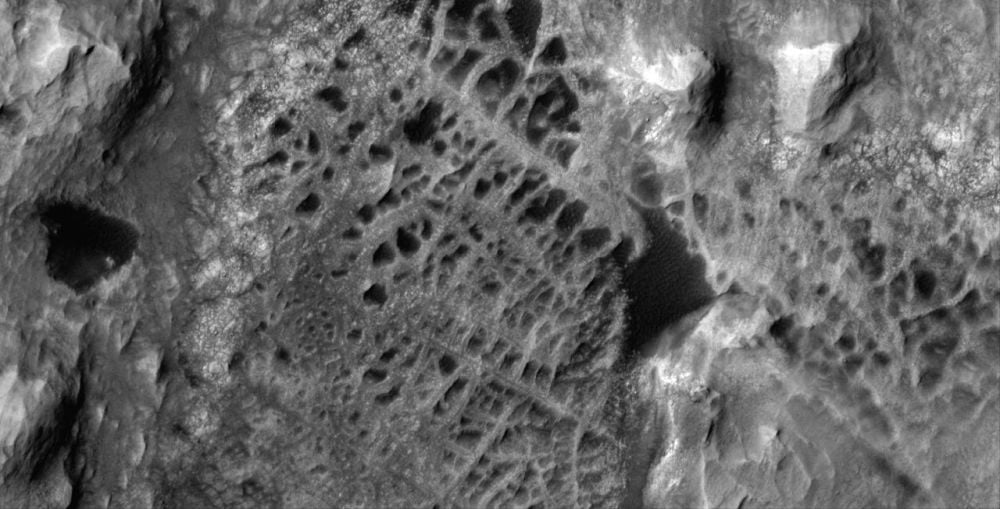 This image from NASA's HiRISE camera shows Martian boxwork features on Mt. Sharp in Gale Crater. One of the reasons that MSL Curiosity landed in the Gale Crater is to study Mt. Sharp's intriguing features, including boxwork ridges. Image Credit: NASA/JPL-Caltech/University of Arizona
Orbital images are helpful in understanding the boxwork features, but to really understand their nature, and how they relate to potential life on Mars, close observations were needed.
MSL Curiosity has spent about six months exploring the boxwork ridges on Mt. Sharp in Gale Crater. One of the problems in exploring them is having the rover traverse the terrain safely. To do so, Curiosity has to drive along the ridge-tops, which aren't much wider than the SUV-sized rover itself.
“It almost feels like a highway we can drive on. But then we have to go down into the hollows, where you need to be mindful of Curiosity’s wheels slipping or having trouble turning in the sand,” said operations systems engineer Ashley Stroupe of NASA’s Jet Propulsion Laboratory in Southern California. “There’s always a solution. It just takes trying different paths.”
On Earth, geologists look for locations where the planet's geological layers are exposed naturally. The same is true on Mars, and Mt. Sharp in Gale Crater is one of these features. It's about 5 km tall, and as Curiosity has ascended it, it's studied layers of the mountain that formed in different geologic eras. Its observations show that Mars became drier over time, and that the long-term drying was interspersed with shorter, wetter periods when the planet hosted surface water.
The mountain itself is a puzzle, just like the rest of Mars. The higher Curiosity went, the more evidence it found that Mars was getting drier. That all makes sense, but since Mt. Sharp is 5 km high, it means that at one time, Mars' water table was also very high.
“Seeing boxwork this far up the mountain suggests the groundwater table had to be pretty high,” said MSL Curiosity scientist Tina Seeger of Rice University in Houston. She's one of the researchers leading the investigation of the boxwork ridges. “And that means the water needed for sustaining life could have lasted much longer than we thought looking from orbit.”
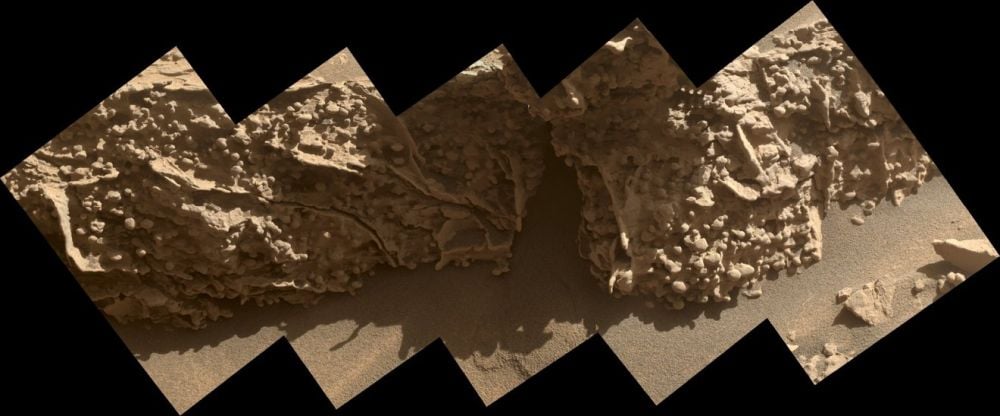 MSL Curiosity captured this close-up image of boxwork ridges on August 21st, 2025. The small rounded nodules are clumps of minerals that precipitated out of groundwater on Mars billions of years ago. Image Credit: NASA/JPL-Caltech/MSSS
Curiosity's close-up images of the boxwork ridges shows nodules of minerals that have been found many times on Mars. Their presence in the boxwork ridges is strong evidence that the ridges did form in the presence of water. But these nodules also pose another question. They aren't along central fractures; instead they're found on ridge walls and the hollows between them.
“We can’t quite explain yet why the nodules appear where they do,” Seeger said. “Maybe the ridges were cemented by minerals first, and later episodes of groundwater left nodules around them.”
Curiosity carries its own portable laboratory, which is why it's called Mars Science Laboratory (MSL) Curiosity. This sets it apart from Perseverance, which is more dedicated to collecting samples for eventual return to Earth. Curiosity collected and analyzed three samples from the boxwork ridges in 2025, and found clay minerals in the ridge and carbonate minerals in the hollow.
In 2026, the rover collected a fourth sample from the boxwork ridges. This sample was subjected to more extensive analysis in Curiosity's onboard lab. This technique is called wet chemistry, and it involves pulverizing a sample, and placing it in the rover's high-temperature oven. This capability is designed to identify carbon-based compounds that are important to life. The oven can reach temperatures of almost 1,000 F, which would destroy organic molecules, but the small yet powerful lab introduces chemical reagents that prevent their destruction. During its time on Mars, Curiosity has used this capability to identify complex carbon-based molecules. Unfortunately, its supply of reagents is limited, so this technique is only used on the most intriguing targets.
As of February 6th, the Curiosity team is still waiting for the results of that analysis. But the previous three samples held long-chain hydrocarbons, the largest ever found on Mars. On Earth, these are important because they're the backbones of lipids, which are themselves building blocks of cell membranes.
The high silica content found in the rocks also suggest that the ancient water that flowed through the cracks was probably neutral or only slightly acidic. This is considered to be in the Goldilocks zone for microbes.
These boxwork ridges and their chemistry are under intense scientific scrutiny right now. A 2026 paper in Astrobiology argued that "...high concentrations of long-chain alkanes are inconsistent with a few known abiotic sources of organic molecules on ancient Mars." They also wrote that "...it is not unreasonable to hypothesize that an ancient martian biosphere would be capable of producing this level of complex organic enrichment in martian mudstone deposits," while also reminding us that, as Sagan said, "extraordinary claims require extraordinary evidence."
Are we approaching the level of "extraordinary evidence" regarding life on Mars? That's hard to say. But no reasonable scientist argues that the evidence being gathered isn't intriguing and that the effort isn't worth making.
Sometime in March, MSL Curiosity will leave this part of Mt. Sharp behind, and continue on its journey up the mountain. The boxwork features are a part of the mountain's larger sulfate layer, which will occupy its time for much of 2026.
The rover will continue to gather evidence, though its ability to perform wet chemistry is limited. It can still perform other types of analyses, and the evidence it uncovers will draw us deeper into the mystery of ancient Mars. As it ascends Mt. Sharp, it will continue to gather evidence of Mars' episodic wet past and its potential habitability.
Maybe along the way it will uncover the extraordinary evidence we all yearn for.

