 Universe Today
The famous opening scene of the Martian has Mark Watney stabbed in the torso with a communications antenna. While this accident sets up the plot for what is widely regarded as a modern classic of sci-fi storytelling, what if he was wearing a space suit that would have stopped the impact altogether? That’s the idea behind a recent NASA Small Business Innovation Research (SBIR) Phase I program run by researchers from Materials Research & Design, Fiber Materials, Inc, and NASA’s Johnson Space Center. Their work, which was recently presented at the National Space & Missile Materials Symposium, showcased a type of advanced 3D-reinforced fabric that could have saved Watney and his compatriots a whole lot of trouble.
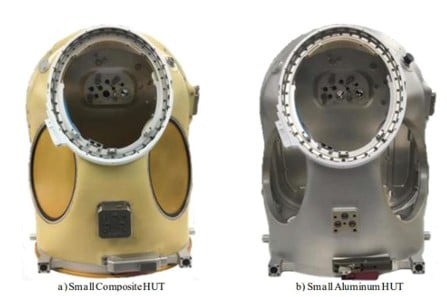
At the center of a modern space suit is the Hard Upper Torso, or HUT. It acts as the chassis for the rest of the suit, connecting the helmet, arms, and even backpack. Critically, it also protects an astronaut's internal organs - from flying communications antennas sure, but also the more prosaic run-ins with rocks or geology tools. If you’ve ever watched videos of the normally extremely athletic Apollo astronauts trying to navigate their way around the Moon, you’ve seen how difficult it can be to walk in low gravity without falling over and potentially hitting some of those prosaic rocks.
The current front-runner for the state-of-the-art HUT is known as the Composite HUT (CHUT), which is made of 2D laminate material such as S-2 glass fibers. Each “2D” layer is then bound with another 2D layer using epoxy resin, which works great in theory, as these materials have an extraordinarily high tolerance for strain. However, they also suffer from a significant weakness - delamination.
Fraser discusses some details of a Dune-style space suit.In a 2D composite laminate, there are no fibers running vertically through the thickness of the material. When a heavy object strikes the surface, the impact can cause the internal layers to peel apart, severely weakening the structure, and potentially leading to catastrophic leaks over time. So, materials scientists have begun working on alternatives that help alleviate some of the downside of laminate materials.
For this particular SBIR, the researchers used two different techniques that would be familiar to anyone interested in textiles - weaving and braiding. In each case, the various strands of material were interwoven, with a different pattern based on what technique was used. The preforms were then infused with SC-15 epoxy using a Resin Transfer Molding process.
After completion, the material samples were subjected to a battery of tests intended to measure their stiffness, tensile strength, and bending limits. Admittedly, the 3D composites didn’t quite match up to the 2D laminates in terms of their initial shear strength. But, they showed a remarkable ability to absorb a massive amount of energy and deform just enough to not catastrophically fail.
Video describing the materials science behind spacesuits. Credit - The Space Race YouTube ChannelBut physical tests weren’t the only ones the samples were subjected to. The researchers came up with a simulation that used real-world drop test data available for the material in the literature. In this simulation, they subjected the material to a 280 Joule force - equivalent to dropping a geology tool from a decent height. Or falling into some particularly sharp rocks.
In these simulations, the 3D woven material emerged as the clear winner, absorbing 73% of the impact energy while only showing a damaged area of around 2.72 square inches. In contrast, the traditional 2D laminate absorbed 67% of the energy with a resultant 3.70 sq in damaged area. The braided material absorbed only 61% of the impact, but still suffered a damaged area of around 3.52 sq inches.
To be clear, these were simulations that, though they were built using real-world data, aren’t the same as actually doing these tests on physical prototypes. That is what the companies plan for in a Phase II proposal (typically SBIR programs have two phases). While it remains to be seen if the work will be funded, if it is, future astronauts on Mars might be spared their fiction counterparts' grueling ordeals.
Learn More:
Higginson et al. - 3D Reinforced Composites for Improved Impact Resistance in Spacesuits
UT - Perseverance is Trying Out Spacesuit Materials on Mars

