Universe Today
This year's Nobel Prize in Physics was awarded to Francis Halzen for "decisive contributions to the IceCube Neutrino Observatory and the discovery of high-energy neutrinos of astrophysical origin." This is the fifth time the Nobel Prize was awarded for work on neutrinos. In 1988 it was awarded for the discovery of the muon neutrino, in 1995 for the detection of neutrinos, in 2002 for detecting cosmic neutrinos, and in 2015 for neutrino oscillations. So why give yet another award for neutrino research?
It's because neutrinos are persnickety.
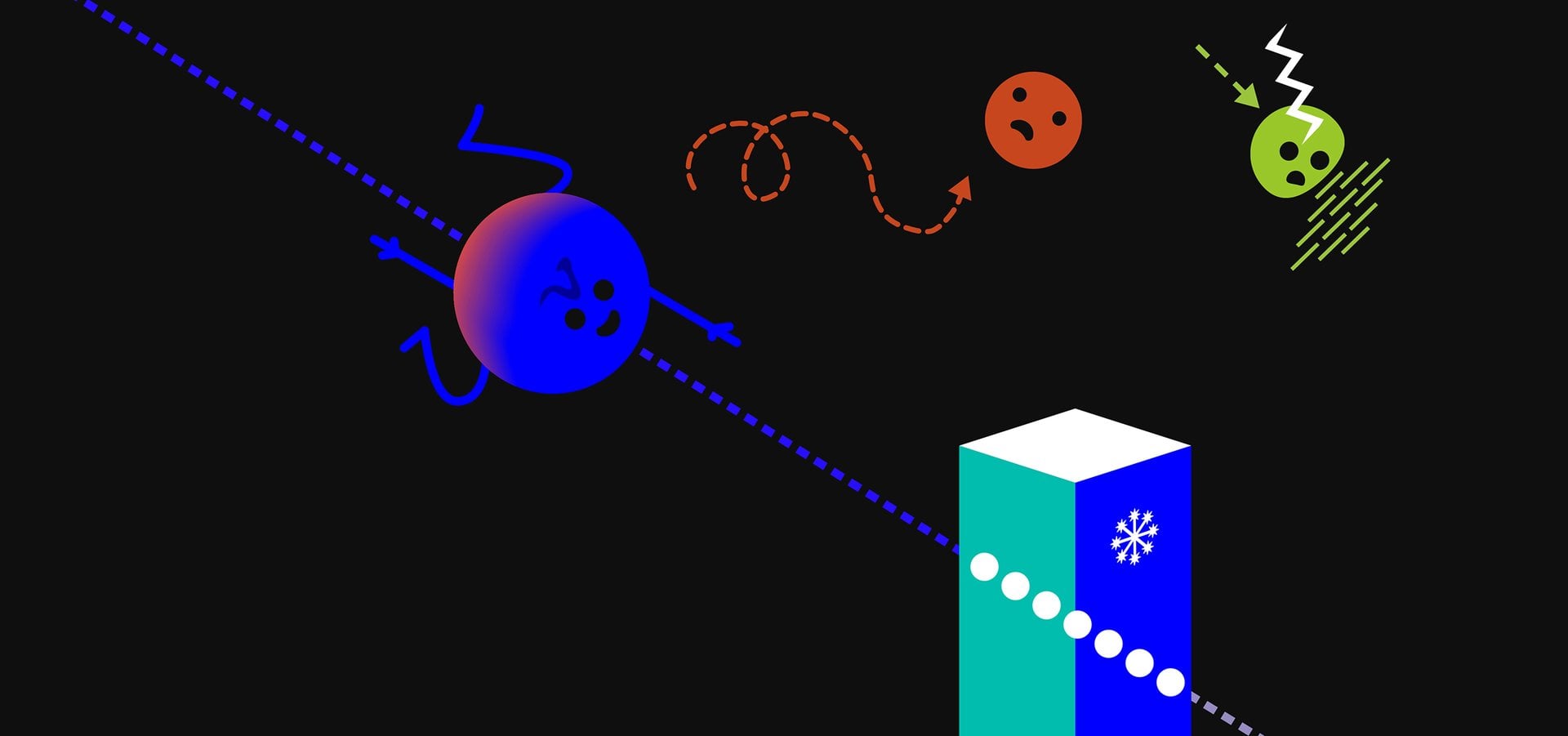
Unlike protons and electrons, neutrinos have no electrical charge. You can make neutrinos by slamming together particles in an accelerator, but they don't show up in your scintillators. Neutrons are also chargeless, but they have about the same mass as a proton and have the good sense to decay into charged particles we can easily detect. Neutrinos have such a small mass they were long thought to be massless. It turns out they do have a tiny mass, but the mass of an individual neutrino is indeterminate. Instead, their mass oscillates between three states! Just as you can never know exactly where an electron is, you can never know the exact mass of a neutrino. The only real way to detect them is when they happen to collide with another particle, and since they mostly interact via the weak force, collisions are rare.
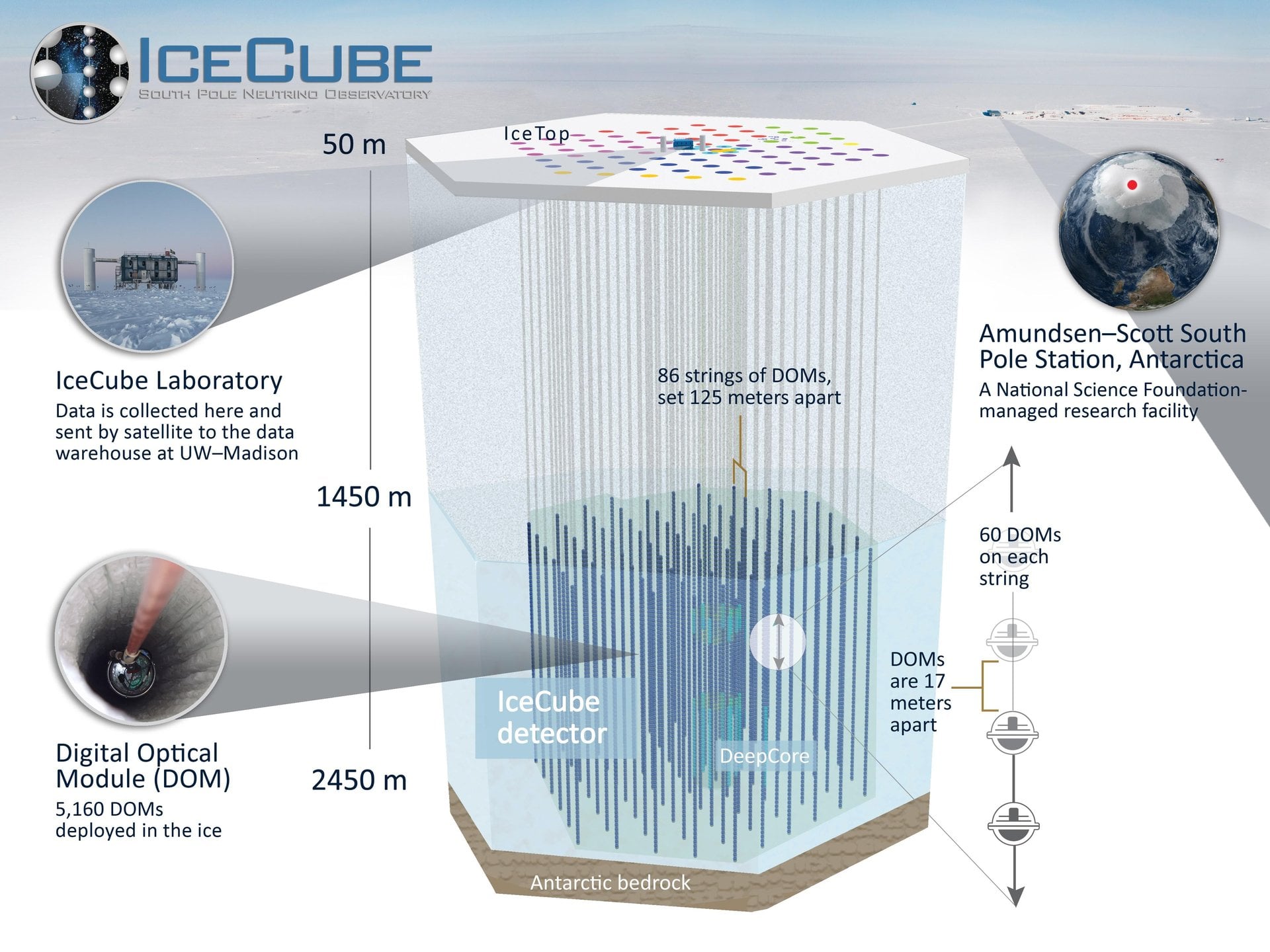 Illustration of the IceCube neutrino observatory. Credit: IceCube Neutrino Observatory
There are two main ways to detect these pesky particles. One is to create a very strong neutrino source, such as a beam of neutrinos from particle accelerator, which is like shining a floodlight on a detector hundreds of miles away. The other way is to surround a dark tank of water with photodetectors. When a neutrino happens to collide with an atomic nucleus, the resulting shower of particles creates a distinct burst of light the photodectors can see.
Even with our best water tank detectors, we can really only see solar neutrinos. The Sun is like a natural neutrino spotlight, and we still need a 50,000-ton water tank to see solar neutrinos well. We know that neutrinos are produced throughout the Universe. There is likely a neutrino cosmic background, similar to the cosmic microwave background. We just can't detect them. The only time we detected neutrinos from beyond our solar system was in 1987 when a supernova in the Large Magellanic Cloud triggered the detection of a handful of neutrinos at multiple observatories around the globe. That's it.
At least until the IceCube Neutrino Observatory came online. Neutrino detectors are big tanks of water because neutrino events are so rare. If you want a more sensitive detector, just build a better tank. Of course "just" is doing a lot of heavy lifting here. It is extremely difficult to build large tanks of ultrapure water. Of course, no one said the water has to be liquid. Ice would also work, and there is plenty of ice at the south pole.
The idea behind IceCube is to utilize ice already in place. Rather than building a tank, you simply place detectors deep within the Antarctic ice sheet. That way your detector is limited only by the size of your optical sensors. By building IceCube at the South Pole the detector can use a block of ice a cubic kilometer in volume. It is effectively a gigaton tank for observing neutrinos, and it is sensitive enough to observe cosmic neutrino events. Thanks to IceCube we can now detect supernova neutrino bursts, neutrino events that correlate with gravitational wave signals, and neutrinos created by cosmic rays. It has given us the ability to do neutrino astronomy.
And since IceCube was Francis Halzen's idea, he gets the Nobel Prize.
Reference: The Nobel Prize in Physics 2026. Royal Swedish Academy of Sciences. (2026, October 6).