 Universe Today
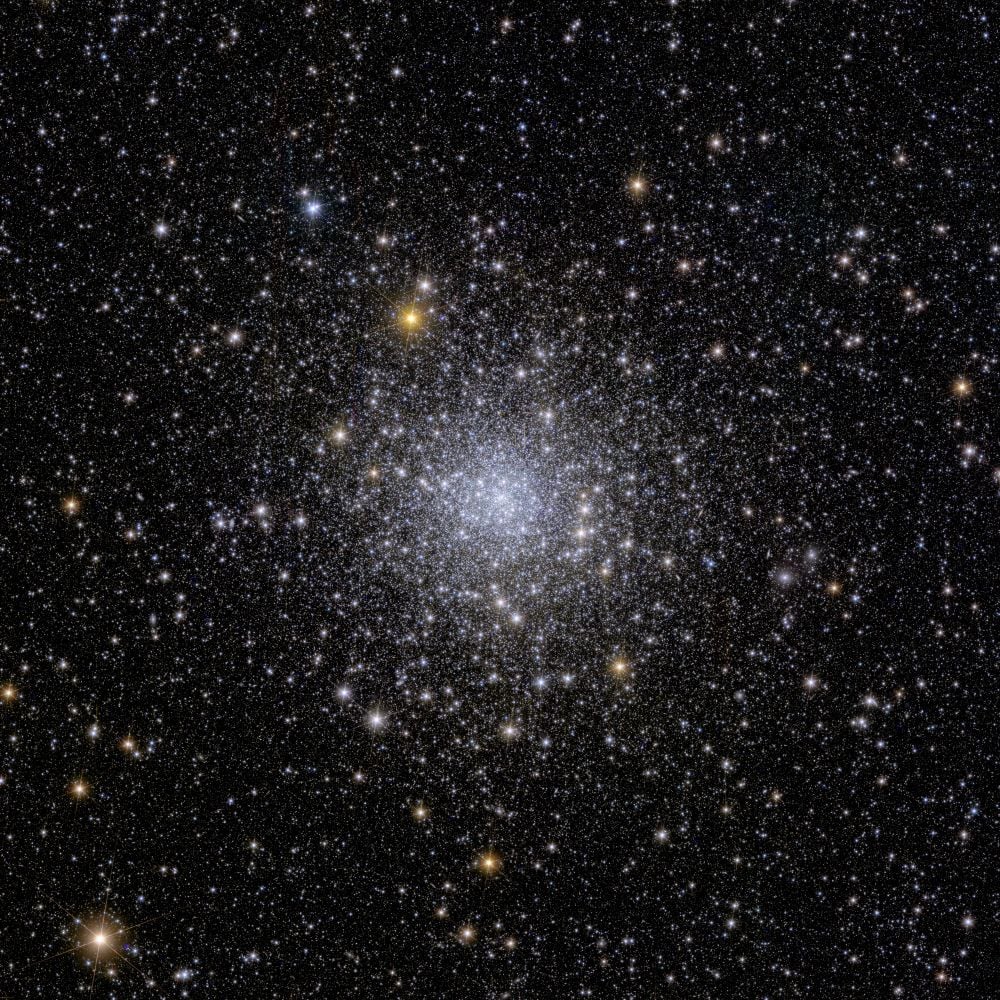
Globular clusters are oddballs. They're the most massive type of star cluster and their stellar population is typically older. Their overall metallicities are lower, yet their stars can have wildly different abundances of some elements. There's also tantalizing but inconclusive evidence showing that they may host the difficult-to-confirm intermediate mass black holes. On top of all that, GC origins are unclear; they could be the remnant cores of dwarf galaxies that were stripped by encounters with larger galaxies. There are a host of unanswered questions.
Astronomers are constantly studying globular clusters (GCs), trying to understand where they came, how they've changed over billions of years, and what role they play in the evolution of galaxies. When a new telescope comes online, it's inevitably used to study GCs. That's true of the Hubble, the JWST, and the ESA's powerful new Euclid Space Telescope, launched in July 2023.
NGC 6397 is one of the two closest GCs to the Milky Way, and contains about 400,000 stars. It's been studied extensively, and in new research, astronomers used the Euclid and observations from other telescopes to analyze the motions of its stars. But, unexpectedly, they observed something else.
Their findings are in a paper titled "Euclid: Early Release Observations – Internal kinematics and the convective-transition gap of NGC 6397. High-precision multiple-pass photometry and astrometry." It's published in the journal Astronomy and Astrophysics, and the lead author is Massimo Griggio from the Space Telescope Science Institute.
When the researchers observed the stellar population in NGC 6397, they discovered a gap: the population of certain M-dwarfs (red dwarfs) was lower than expected.
“The discovery was serendipitous,” said co-authorAndrea Bellini from the Space Telescope Science Institute. “We were not looking for the gap, but we found it.”
The gap is called the Jao gap, after the lead author of a paper that first presented the discovery in 2018. "We present the discovery of a gap near MG ≈ 10 in the main sequence on the Hertzsprung–Russell Diagram (HRD) based on measurements presented in Gaia Data Release 2 (DR2)," that paper said. The Jao gap is a subtle yet observable gap in the population of M-dwarf stars with a magnitude of about 10 in Gaia's G-band. "The gap is very narrow (∼0.05 mag) and is near the luminosity–temperature regime where M dwarf stars transition from partially to fully convective, i.e., near spectral type M3.0V," the authors of the 2018 paper explained. "This gap provides a new feature in the HRD that hints at an underlying astrophysical cause, and we propose that it is linked to the onset of full convection in M dwarfs."
The Jao gap shows up as a narrow feature on the HRD.
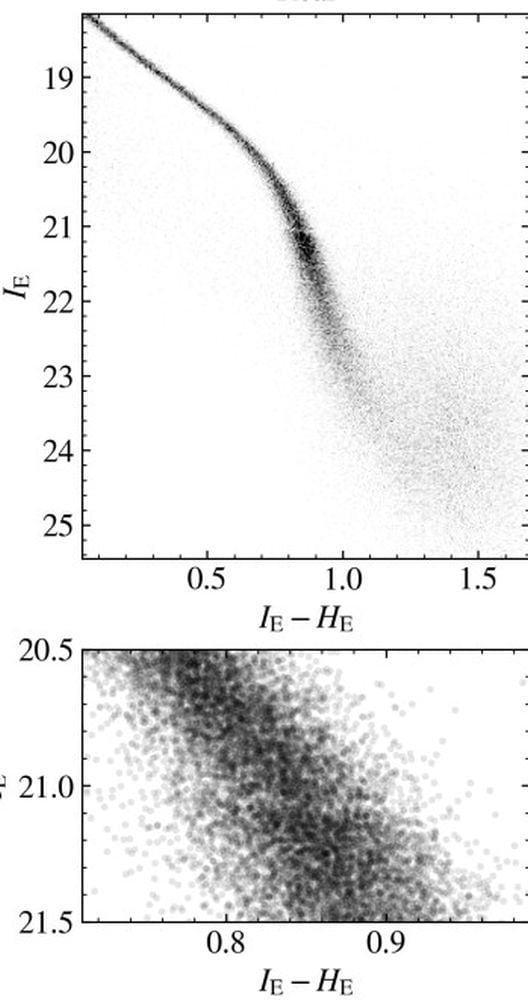 The gap in NGC 6397 is faint but discernible in these panels. The bottom panel is a zoomed-in section of the larger diagram and shows the gap more clearly. Image Credit: Griggio et al. 2026. A&A.
GCs have extremely dense stellar populations in their centers, making it difficult to observe dimmer stars like red dwarfs. The researchers were dealing with that obstacle when they detected the gap.
"We present a ‘multiple-pass’ data-reduction tool designed for Euclid, based on software developed for the Hubble Space Telescope (HST), which improves the astrometric and photometric precision for faint sources and in crowded fields," the authors write. "We report the discovery of a subtle under-density of stars in the colour-magnitude diagram of NGC 6397 around a stellar mass of 0.35 solar masses with a more than 5σ confidence level."
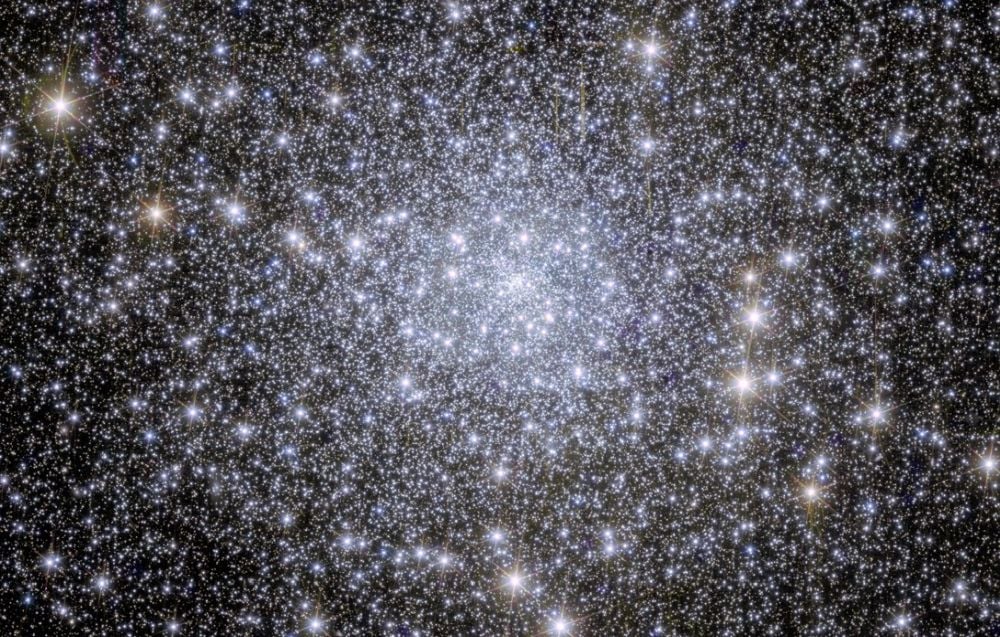 This zoom-in from Euclid's NGC 6397 image shows how tightly-packed with stars the center of the GC is. In dense stellar environments like this, red dwarfs can get lost and be difficult to observe. A new data-reduction tool let the researchers discover the M-dwarf brightness gap. Image Credit: ESA/Euclid/Euclid Consortium/NASA, image processing by J.-C. Cuillandre (CEA Paris-Saclay), G. Anselmi
Internal changes in these stars create the gap. "The gap is associated with the transition of low-mass stars from being fully convective to having a radiative zone, and it provides a unique window into stellar interiors on the lower main sequence," the authors write.
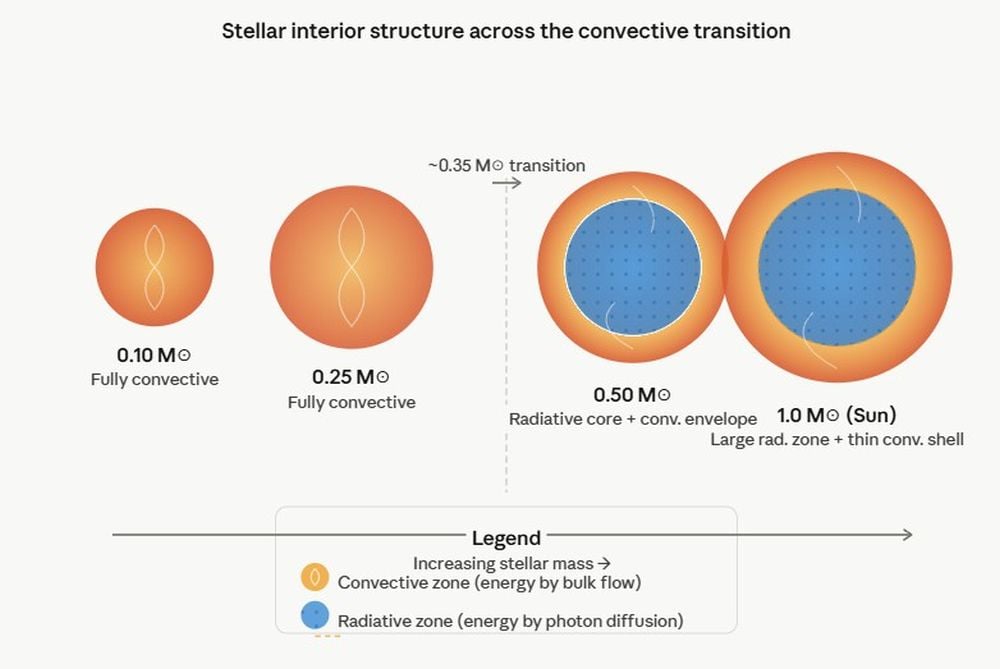 This diagram shows how low-mass stars transition from fully convective to radiative-convective. Since there are few stars exactly at the 0.35 solar mass transition boundary, it creates a small luminosity gap. Image Credit: Evan Gough/Claude
Stars transition through this change at about 0.35 solar masses, which is roughly in the middle of the M-dwarf mass range. The transition creates subtle but detectable changes in the star's size, brightness, and temperature that show up in the HRD. Since there are few stars right at this mass, the brightness gap is small.
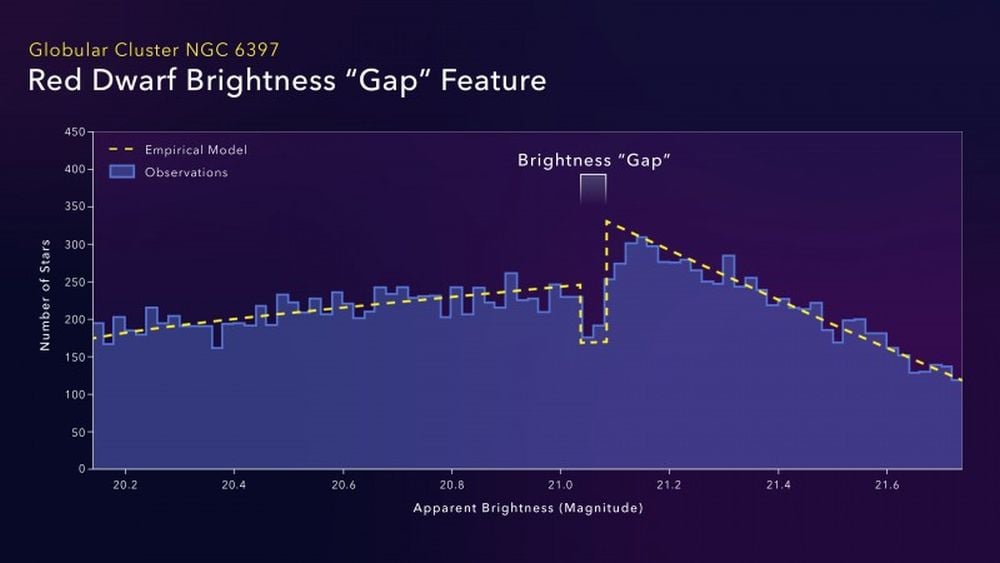 This illustration does a better job of highlighting the red dwarf brightness gap in NGC 6397. Image Credit: Massimo Griggio and Leah Hustak (STScI)
The ESA's Euclid space telescope played a leading role in detecting this gap in a GC for the first time. The telescope's wide field of view generated a large photometric sample of stars in NGC 6397, and larger samples are always better. "This study is the first detection of the gap in a star cluster, uniquely enabled by the photometric precision achieved by our data reduction and the wide field of view of the Euclid telescope," the authors write.
One of globular clusters' defining features is their densely-packed centers. Their compactness makes them great observational targets to study stars, how they evolve, and their populations. “Globular clusters are the ideal laboratories to study stellar evolution and stellar populations,” said lead author Griggio. “In this globular cluster, the stars are basically at the same distance and have approximately the same age."
The observations of this gap do more than highlight the transition that M-dwarfs go through. They're a window into a deeper understanding of other aspects of stars in globular clusters, including their metallicity and evolution.
"We demonstrate that the properties of the gap provide tight constraints on the distance to NGC 6397 and its intrinsic metallicity dispersion, offering a new benchmark for stellar evolution models," the researchers explain.

