Universe Today
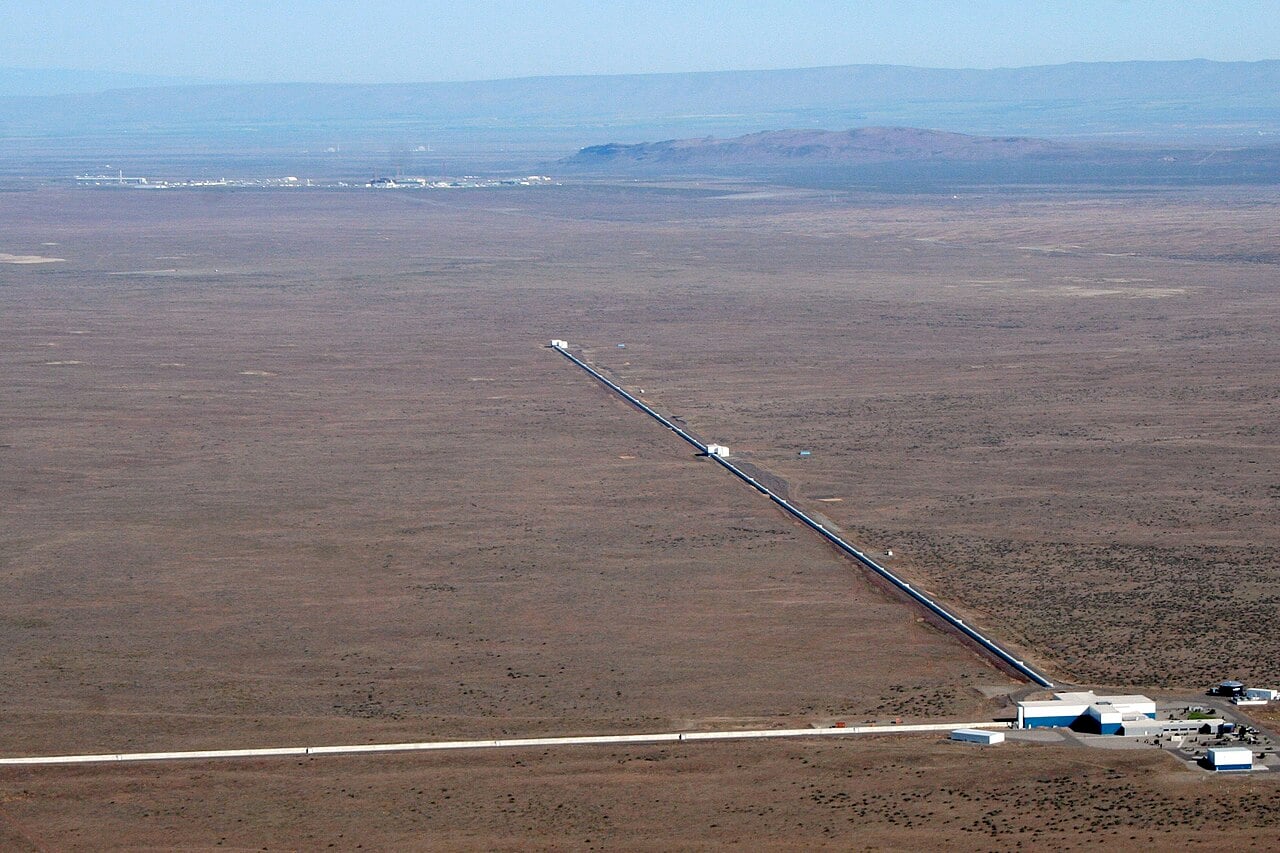
There's a nice kind of irony buried in this story, one of the most sensitive instruments ever built, capable of measuring distortions smaller than the width of a proton, has been quietly held back by something as mundane as heat. And the fix, it turns out, is not some exotic new sensor, but a thermal camera you could genuinely buy off the shelf.
LIGO detects gravitational waves, ripples in spacetime thrown off by colliding black holes and neutron stars, by watching for impossibly tiny changes in distance along its four kilometre arms. To do that, it circulates laser light at power levels approaching a megawatt. The trouble is, even LIGO's mirrors, among the purest optical components ever manufactured, absorb a sliver of that light. That absorbed energy heats the mirror, warping its shape by just a few nanometres, and that tiny warp is enough to distort the beam and quietly erode the detector's sensitivity.
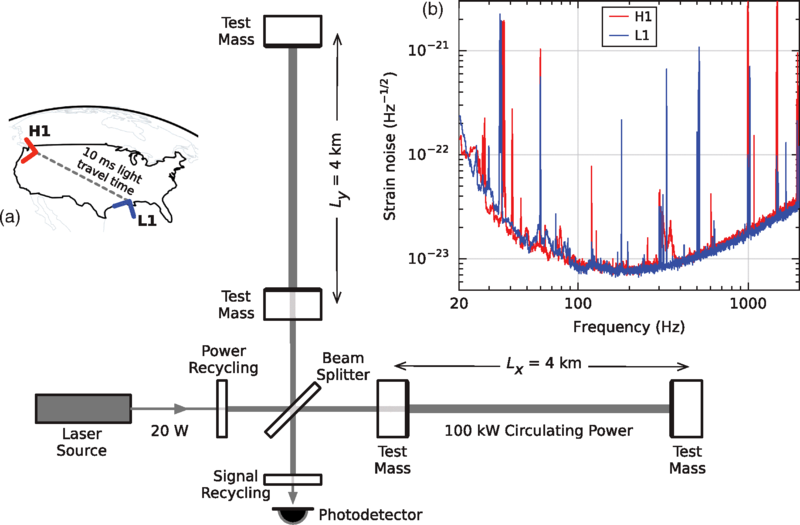 A simplified diagram of an Advanced LIGO detector, showing the four highly reflective test mass mirrors that form the interferometer's two arm cavities (Credit : Caltech/MIT/LIGO Lab)
Scientists already knew how to correct for this, by applying carefully controlled counter heating to the mirror. What they didn't have was a reliable way to know exactly how each mirror was distorted in the first place, so the correction could be properly targeted. That's the gap Jonathan Richardson's team at UC Riverside has now filled, and the method they landed on is really quite simple. Photograph the mirror's surface temperature with an infrared camera, then combine that with existing measurements and computer models of how heat moves through the glass, to reconstruct the distortion across the mirror's entire face. Richardson describes it rather nicely as being much like a mechanic reading a car engine's temperature pattern from the outside to work out what's happening inside.
The result wasn't even what the team originally set out to find, instead they stumbled on it while testing a new adaptive optics system designed to reshape LIGO's mirrors directly. Only afterward did they realise that surface temperature readings, combined with a good thermal model, could reveal the internal distortion on their own.
 An artist's illustration of the aftermath of GW170817, the neutron star merger detected by LIGO in 2017, the type of event the new technique aims to help LIGO catch more of (Credit : NASA/CXC/M. Weiss)
The beauty of their approach is that it needs no new technology at all, just a commercially available thermal camera, mounted outside the interferometer, something Richardson points out is almost unheard of for a LIGO instrumentation upgrade. Run through the numbers, the team estimates it could boost the strain sensitivity of the upcoming LIGO A+ upgrade by as much as 31%, letting it spot binary neutron star mergers roughly 33 million light years farther away on average. That might sound modest, but because the volume of space you can survey scales with the cube of the distance, a fairly small sensitivity gain translates into a much larger jump in the number of events LIGO can actually catch.
The technique is already being folded into the baseline design of Cosmic Explorer, the proposed next generation gravitational wave observatory, with Richardson himself leading its sensing and control system design. It's a satisfying example of how the next big leap in astronomy doesn't always come from a bigger telescope or a bolder mission, sometimes it comes from someone finally working out how to properly read the instrument.
Source : New technique enables LIGO to peer farther into the distant universe