 Universe Today
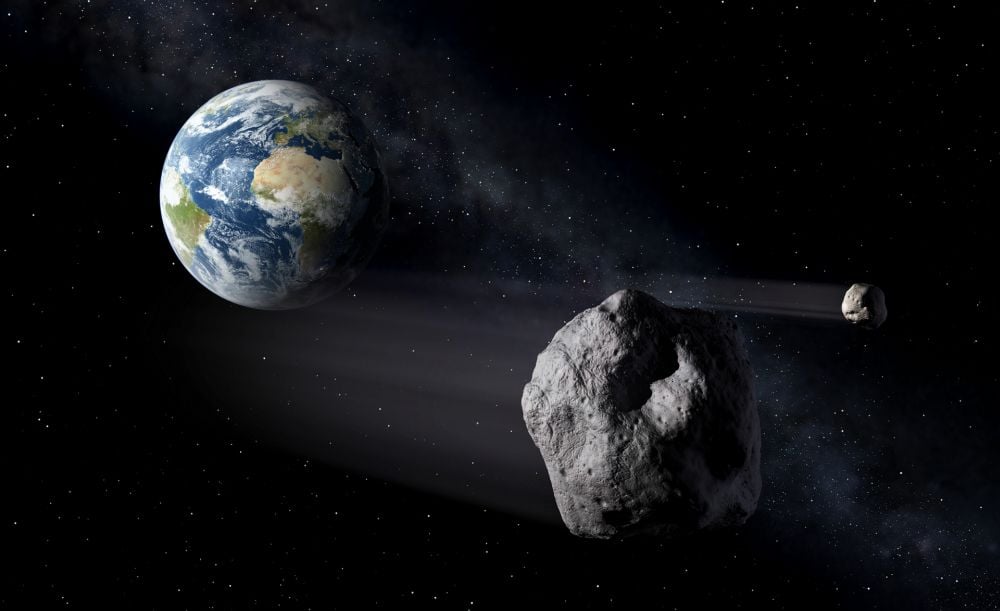
The Vera Rubin Observatory (VRO) has barely begun observations and is already wowing us. Images like its Cosmic Treasure Chest have us anticipating even more cosmic glory. And when the observatory sent out 800,000 alerts in one night in February, we got a taste of the scientific boost it will give astronomers. But while it's being lauded for its upcoming contributions to dark energy, supernovae, active galactic nuclei, and other distant and foundational subjects, it will also make important discoveries much closer to home. Its Legacy Survey of Space and Time (LSST) will find asteroids by the millions, and potentially dangerous Near-Earth Objects (NEO) by the tens of thousands.
This is obviously important, considering the damage an impact can cause. But the VRO is poised to do more than just detect them.
New research to be published in The Astrophysical Journal shows how the Rubin will advance our understanding of NEOs beyond just detection. It's titled "Predictions of Imminent Earth Impactors Discovered by LSST," and the lead author is Ian Chow. Chow is from the DiRAC Institute and the Department of Astronomy at the University of Washington in Seattle.
"Imminent impactors are natural bodies discovered in space before impacting the Earth," the researchers write. "They provide a rare opportunity to characterize individual near-Earth objects (NEOs) in great detail as asteroids in space, meteors in Earth's atmosphere and meteorites on the ground." They say the LSST is "expected to transform our understanding of the NEO population."
To dig deeper into this transformation, the researchers simulated 343 objects from NASA's Center for NEO Studies database. They're one-meter size objects that were fireballs impacting Earth's atmosphere. The VRO's capabilities are well-understood, and astronomers use a survey simulator called Sorcha to understand how the observatory will perform in different endeavours. In this work, the researchers simulated the pre-impact behaviour of the 343 objects with Sorcha to see how effective the observatory will be at detecting imminent impactors.
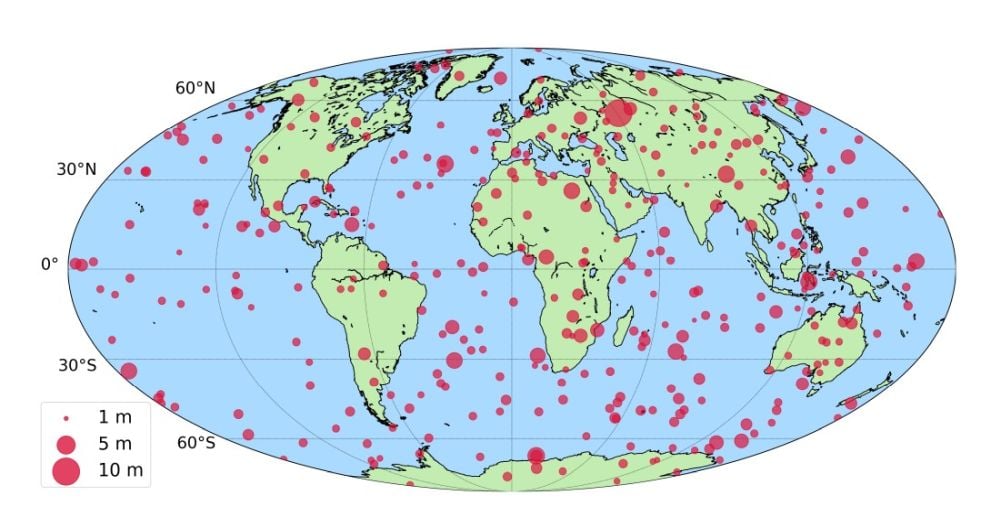 This map shows the impact locations for all 343 objects in the research. They're from NASA’s Center for Near-Earth Object Studies (CNEOS) Fireball and Bolide Database. They span from February 1 1994 February January 1 2026. The impactors are spread uniformly over Earth's surface. Image Credit: Chow et al. 2026. ApJ
As a result of these simulations, Chow and his co-researchers expect the VRO to find about 1 or 2 meter-sized and larger NEOs each year that are at imminent risk of impacting Earth. That would double the current rate of detections for those objects. "The median time of discovery and median time of first observation for impactors discovered in our simulations are about 1.57 and 3.06 days before impact, respectively," they write.
1.57 days isn't much warning, but it's still an improvement. In fact, that's more warning time than for any previously discovered imminent impactor. The longest warning time for an imminent impactor so far is only 21 hours back in 2016. And 1.57 is only the median time of discovery. In their simulations, some impactors were discovered weeks before impact.
Other telescopes have detected 11 imminent impactors up until now, but those discoveries are biased towards the northern hemisphere. That's where most of the facilities capable of detecting them are located. The most recent one was in 2024. It's designated 2024 XA1 and was detected in December 2024, 10 hours before impact, by the Kitt Peak Observatory in Arizona. It struck Earth somewhere in the remote Sakha Republic in Russia.
The VRO will help correct this northern bias, according to the authors. "We find a similar trend towards Southern Hemisphere impacts in our simulated LSST detections of the CNEOS impactors, suggesting Rubin will provide a powerful counterpart to existing asteroid surveys primarily located in the Northern Hemisphere," they write.
More advance warning means more time to observe the impactor's behaviour. Follow-up pre-impact observations can reveal more about an object's albedo, surface roughness, taxonomy, rotation period, and other characteristics with greater fidelity than currently possible. The researchers say the advanced warning will also allow other observational modes like radar to be employed.
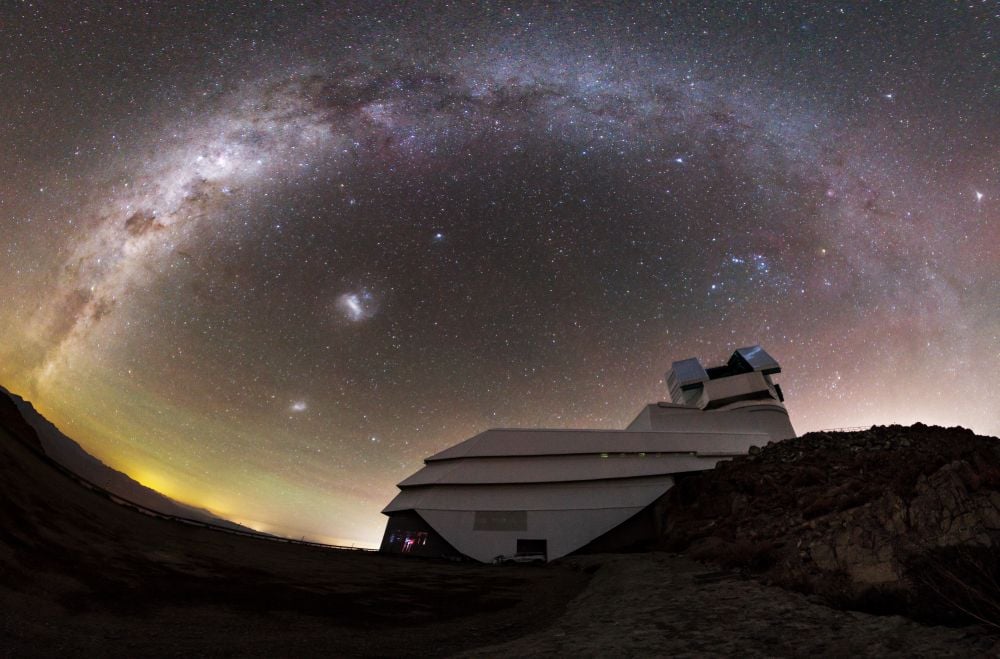 This image from February 2026 shows the Vera Rubin Observatory at Cerro Pachon in Chile, with the Milky Way arching overhead. Designed to detect small changes in the night sky, the VRO and its decade-long Legacy Survey of Space and Time will help us discover more imminent impactors, alerting other telescopes and determining where they strike Earth. Image Credit: NSF–DOE Rubin Observatory/NOIRLab/SLAC/AURA/P. Lago
But the main benefit of VRO's advance warning of imminent impactors is to allow a more accurate prediction of their impact sites. "Longer observational arcs will also improve impactor trajectory precision, making the calculation of meteorite fall locations more accurate and thus facilitating meteorite recovery," the researchers explain.
Previous research into one impactor in 2023 showed how well an impactor alert system can work. A rapid mobilization of impactor observing resources soon after a detection results in very accurate predictions of impact locations. The 2023 research showed that "respective trajectories determined from astrometric and fireball observations for imminent impactor 2023 CX1 to be within 18 m of one another," the authors write. That's incredibly accurate.
Most impacts occur over Earth's oceans, making recovery impossible. But advance warnings are still desirable. "... the additional warning time provided by LSST could make feasible airborne dust sampling of the resulting fireball in lieu of meteorites on the ground, helping provide a compositional “ground-truth” for a larger sample of imminent impactors," Chow and his co-researchers explain.
The estimate of 1 or 2 meter-sized imminent impactors per year is a lower limit for the Rubin and its LSST. In their conclusion, the authors explain that the LSST will, for the first time, allow telescopes to observe meter-size impactors for the first time. That's a huge scientific advance that will help us understand the NEO population in far greater detail, especially when recovery is possible.
But what may be even more important is advance notice of much rarer yet far more dangerous larger impactors. This will impact our planetary defense efforts.
"Importantly, the near doubling of time-before-impact for most objects, and extension to weeks for some (typically larger) objects, would allow coordinated world-wide observing campaigns for orbit determination, meteor observations, and meteorite recovery of many more imminent impactors to be mounted over the next decade, as well as help inform planetary defense initiatives for larger and more hazardous (but rarer) impactors," they conclude

