 Universe Today
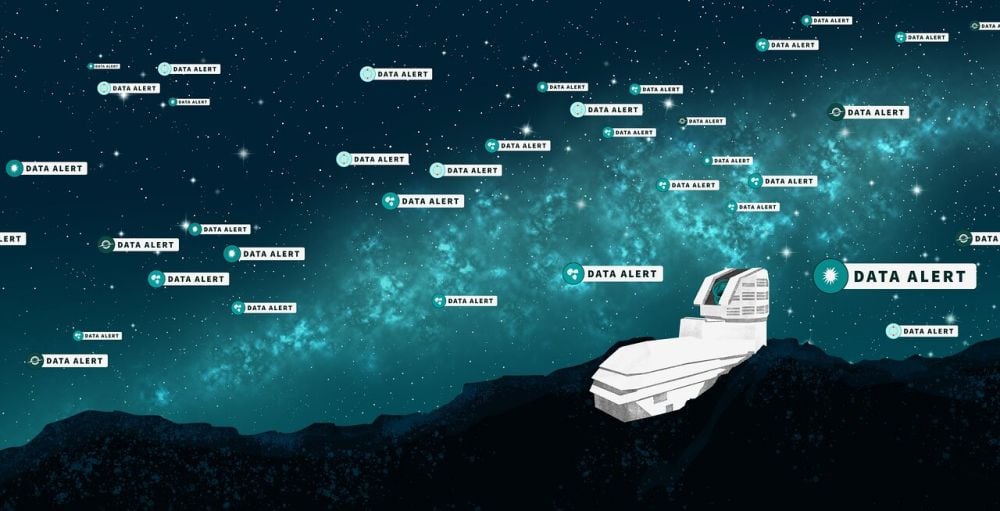
It's been about 8 months since the Vera Rubin Observatory (VRO) saw first light. Now the observatory's Simonyi Survey Telescope is scanning the night sky to detect transient changes and sending alerts to astronomers and observatories around the world so they can perform follow-up observations. This alert system is one of the last milestones before the VRO starts its primary endeavour: the decade-long Legacy Survey of Space and Time (LSST).
On the night of February 24th, the VRO sent 800,000 astronomical alerts that direct astronomers' attention to new asteroids, supernovae, and other transient phenomenon. But the VRO is just getting started. The 800,000 alerts will be dwarfed by the seven million nightly alerts the telescope is expected to deliver once it's up to full speed.
The VRO has the largest digital camera ever made, a 3.2 gigapixel camera that takes 30-second exposures. For ten years it will image the southern hemisphere sky each night and capture visible changes. It's building a decade-long timelapse of the night sky, and astronomers are eagerly awaiting the discoveries contained in all these images. In fact, in its first year of observations, it will image more objects than all other optical observatories in the history of humanity combined.
The telescope is poised to unleash a massive deluge of near real-time data.
“By connecting scientists to a vast and continuous stream of information, NSF–DOE Rubin Observatory will make it possible to follow the Universe’s events as they unfold, from the explosive to the most faint and fleeting,” says Luca Rizzi, a program director for research infrastructure at NSF.
Managing this massive amount of data is a critical part of the VRO. The dense data stream flows through purpose-built fiber optic cables from the observatory to Santiago, Chile's capital city. From there it travels to Miami, Florida, then flows through existing high-speed infrastructure to the Rubin Observatory United States Data Facility (USDF) at SLAC National Accelerator Laboratory in California. Finally, the data flows through a dedicated, encrypted network to a United States Intelligence Community facility in California.
The data is turned into useful science products at the USDF. There, an automated system filters the images and generates alerts. Images of the events are available to scientists after only 60 seconds, while more complete images are released 80 hours later. The 80-hour delay allows orbiting satellites to be removed from the images.
Seven million nightly alerts is an overwhelming number. But no single astronomer faces such an unmanageable deluge. Instead, the millions of alerts will flow through a network of intelligent filters called brokers. These filters let individual researchers subscribe to different types of alerts for different objects depending on their research area: AGN, supernovae, variable stars, etc.
The VRO's alerts are open to the public, too. Any interested party can subscribe to them and observe detected objects with personal telescopes. Citizen scientists can take part in the cornucopia of alerts through the VRO's collaboration with Zooniverse.
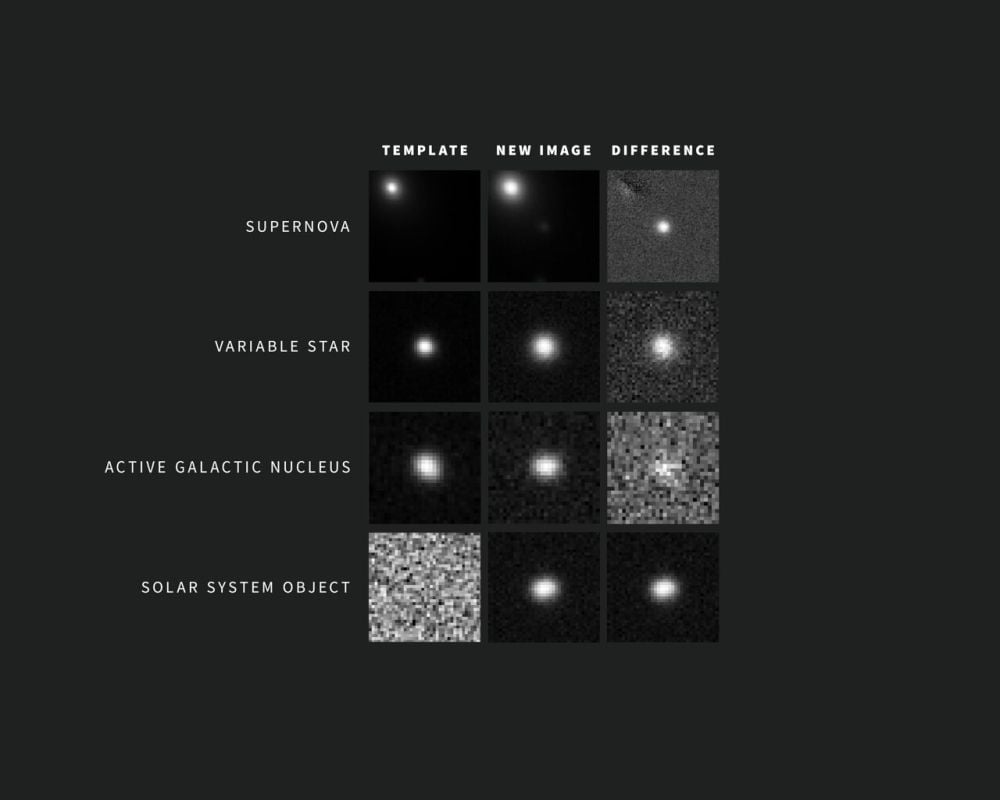 The VRO detects transients by comparing new images with previous images and detecting any changes. When changes are detected, and alert is sent. Image Credit: NSF–DOE Vera C. Rubin Observatory/NOIRLab/SLAC/AURA
We're accustomed to powerful new telescopes coming online, and bringing new observational capabilities. But there's something different about the VRO. Instead of observing one target at a time, it will generate new discoveries in massive numbers, and some of them will be groundbreaking, even revolutionary.
“The discoveries reported in these alerts reflect the power of NSF–DOE Rubin Observatory as a tool for astrophysics and the importance of sustained federal support,” says Kathy Turner, program manager in the High Energy Physics program in the DOE’s Office of Science. “Rubin Observatory’s groundbreaking capabilities are revealing untold astrophysical treasures and expanding scientists’ access to the ever-changing cosmos.”
To us, the night sky can seem mostly static. We can watch the Moon gradually change night by night, and we can catch the quickly-disappearing streaks of meteors. If we're dedicated, we can follow the planets as they plod across the heavens. We can also watch as our satellites tack across the sky. But the reality is much different, and the powerful VRO will show us how different.
The cosmos is practically alive with objects that change over time. From asteroids in our inner Solar System, to distant active galactic nuclei in other galaxies, the VRO will detect almost anything that moves or changes brightness. From the beginnings of a supernova explosion to visiting interstellar objects, the Rubin will catch them all. The VRO's discoveries will lead scientists to a deeper understanding of everything from simple space rocks to complex and mysterious phenomena like dark energy and dark matter.
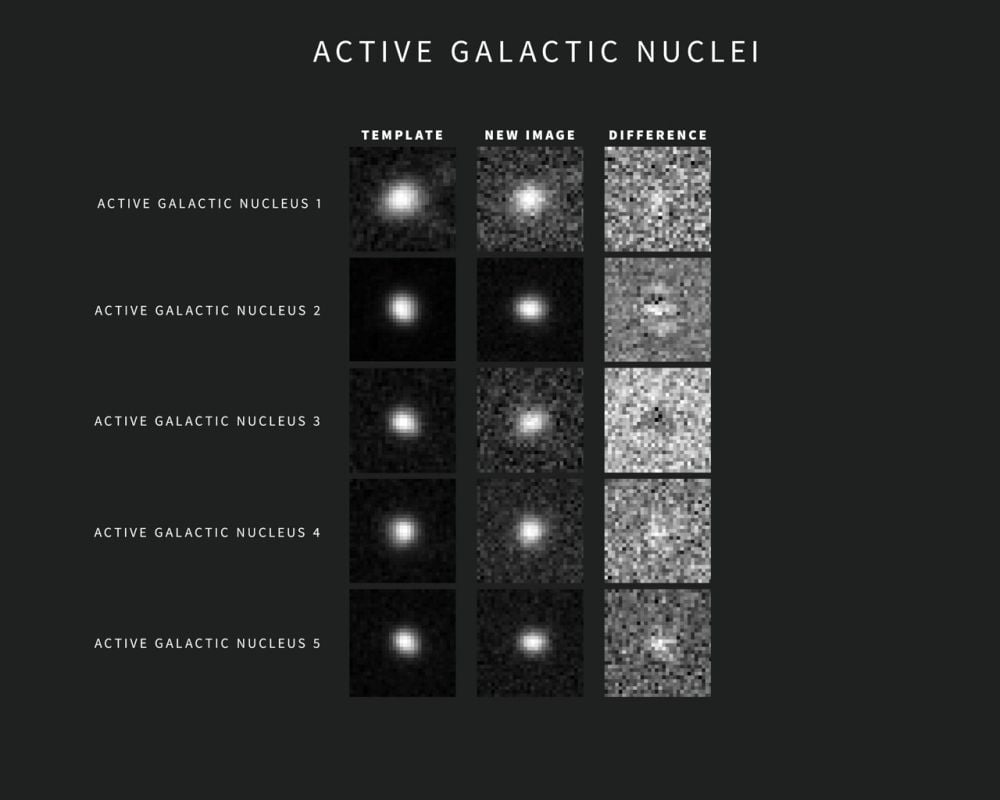 This image shows five examples of VRO alerts for AGN. The images were captured during commissioning with the LSST Camera. Each alert includes three “postage stamp” images — the left shows the template image, the center shows the new image, and the right shows the subtracted, or difference, image. Image Credit: NSF–DOE Vera C. Rubin Observatory/NOIRLab/SLAC/AURA
“Rubin's alert system was designed to allow anyone to identify interesting astronomical events with enough notice to rapidly obtain time-critical follow-up observations,” said Eric Bellm, Alert Production Pipeline Group Lead for Rubin Data Management from NSF NOIRLab and the University of Washington. “Enabling real-time discovery on 10 terabytes of images nightly has required years of technical innovation in image processing algorithms, databases, and data orchestration. We can’t wait to see the exciting science that comes from these data.”
There's more to the VRO than scientific discovery, though. By detecting large numbers of new Near-Earth Objects (NEO), the VRO will identify space rocks that pose an impact risk to Earth.
The heart of the VRO is collaboration with other telescopes. It's alert system means that the most powerful telescopes at our disposal, including upcoming ones like the Giant Magellan Telescope and the Extremely Large Telescope, will be able to quickly target important targets. These telescopes are scientific behemoths and will image distant objects with a level of detail never before attained. Expect a steady stream of observations from these telescopes stemming from the deluge of VRO alerts.
It's nearly impossible to overstate the VRO's contribution to science. Researchers have worked hard to simulate what the telescope will find. According to research and simulations, the VRO will find many more gravitational lenses, including 44 lensed Type Ia supernovae detections per year. It's expected to detect about 130 new Near-Earth Objects every night, and a total of 36,500 new NEO discoveries over ten years. It will also find more Kuiper Belt Objects, 20 billion galaxies, 20,000 galaxy clusters, and thousands of core-collapse supernovae.
The wide-angle nature of the VRO also creates massive static images filled with objects. Even without discovering any new objects or generating any alerts, the VRO's images have scientific value.
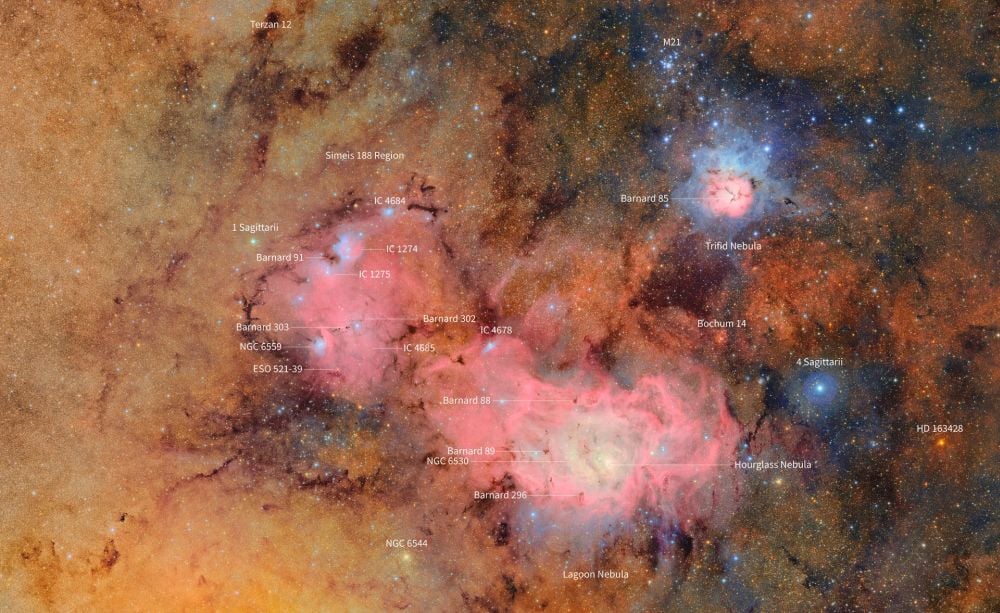 This VRO First Look image shows the Trifid and Lagoon Nebulae. It's a dramatic look at how young, massive stars can affect their surroundings with their powerful radiation. Images like this one also help astronomers study how gas clouds collapse to form stars and how those stars form star clusters. Image Credit: NSF–DOE Vera C. Rubin Observatory
The VRO is unlike any prior telescope. From its perch in the Chilean Andes, it will monitor the heavens with a thoroughness no other telescope can match. By working with other conventional yet powerful telescopes, it promises to open the heavens up to our curious minds and supercharge our sense of wonder. If you've ever gazed up at the night sky and pondered the big questions, your pondering is about to get a big boost.
Get ready.

