Universe Today

It's no secret that prolonged periods spent in microgravity takes a toll on the human body. This includes muscle atrophy, bone density loss, and changes to the cardiovascular, endocrine, and nervous systems. But for female astronauts, there is also the greater risk of developing blood clots, according to recent findings. This highlights the fact that, to date, most studies of human health in space have involved male astronauts. But as the number of female astronauts continues to grow, more research is required to address potentially gender-related health risks.
This was the motivation behind a new study that examined how microgravity affects blood clotting, specifically in women. The study was conducted by Simon Fraser University (SFU) and the European Space Agency (ESA), with support provided through a grant from the Canadian Space Agency (CSA). It consisted of 18 women participating in a 5-day dry immersion test to assess the risk of developing potentially life-threatening blood clots. The results support existing evidence that women are at a greater risk of venous thromboembolism and identified hypercoagulability as a potential key mechanism.
The research was conducted by a team from SFU’s Aerospace Physiology Laboratory, which routinely collaborates with the CSA and international space agencies to study the effects of space exploration on astronauts. Other researchers came from the Department of Biomedical Physiology and Kinesiology at SFU, the Medical University of Graz, Antwerp University Hospital, University Medical Center Maribor, the European Astronaut Center Department (EACD), and the Mohammed Bin Rashid University of Medicine and Health Sciences. The study describing their research appeared in the journal Acta Astronautica.
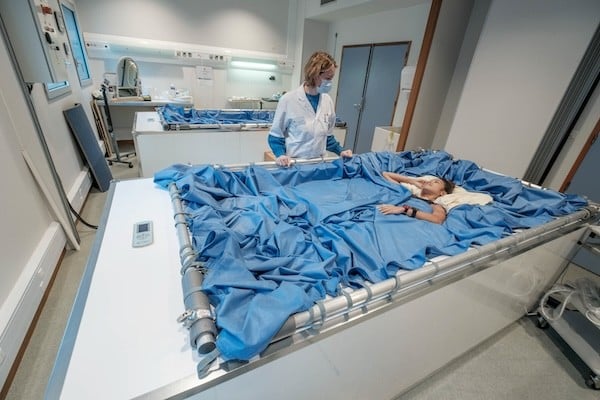 Researchers from the ESA's SciSpacE team tend to participants engaged in dry immersion studies. Credit: ESA.
On Earth, blood clots are often associated with aging, but they can affect younger people as well. Due to Earth's gravity, clots generally form in the leg veins, where they block blood flow and lead to pain and swelling. In some cases, they can travel to the lungs, causing a life-threatening pulmonary embolism, heart attack, or stroke. The fact that they form in the legs allows the person more time to seek treatment and have it removed, or for the body to break it down on its own. But in microgravity, blood pools in the head and sometimes in the feet, creating the conditions where clots are more likely to form. As Blaber explained in an SFU press release:
We’ve found that in space, blood clots are more likely to form in the jugular vein. From there, it doesn’t have to travel far to reach [the] lungs or heart, and trigger a serious medical event. Space is not a place where you want these things to happen. Now that they know it can happen, they’re looking at it more frequently as part of the standard measures.
The first hints that female astronauts could be at greater risk of clotting came in 2020 when a female astronaut aboard the International Space Station (ISS) developed an unexpected clot in her jugular vein. For their study, the team examined real-time clotting responses in 18 healthy women over five days in a dry immersion tank. This consisted of a water bath with a waterproof seal that kept the volunteers dry while they floated, simulating weightlessness. The team then analyzed the participants using rotational thromboelastometry (ROTEM), to measure the rate at which blood clots formed and progressed.
This rapid blood-testing method assesses coagulation function and the causes of bleeding in real time. They also analyzed the volunteers' blood for menstrual hormones, which were found to have no effects on blood coagulation. The key findings of their study indicate that the time it takes for blood clots to form (coagulation time) in microgravity is longer, but that once the process starts, clots form faster. And once formed, the clots showed greater strength and stability than what is typically observed with patients on Earth. Said Blaber:
We know that on Earth, clotting in men and women can vary with age, but we have little information on whether these will be different when in space. In this microgravity environment, we found the female participants took longer for their blood to start clotting. But once that clotting began, it formed faster and was more stable, making it harder to break down.
 Illustration of NASA astronauts on the lunar South Pole. Credit: NASA
While the study findings were not concerning after just five days, they do raise concerns for astronauts crews that will be far from medical or emergency care. They also indicate that further research is needed to assess potential risks to crews on long-duration missions. This includes crews operating on the Moon as part of NASA's Artemis Program and on future missions to Mars, where astronauts will spend months in transit. Baber and his team are now analyzing and comparing their results to dry immersion studies involving male volunteers.
These studies will help inform future medical monitoring and treatment procedures needed for longer missions to space. In the meantime, space agencies are already ensuring that astronauts aboard the ISS are regularly getting jugular vein ultrasounds - the same treatment that accidentally identified the female astronaut's clot in 2020.
Further Reading: SFU, Acta Astronautica