Universe Today
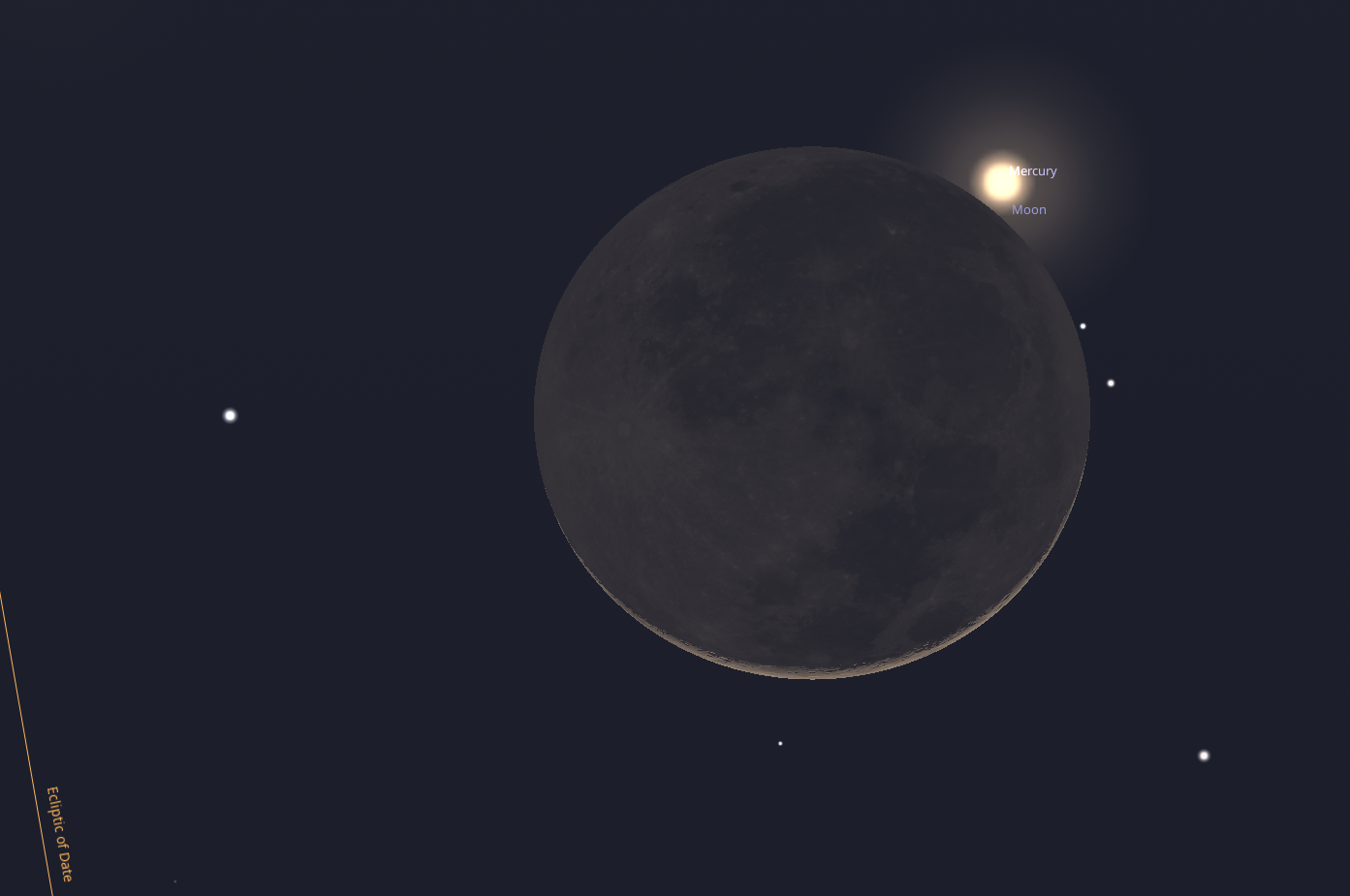
The Moon paves the way among the planets in the last half of February.
The Moon has a busy next two weeks ahead of it. Fresh off of Tuesday’s annular solar eclipse, the Moon begins an evening tour of the planets in the last half of February 2026. The waxing Moon actually slides by every planet except Mars over the next week. As a highlight, the waxing crescent Moon actually occults the planet Mercury in a rare celestial event on the night of Wednesday, February 18th.
Tuesday’s New Moon and annular eclipse across the Antarctic kicked off the start of eclipse season, and sets up the celestial drama to come. Few souls witnessed the annular eclipse itself as it swept across the southernmost continent.
You might just manage to spot the slender waxing crescent Moon low to the west Tuesday night on February 17th, near -4th magnitude Venus. Both are currently 10 degrees from the Sun, making them a tough binocular challenge. Venus gets steadily better in the coming months and dominates the evening sky through mid-2026.
The real action begins on Wednesday night February 18th, when the Moon pairs with the innermost planet Mercury. This is a rare event, well-placed for viewers in the southeastern U.S., Mexico and Central America, the Gulf of Mexico and the Caribbean. Although the Moon occults Mercury several times a year, these usually occur close to the Sun or over a remote location worldwide.
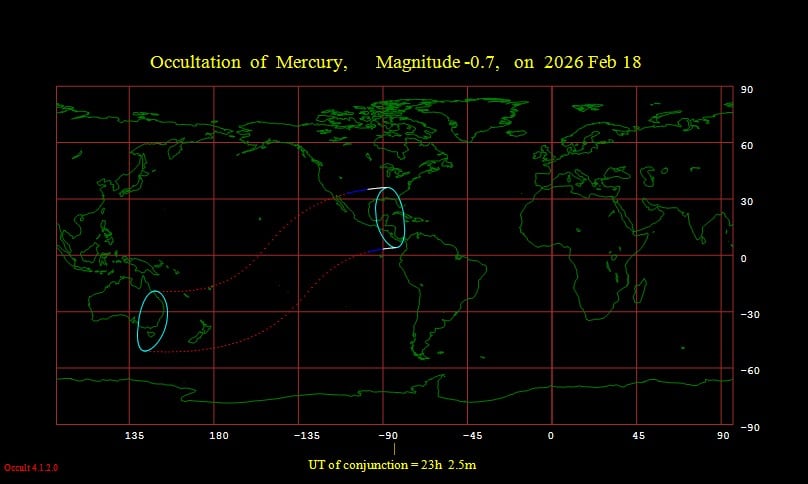 The occultation footprint for Wednesday night's occultation of Mercury by the Moon. Credit: Occult 4.2.
Part of what makes this rare event ideal is how relatively far it occurs from the Sun. Mercury reaches greatest eastern elongation 18 degrees from the Sun on February 19th, just 18 hours after to the occultation. The Moon is 2.5% illuminated at the time of the event, and Mercury presents a -0.5 magnitude, 7” in diameter, 53% illuminated disk.
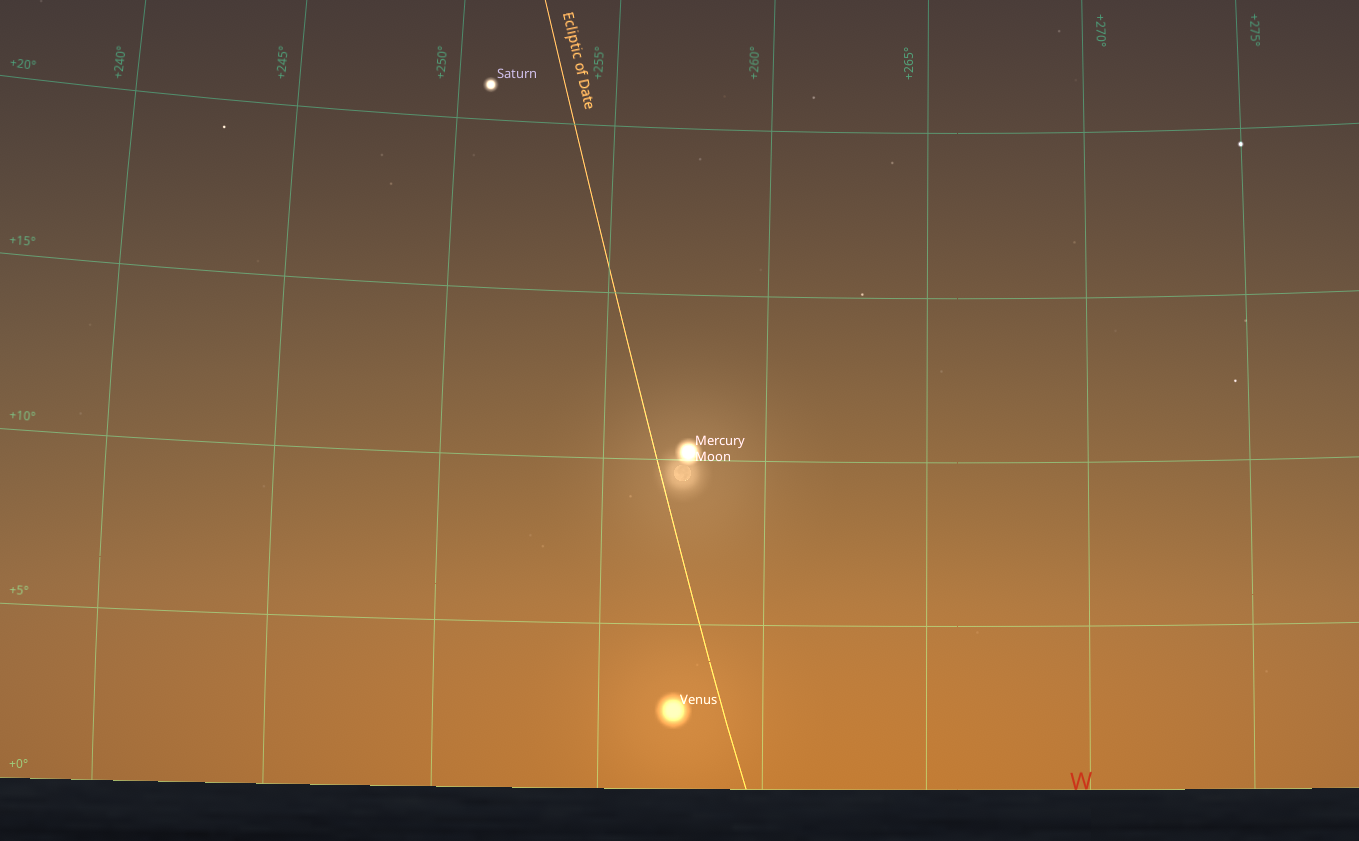 Looking westward, Wednesday night at dusk. Credit: Stellarium.
The last time we had an occultation of Mercury near greatest elongation occurred on September 29th, 2016 for southeastern South America, and the next time this occurs is on April 4th, 2030 for the remote Siberian Arctic. It's rare indeed to catch such an elusive event.
The International Occultation Timing Association (IOTA) lists ingress/egress times for select sites around the region. The Moon moves roughly its own 30’ diameter once an hour, and will take about 20 to 30 seconds to cover Mercury.
Texas and Mexico will see the event transpire in twilight, while areas eastward through Florida will see the occultation occur under darker skies. An especially intriguing zone is the graze line, where Mercury will play hide-and-seek among the lunar peaks and valleys along the limb. This can appear especially dramatic as the star or planet disappears and vanishes multiple times:
The graze line runs from north of Chattanooga Tennessee, westward through Arkansas north of Little Rock and into southern Oklahoma and northern Texas. Use a planetarium program like Stellarium to get precise ingress/egress times for your locale.
The Moon occults 4 planets 11 times in 2026.
You can follow the occultation with the naked eye, or use binoculars or a small telescope to enhance the view. Running video is a great way to document the event, especially when Mercury disappears behind the leading edge dark limb of the Moon.
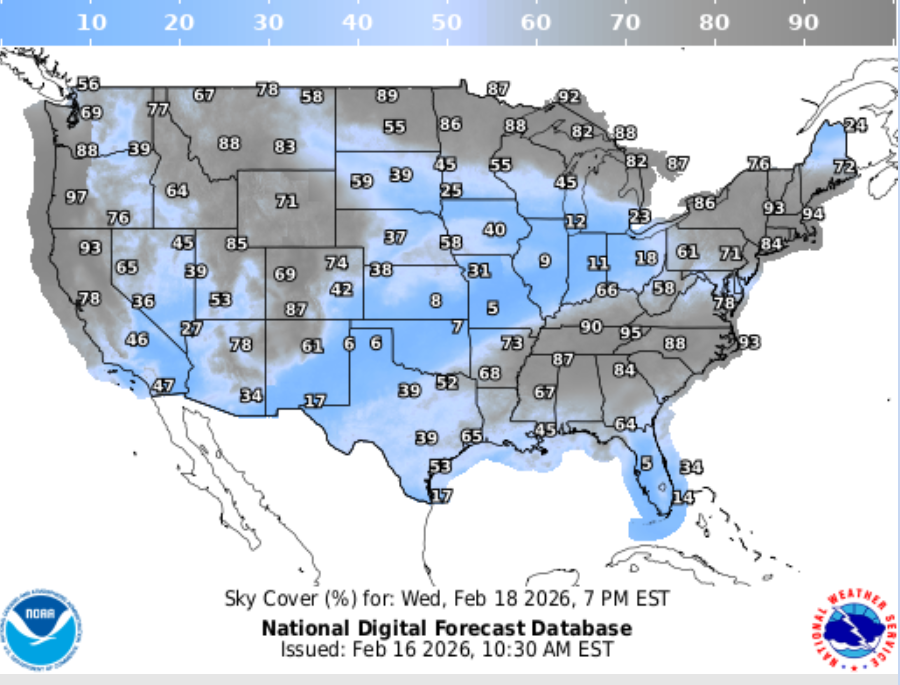 Cloud cover prospects for Wednesday night. Credit: NOAA.
Mercury never shows much detail at the telescope, though we’ve seen it up close in the past. NASA’s MESSENGER mission revealed Mercury as a pock-marked world, resembling our own Moon sans maria. ESA and JAXA are revisiting the small world coming right up starting at the end of 2026, as the joint BepiColombo mission enters orbit around Mercury.
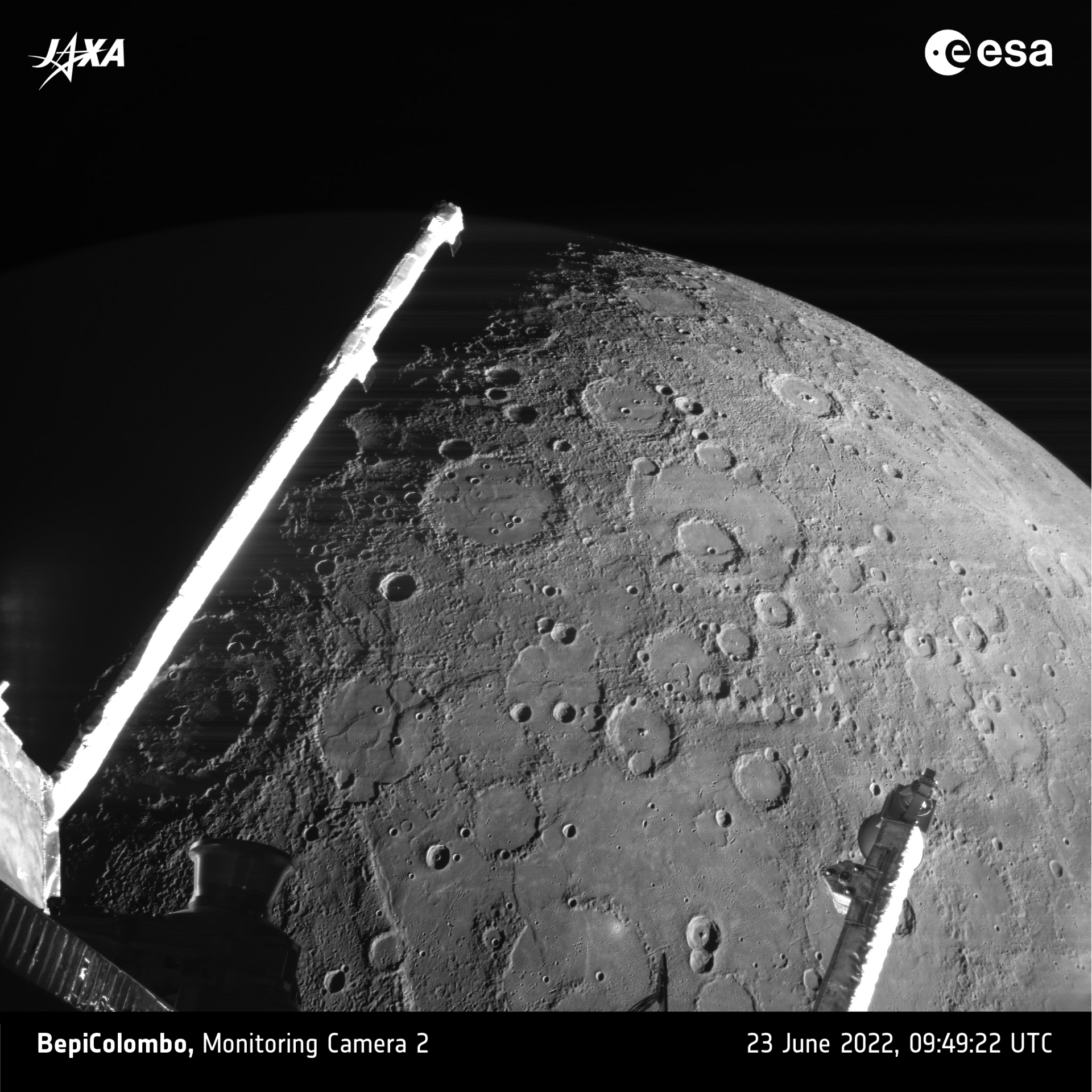 BepiColombo images Mercury during its 2022 flyby. Credit: ESA/BepiColombo/MTM
Follow that Moon, as it completes its evening planetary tour over the next week, passing Saturn on the evening of February 19th. As an added plus, +8th magnitude Neptune is nearby, passing less than a degree from Saturn on the 20th. The waxing crescent Moon then goes on to pass Uranus and occults the Pleiades for the high Arctic. Finally, the waxing gibbous Moon pairs with Jupiter on February 27th, fresh off of last month’s opposition. Only Mars, currently situated low in the dawn sky sits this one out.
And the best is yet to come. The ongoing eclipse season is bookended by an event that lots of observers will see: the total lunar eclipse on March 3rd, favoring the Americas and the Pacific Ocean region.
More to come on that soon. We’ll post images for the eclipse and the occultation here as we see ‘em. For now, enjoy the planetary tour of the Moon over the next week, and if you’re lucky, a fine pairing of Mercury and the Moon.