Universe Today
After more than thirty years of service, the International Space Station (ISS) is set to retire in 2030. To fill the vacuum this will create in terms of space science, research, innovation, and biological studies, multiple space agencies are planning successor stations. As addressed in the first installment, this includes NASA's Lunar Gateway, China's expansion of its Tiangong space station, India's proposed Bharatiya Antariksh Station (BAS), and Roscosmos' plans to recycle the modules that make up the Russian Orbital Segment (ROS) of the ISS.
However, there are also many plans for commercial space stations. This mirrors the growth of the private space sector in recent decades and the innovations commercial space has achieved. Examples include Blue Origin's Orbital Reef, Axiom Station, the Vast's Haven-1, the Gateway Foundation's VERA station, and the Airbus LOOP and Starlab space stations. These concepts offer a glimpse of what the "commercialization" of Low Earth Orbit will look like.
Orbital Reef
In December 2021, NASA announced it had selected Blue Origin and Sierra Space to create a "mixed-use business park" in LEO for commercial space activities and space tourism. Several commercial partners and institutes have signed on to this project, including Amazon, Amazon Web Services, Mitsubishi Heavy Industries, Boeing, Redwire Space, Genesis Engineering Solutions, and Arizona State University (ASU). The contract was one of three Space Act Agreements (SAA) issued for the first phase of NASA's Commercial LEO Destinations (CLD) program.
These SAAs were the first of two phases by which NASA hopes to maintain an interrupted U.S.presence in LEO after the retirement of the ISS. As of the Summer 2024, NASA reported that both Blue Origin and Sierra Space had passed several developmental milestones, including successful burst tests of Sierra Space's Large Integrated Flexible Environment (LIFE) modules. The station is being designed to support 10 persons in 830 m3 (29,310 ft3) of volume. The two companies plan to launch their first modules by 2027, aiming to be fully operational by the end of the decade, coinciding with the ISS's retirement.
Orbital Reef’s modular design is intended to provide maximum customization and compatibility for commercial partners. It will reportedly feature docking collars that can accommodate almost every spacecraft in operation, including SpaceX Dragon 2, Soyuz, Dream Chaser, and Boeing Starliner. Initially, the station will consist of four initial modules, including:
- The Core module, with 250 m3 (8,830 ft3) of habitable volume, will be able to accommodate up to 10 astronauts. It will serve as the central hub for the rest of the station's modules and docked vehicles. It will house the station's command and control, data processing, and communications centers, and will host internal and external payloads, stowage, an ECLSS, a commode, and six of the largest windows ever flown to space facing Earth.
- The Research Module, similar in size to the Core, will include a payload airlock/cupola and will host internal and external payloads, serving as a multi-disciplinary laboratory, customizable to user requirements. The Mast will generate 100 kWe through its deployable solar arrays. It will collect and reject heat, and will serve as the bus for communications and other critical systems, including an external robotic arm and docking and berthing nodes.
- The Large Integrated Flexible Environment (LIFE) module, built by Sierra Space, is an inflatable structure measuring about 10 m (33 ft) long and 8.5 m (27 ft) in diameter. The module will accommodate four astronauts, science experiments, exercise equipment, a medical center, and an Astro Garden® system for growing plants in space.
- The Node module, with 40 m3 (1415 ft3) of volume, will include two International Docking System Standard (IDSS)-compatible docking ports, an airlock for extravehicular activity (EVA), and will be able to host external payloads and provide station-keeping functions.
Axiom Station
Here we have another modular concept being developed by Houston-based aerospace company Axiom Space and global space manufacturer Thales Alenia Space, in collaboration with NASA. The station concept grew out of a proposal for a commercial module to be added to the ISS, as part of NASA's CLD program. However, the plan evolved into a free-flying, independent station that would succeed the ISS, continue the same research activities, and support commercial activities in LEO.
According to Axiom's current design, the final station will consist of five modules, each dedicated to a different purpose. This will include the Payload Power Thermal Module (PPTM), the first module to launch, designed to dock with the ISS and facilitate the transfer of critical infrastructure and payloads. This will be followed by the Habitation Module-1 (HAB-1), the Airlock (AL), HAB-2, and the Research and Manufacturing with Earth Observation (RAM) module.
The company has since completed preliminary and critical design reviews with NASA, and Thales Alenia Space has begun work on the primary structures that make up the PPTM. Once complete, the module will be shipped to Houston to complete final assembly and integration before launch, scheduled for no earlier than 2027. The module will initially be attached to one of two ports currently being used by cargo spacecraft. By 2028, it will detach and dock with HAB-1, which will be launched that year.
HAB-1 will measure 11 m (ft) long and 4.2 m (ft) in diameter, provide quarters for four crew members, and have enough volume to accommodate research and manufacturing applications. This module will provide propulsion, guidance, navigation, and station control. The AL module will follow in the late 2020s, while HAB-2 will follow and (combined with the airlock) will be a fully capable space station. HAB-2 will provide quarters for four additional crew members, doubling its crew capacity.
HAB-2 will provide complete Environmental Control and Life Support System (ECLSS) support, commercial satellite communications, and will include a remote manipulator arm (similar to the Canadarm-3) to assist with docking and docking for additional models. The RMF is expected to be launched by the 2030s and would enable research, product development, and space manufacturing in a microgravity environment, while a glass-walled cupola will serve as the Earth Observatory.
Additional modules that will come later include the Space Entertainment Enterprise (SEE-1) module, a spherical six-meter (ft) inflatable module that will be the first entertainment studio in space. Named after the British company of the same name, this module is expected to be a film location for a future movie starring Tom Cruise. Similarly, the Raffaello Multi-Purpose Logistics Modules (MPLM) are planned to be modified and installed on Axiom Station after the ISS is decommissioned.
Haven-1
The Haven-1 concept is a temporary orbital platform that offers 45 m3 (1,600 ft3) of habitable volume. It will rely on the Crew Dragon for long-term missions, use its life support systems, and be capable of sustaining a crew of 4 for up to 30 days at a time. The station will also have 150 kg (330 lb) of preloaded cargo that will enable science, research, and in-space manufacturing opportunities. The station is expected to launch in early 2027 atop a SpaceX Falcon 9, followed by the arrival of its first 4-person crew.
According to Vast's overall architecture, Haven-1 is essentially a stepping stone towards Haven-2, a modular station consisting of four Haven modules connected to a Haven Core in a four-arm configuration. The company plans to begin launching Haven modules by 2028, with the launch of the Haven Core by 2030. By 2032, they plan to expand the station by adding for additional modules, creating a nine-module station with two airlocks, multiple external payload facilities on each arm, and a robotic arm to assist with docking.
The Haven-2 station will reportedly be able to support a crew of 12 within its 510 m3 (667 cubic yards) of habitable volume, while a total pressurized volume of 1160 m3 (1,517 cubic yards). It will also feature airlocks for extravehicular activity (EVAs), or spacewalks, and have Starlink-enabled access to the internet.
VERA Station
The Voluminous Environment Rotating Architecture (VERA) concept is a torus-shaped pinwheel station (or Von Braun wheel) that rotates to simulate gravity. It is similar in concept to Space Station Five featured in Stanley Kubrick's 2001: A Space Odyssey, co-written by Arthur C. Clarke. Their proposed station would consist of two tori (one inner, one outer), measuring 84 meters (275.5 ft) in diameter and containing 369,523 cubic meters (483,318 yards3) of pressurized volume. The two-torus design allows for two levels of simulated gravity.
It also means that Emergency Rescue Vehicles (ERVs) are not needed to evacuate the Outer Torus, since passengers can move to the Inner Torus in the event of a crisis. The Inner Torus will contain 85,278 m3 (111,540 yards3) and will house the crew quarters, maintenance facilities, and station control. This smaller torus will be built before anything else (Outer Torus, elevators, Hub…) so that the construction crew will have a very large staging area to build the other station components.
The Gateway Foundation plans to build the station using the Sargon Construction Ring, a series of machines in a ring formation that employ a technique known as Panel Construction. This consists of welding hull plates with pre-attached Whipple shielding, enabling rapid automated construction of large pressurized volumes. The Gateway Foundation views the VERA Station as a critical stepping stone towards the creation of its proposed Gateway Spaceport.
Similar in design and featuring a two-torus profile, the Gateway will measure 488 m (1,600 ft) in diameter and 76 m (250 ft) deep, and will be able to accommodate 150 crew members and up to 1,250 guests within its 11.9 million m3 (15.57 million yards3) of pressurized volume. The inner torus, the Lunar Gravity Area (LGA), which features a large docking bay in the center, rotates to simulate lunar gravity (0.16 g). The outer torus, the Mars Gravity Area (MGA), simulates Martian gravity (0.38 g).
These two tori will allow visitors to acclimate to the gravity they will experience at their destination - the Moon, Mars, or beyond. In this respect, the Gateway is aptly named, since its intended purpose is to be a commercial hub in orbit and enable regular access to the Solar System.
Airbus LOOP
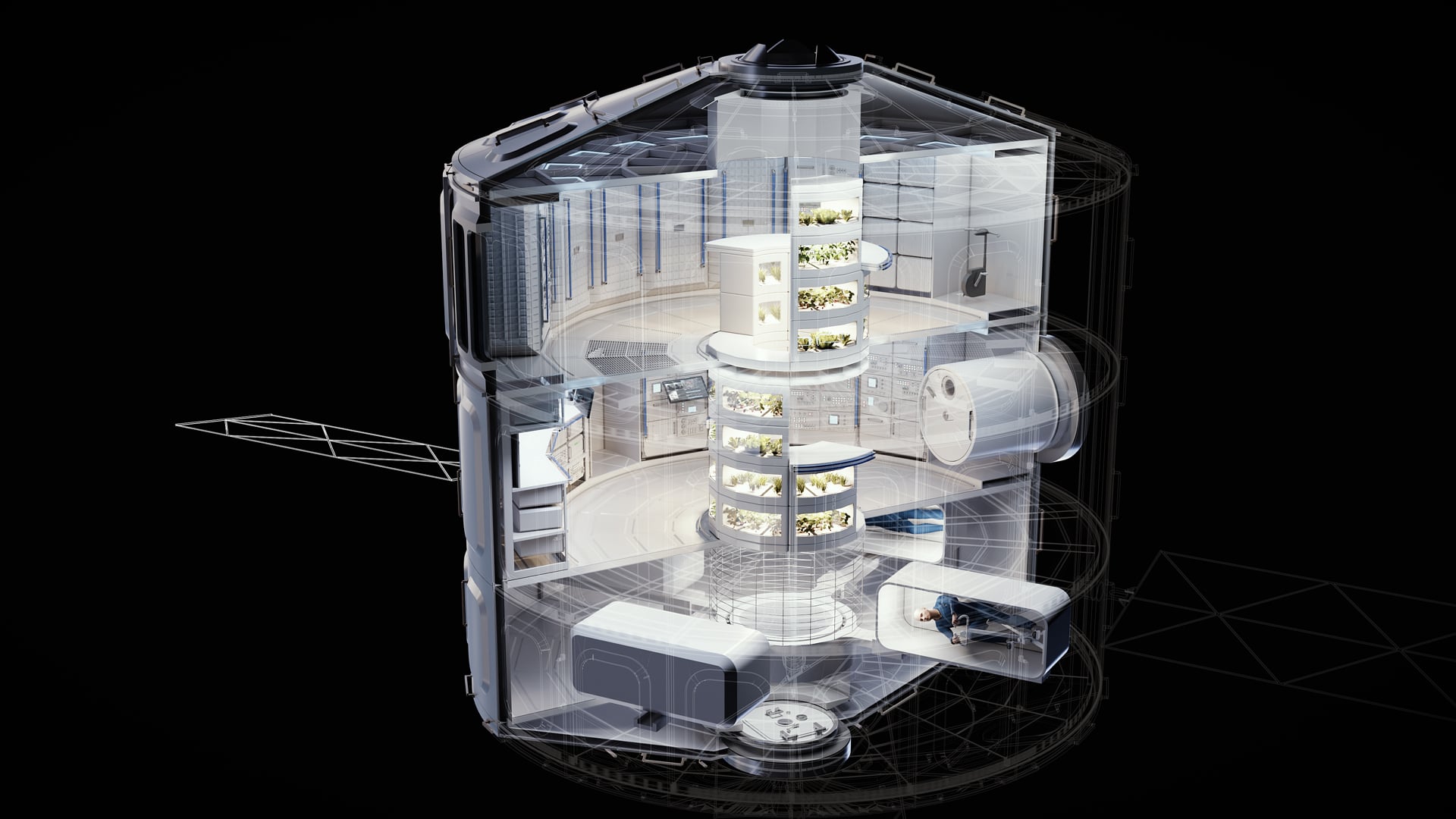
The LOOP, under development by European aerospace giant Airbus, is a multi-purpose orbital module measuring eight meters (26 feet) in diameter and about the same in height. The station consists of a rigid outer shell with windows, airlocks, and docking ports for visiting vehicles, which also enable the addition of more modules. The station is designed for a four-person crew, but can accommodate up to eight astronauts.
The interior structure comprises three decks dedicated to specific tasks (habitation, science, medical, in-orbit factory, etc.) that are connected by a central tunnel, with greenhouse elements surrounding it. The modular design also allows decks to be swapped out or added for additional purposes (entertainment, tourism, etc.). The bottom level contains a centrifuge system with multiple pods that simulates partial gravity while crew members ride exercise bikes. The station will be equipped with all necessary life support systems, including body-mounted radiators for thermal control, solar-electric power, and multiple communication systems.
Starlab Station
Another concept in development by Airbus, in collaboration with Starlab Space LLC, the Starlab Station is designed to ensure a continued human presence in LEO. The station measures 17 m (~56 ft) tall, 7.7 m (25.25 ft) wide, and will accommodate a regular crew of 4 and 8 during turnover. With a scheduled start date for 2030, it is intended to enable a seamless transition from the ISS and its microgravity science research to the next generation of commercial space stations.
The design teams are currently working towards the Critical Design Review (CDR), which began at the end of 2025.
Space exploration has a way of inspiring bold plans and ambitious designs. But with NASA setting its sights on the next "big leap," the recent advances in commercial space and the rise of several new major players, we may be living in the most auspicious time since the Apollo Era.