Universe Today
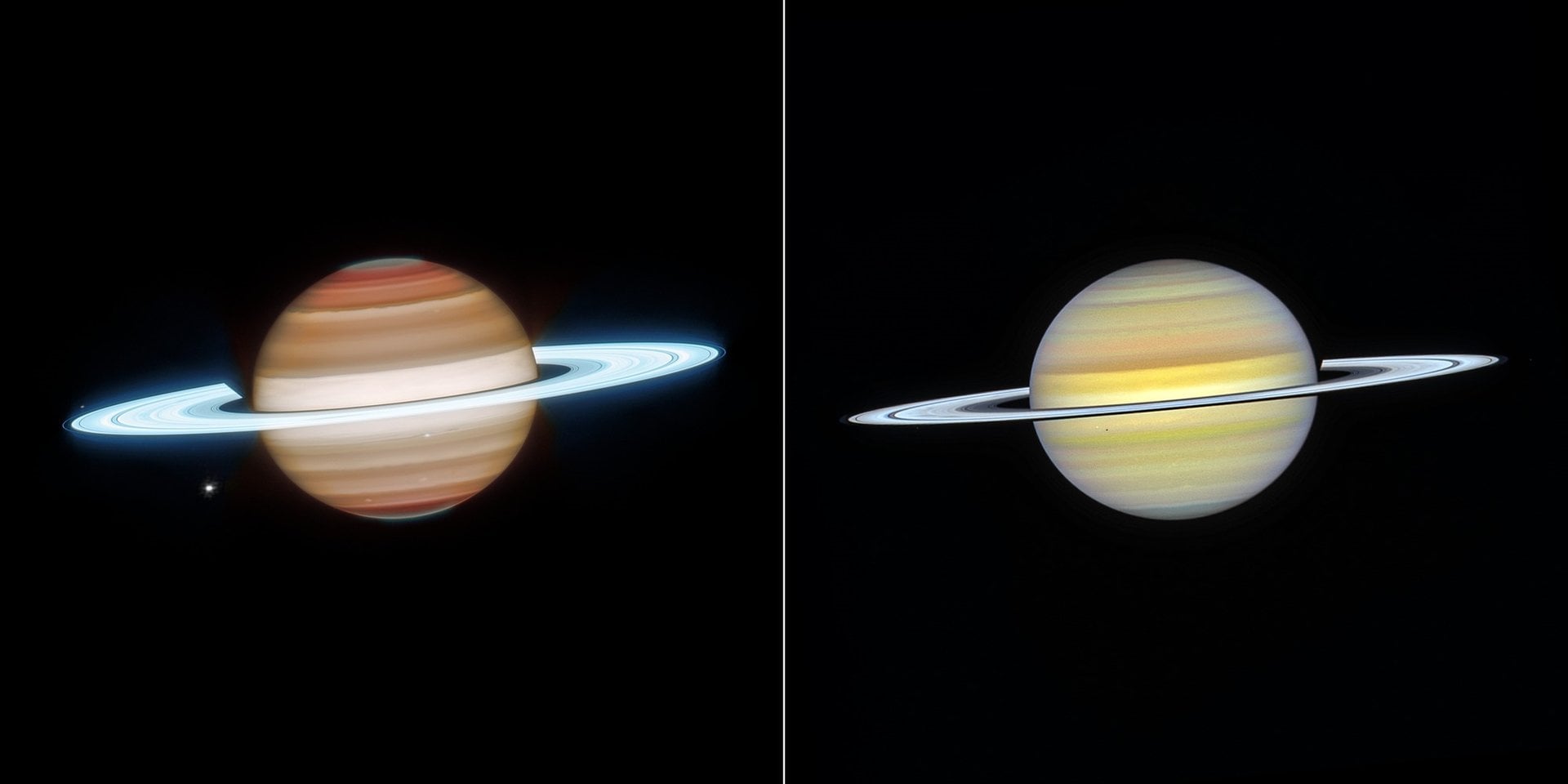
NASA is serving up a double scoop of delicious Saturn imagery in two flavors — near-infrared and visible light. The subtle differences between the James Webb Space Telescope’s infrared view and the Hubble Space Telescope’s visible-light view can help scientists dig deeper into the workings of the ringed planet’s atmosphere.
Both images were captured in the latter half of 2024 and released today. The Hubble image, produced as part of a 12-year-long monitoring program known as the Outer Planet Atmospheres Legacy, shows Saturn’s bands of clouds as they’d appear to the naked eye.
In the JWST image, it’s easier to make out a long-lived jet stream known as the “Ribbon Wave” at northern mid-latitudes. Just below the wave, there’s a whitish speck that represents the remnant of the “Great Springtime Storm,” an atmospheric disturbance that made a huge impression from 2010 to 2012. Other storms show up as pockmarks in the clouds of the southern hemisphere.
Saturn’s poles take on a gray-green glint in the color-coded infrared view, which indicates light emissions in wavelengths around 4.3 microns. NASA says that could be due to a layer of high-altitude aerosols in Saturn’s atmosphere that scatters light differently at those latitudes. Auroral activity could serve as an alternate explanation.
The two images provide different views of Saturn’s rings as well. In JWST’s infrared view, the rings appear brighter due to the light reflected by water ice. The infrared view clearly shows the outermost ring, known as the F ring, which glows only slightly in the Hubble view.
Some of Saturn’s more than 250 moons make cameo appearances in the the images. You can make out Titan, Janus, Dione, Enceladus, Mimas and Tethys in JWST’s wide-angle view, while Hubble’s view highlights Janus, Epimetheus and Mimas (plus Mimas’ shadow).
These pictures were taken as Saturn approached last year’s equinox, and the views will keep changing with the seasons. “As Saturn transitions into southern spring, and later southern summer in the 2030s, Hubble and Webb will have progressively better views of that hemisphere,” NASA says in today’s image advisory.
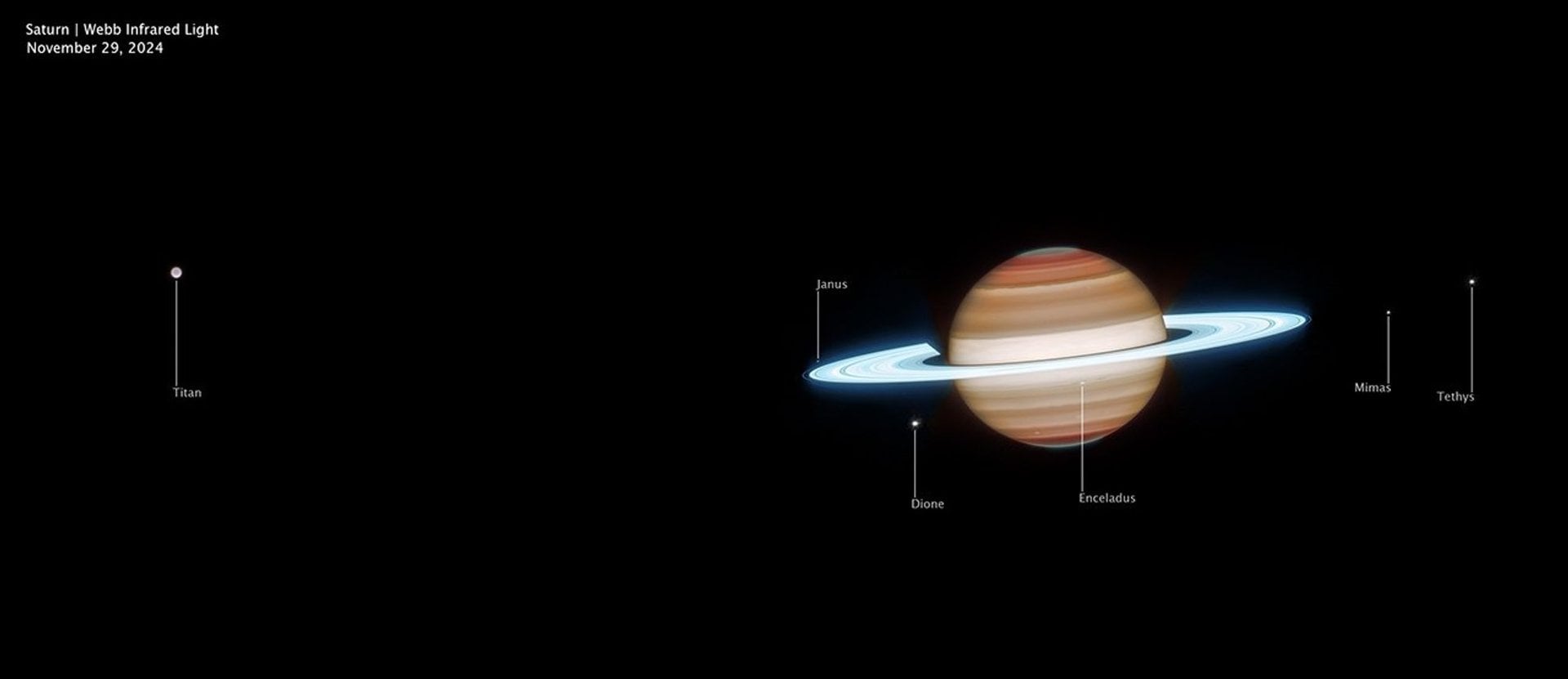 A wide-angle version of the James Webb Space Telescope’s view of Saturn shows Titan, Janus, Dione, Enceladus, Mimas and Tethys. Click on the image for a larger version. Image: NASA, ESA, CSA, STScI; Image Processing: Joseph DePasquale (STScI)
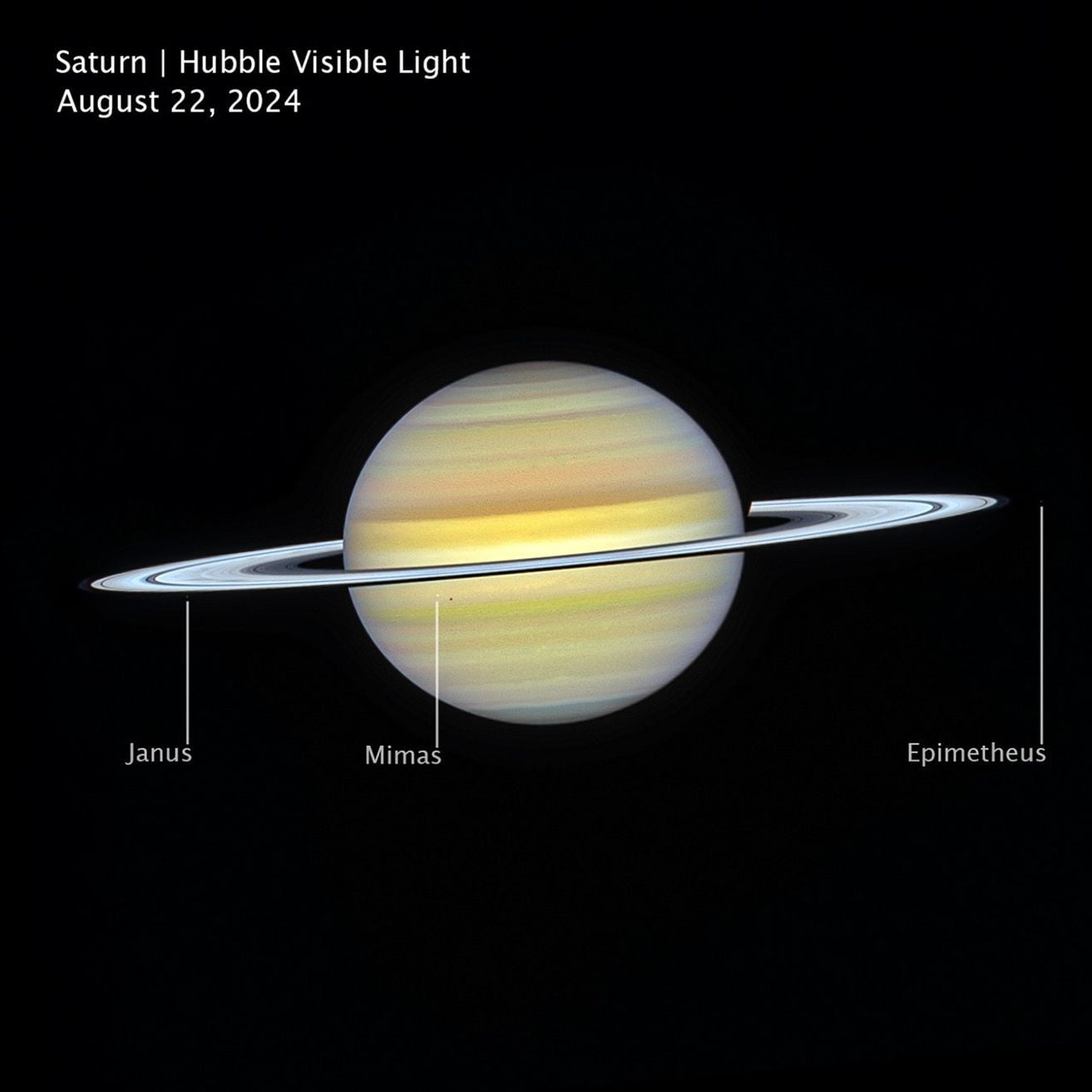 The Hubble Space Telescope’s view of Saturn shows Janus, Mimas and Epimetheus, three of the planet’s moons. Click on the image for a larger version. Image: NASA, ESA, STScI, Amy Simon (NASA-GSFC), Michael Wong (UC Berkeley); Image Processing: Joseph DePasquale (STScI)