 Universe Today
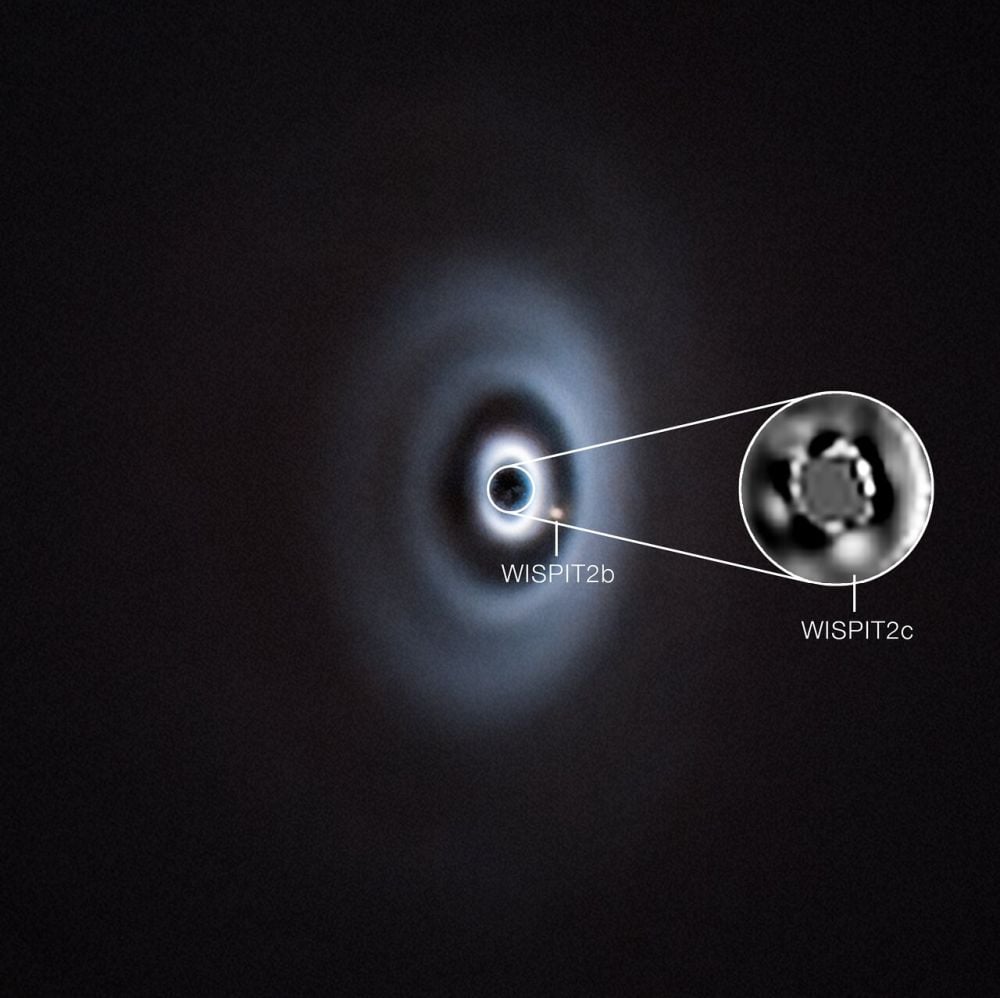
As the number of exoplanet detections has breached 6,000 and continues to grow, scientists are finding a wide variety of different solar system architectures. Critical to understanding how these architectures take shape is finding young planets forming around very young stars. In 2025 a team of astronomers announced the discovery of a planet about 5 times more massive than Jupiter around a star that's very much a younger version of our Sun.
The star is called WISPIT 2, is about 437 light-years away, and has around 1.08 solar masses. It's very young, at only about 5 million years old. It's so young it hasn't yet commenced its life of fusion on the main sequence. That also means that it's in the stage where young planets are still forming. Taken together, it's a helpful analogue for our Solar System.
The exoplanet discovered around the star last year is named WISPIT 2-b, following convention. It was found with the Very Large Telescope (VLT) and its Spectro-Polarimetric High-contrast Exoplanet REsearch (SPHERE) instrument. The powerful VLT was able to image the planet, and that image became the ESO's Picture of the Week.
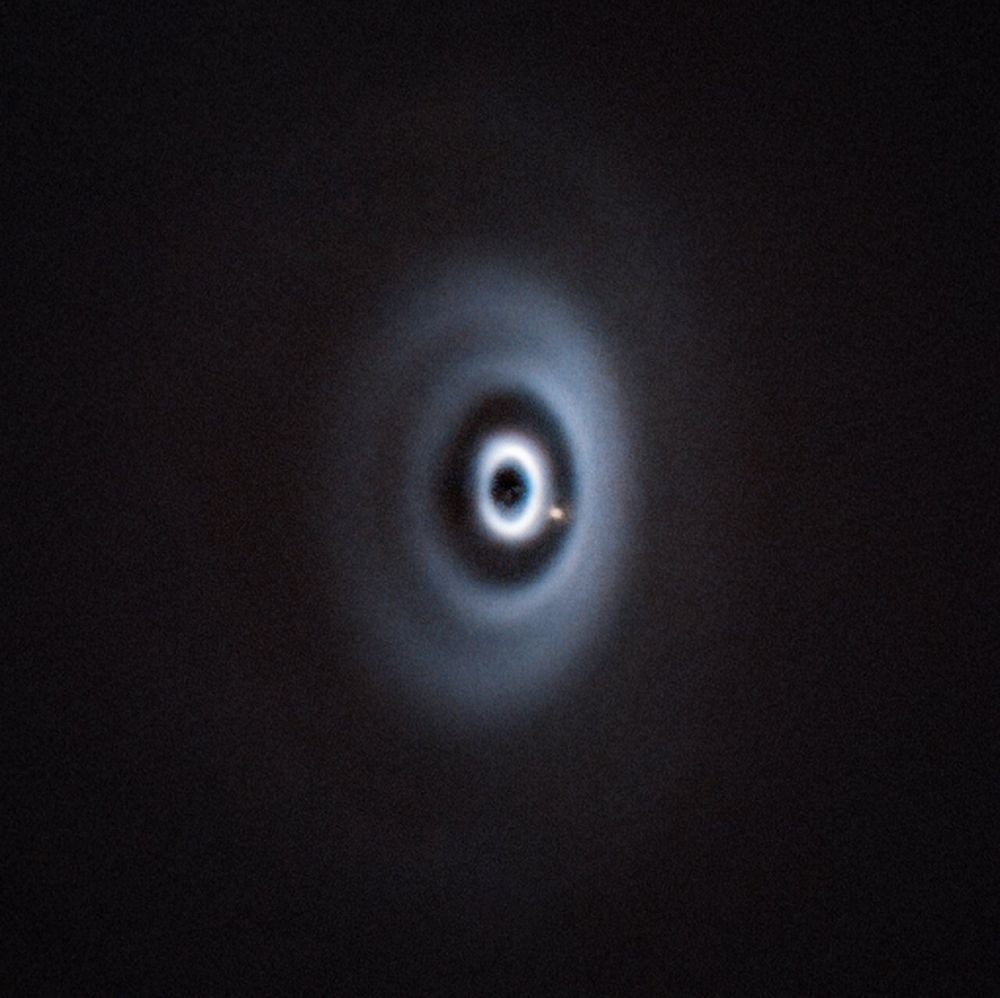 This ESO Picture of the Week from August 26, 2025 shows the exoplanet WISPIT 2b as it forms in the protoplanetary disk around the star WISPIT 2. The ESO said it's "the first clear detection of a baby planet in a disc with multiple rings." Astronomers think that the gaps in the disk are created by young planets as they accrete material from the disk. Image Credit: ESO/R. F. van Capelleveen et al.
Now some of the same astronomers behind the detection of WISPIT 2b have found another planet in the same young solar system, WISPIT 2c. The discovery is in new research published in The Astrophysical Journal Letters titled "Direct Spectroscopic Confirmation of the Young Embedded Protoplanet WISPIT 2c." The lead author is Chloe Lawlor, a PhD student from the University of Galway's Centre for Astronomy and the Ryan Institute.
"WISPIT 2 is a nearby young star with a multiringed disk that was recently confirmed to host a ∼4.9 MJup gas giant planet embedded in a large (60 au) gap at a radial separation of 57 au from the host star. We confirm and characterize a second, close-in planet in the WISPIT 2 system..." the authors write. WISPIT 2c is likely twice as massive as its sibling, and also closer to the host star, "with a mass range of 8–12 MJup and a radial separation of 14 au.," the authors add.
The "Direct Spectroscopic Confirmation" in the study's title refers to observations with VLT/SPHERE and VLTI/GRAVITY.
Exoplanets can sometimes appear as little more than anomalies in astronomical data, and background stars can mimic exoplanets, so direct spectroscopic confirmation is important. This type of confirmation can also constrain exoplanet physical models, tell us about an exoplanet's composition, and provide other important data. Direct spectroscopic confirmation is also technically demanding, boosting the relevance of this work.
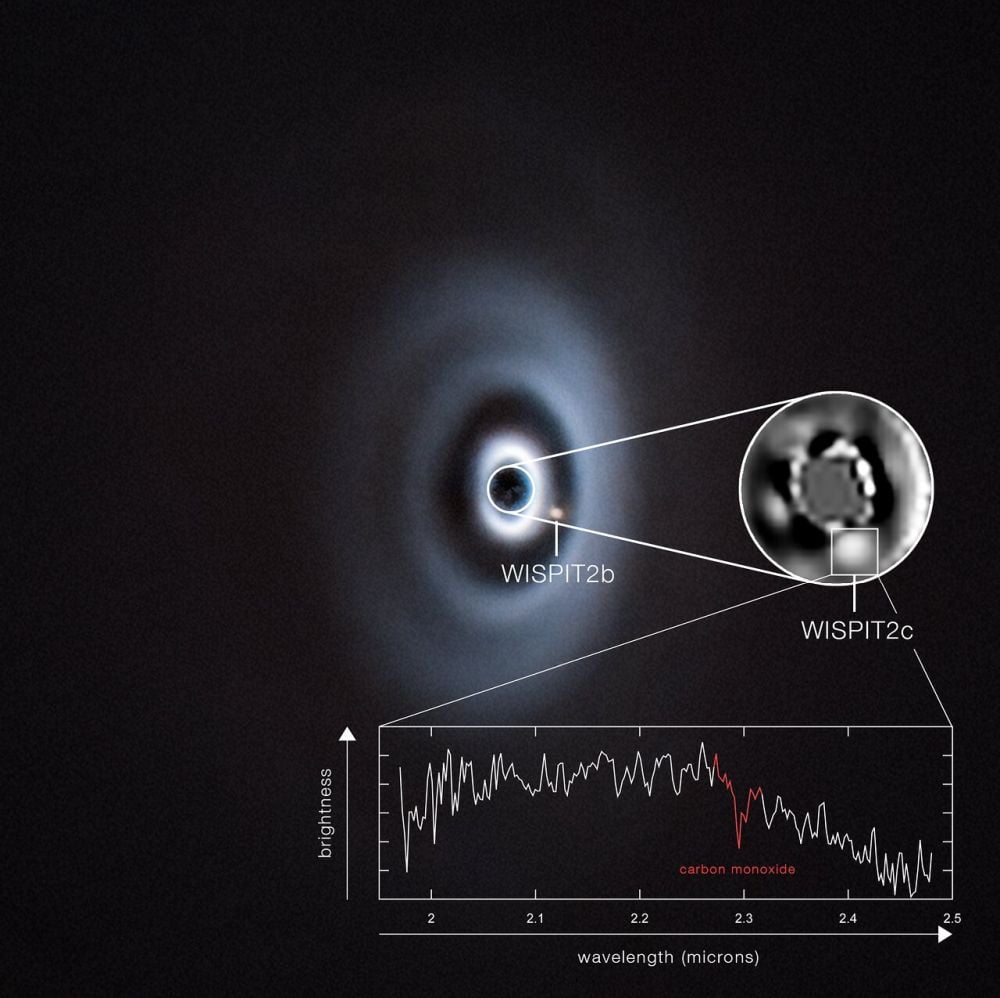 This image shows two planets forming around the young star WISPIT 2. The top images were captured with the ESO's VLT/SPHERE. WISPIT 2c's spectrum was captured with the VLTI/GRAVITY+ instrument. It shows the presence of carbon dioxide which is a common atmospheric component of gas giants. The CO2 detection is further confirmation that the object is an exoplanet. Image Credit: ESO/C. Lawlor, R. F. van Capelleveen et al.
The WISPIT 2 system is also important because the star is so similar to our Sun, and that always attracts the interest of astronomers. “WISPIT 2 is the best look into our own past that we have to date,” lead author Lawlor said in a press release.
The system is only the second instance of two exoplanets observed forming around their star, after PDS 70. PDS 70 is a young T-Tauri star about 370 light-years away with two confirmed and one unconfirmed exoplanet.
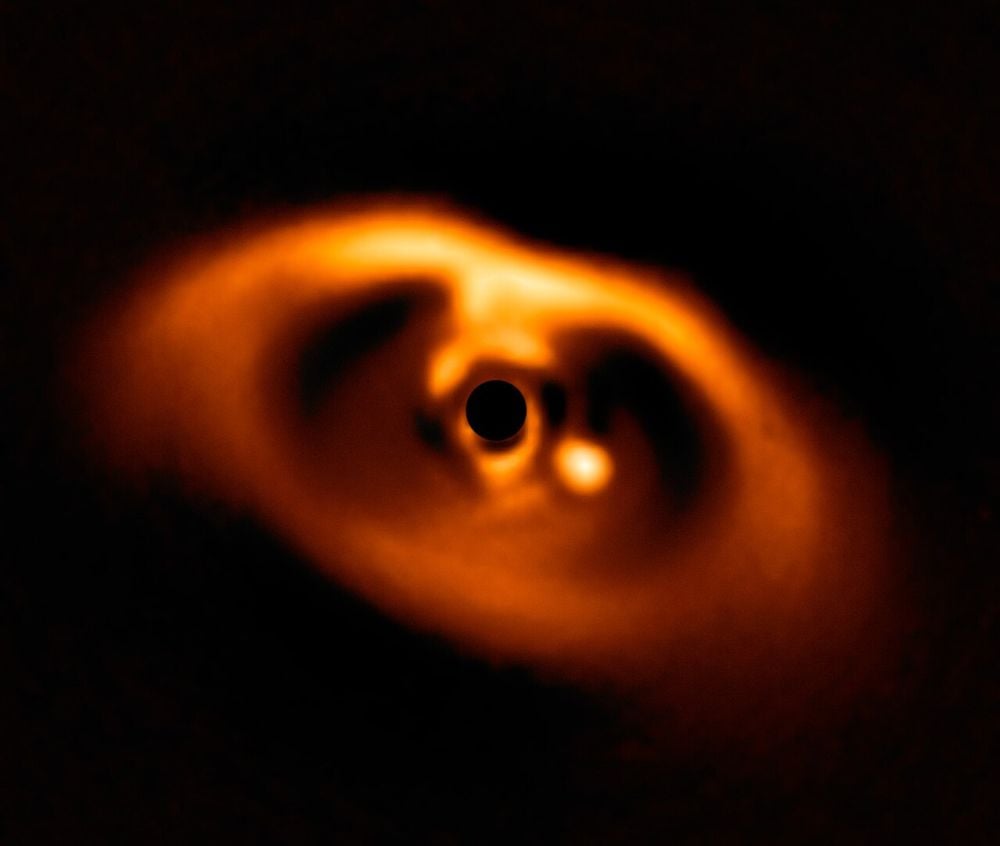 This is the VLT/SPHERE image of PDS 70, the first clear image of a planet forming around its star. The planet is visible as a bright point to the right of the centre of the image, which is blacked out by the coronagraph mask used to block the blinding light of the central star. Image Credit: By ESO/A. Müller et al., CC BY 4.0, https://commons.wikimedia.org/w/index.php?curid=70463981
"The young T Tauri star PDS 70 once acted as a lone candle in the dark for early planet formation studies, owing to its two confirmed planets, PDS 70b," the authors write.
"WISPIT 2 now becomes an analog to PDS 70, offering a second laboratory for studying the formation and early evolution of a multiplanet system within its natal disk," the researchers explain in their paper.
But WISPIT 2 has a more extended and resolved system of rings and gaps. "These structures suggest that more planets are currently forming, which we will eventually detect,” Lawlor said.
"WISPIT 2 gives us a critical laboratory not just to observe the formation of a single planet but an entire planetary system," said study co-author Christian Ginski, a researcher at the University of Galway.
Watching as young planets form and an entire solar system takes shape was unattainable only a short time ago. It's all possible because of powerful telescopes and their attached instruments.
“This detection of a new world in formation really showed the amazing potential of our current instrumentation,” said Richelle van Capelleveen, PhD student at Leiden Observatory, the Netherlands, leader of the previous study and a co-author on the new one.
"Critically our study made use of the recent upgrade to GRAVITY+ without which we would not have been able to get such a clear detection of the planet so close to its star," said study co-author Guillaume Bourdarot, Bourdarot is a researcher at the Max Planck Institute for Extraterrestrial Physics in Germany. GRAVITY+ allows the imaging of even fainter astronomical objects at further distances than the original GRAVITY instrument.
With these detections, and with others on the way from even more powerful upcoming telescopes and instruments like the ELT, our understanding of solar system formation is poised to take a forward leap. The ELT features a gargantuan 39 meter primary mirror, and should see first light in March 2029.
There may even be another exoplanet detection waiting in the WISPIT 2 system itself. Both of the discovered exoplanets reside in gaps in the star's protoplanetary disk, and there's evidence of another gap in the disk that's more distant from the star. "We suspect there may be a third planet carving out this gap" says Lawlor, "potentially of Saturn mass owing to the gap’s being much narrower and shallower." Co-author Ginski noted that “with ESO’s upcoming Extremely Large Telescope, we may be able to directly image such a planet.”
Overall, the WISPIT 2 system is a rare opportunity to probe the emergence of solar system architectures. The authors speculate that the orbital separations in both PDS 70 and WISPIT 2 suggest a sort of Goldilocks Zone for giant planet formation, though that's far from clear right now.
"While the available data remain limited, these results bring us one step closer to making direct connections between the initial conditions of planet formation and the final architectures of planetary systems," the authors conclude.

