Universe Today
Every so often, a piece of space news comes along that makes you raise an eyebrow and this is one of those moments. A team of astronomers have, for the first time, confirmed an atmosphere around a rocky planet sitting in another star's habitable zone, the region where conditions might just be right for liquid water. It's the kind of discovery that sounds modest until you understand exactly how much rides on it.
The planet in question is LHS 1140 b, a rocky world about 48 light years away, orbiting a small red dwarf star. Over 6,000 exoplanets have now been discovered and a handful of them sit tantalisingly within their star's habitable zone. But finding a planet in the right place has never been the same as knowing it can actually hold onto an atmosphere, and that distinction matters enormously, because without an atmosphere, nothing else about "habitable" really applies. No air, no weather, no protection from radiation, no chance of the kind of chemistry life as we understand it depends on.
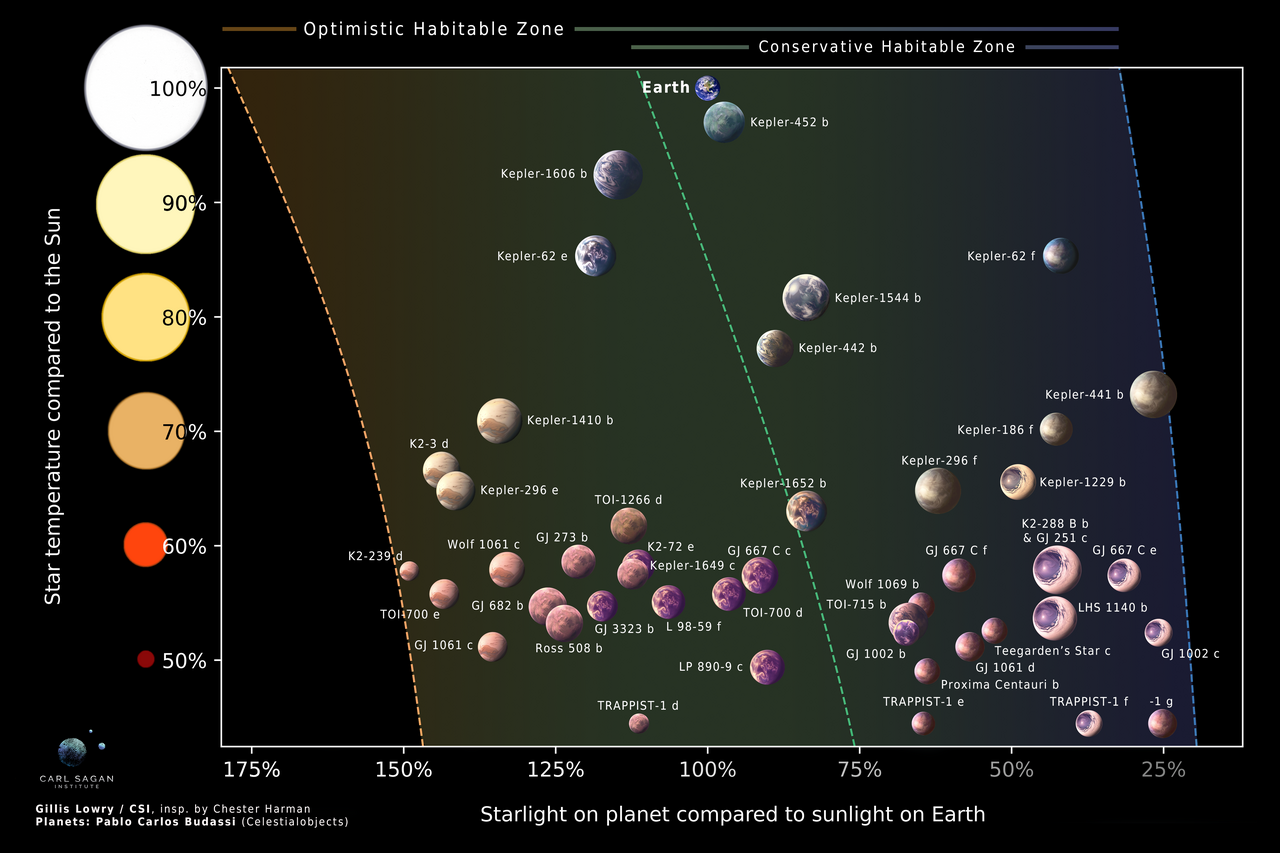 A diagram depicting habitable zone boundaries across star type. Earth is plotted alongside 45 exoplanets with radii less than 2 times that of Earth or masses less than 5 times that of Earth, making them potentially rocky worlds in the habitable zone (Credit : Spacegel)
That's what makes this result, published in the journal Science and led by Collin Cherubim of Harvard University, so significant. Rather than simply hoping a suitable planet might have an atmosphere, Cherubim and his team predicted one mathematically first. Their model suggested LHS 1140 b should have an upper atmosphere rich in helium, slowly leaking away into space. It's one thing to predict that on paper but it's quite another to go and prove it using a telescope.
To test the idea, the team used the WINERED spectrograph on the Magellan Telescope in Chile, and caught an unusually lucky break. On the night of their observation run, LHS 1140 b and a neighbouring planet both happened to cross in front of their star. That gave the astronomers a direct comparison. One planet showed no sign of an atmosphere at all. The other, LHS 1140 b, showed helium clearly escaping from around it, the unmistakable signature of an atmosphere that has likely survived, remarkably, for more than three billion years.
 Nighttime exterior rendering of the Giant Magellan Telescope with support site buildings in the foreground at Las Campanas Observatory in the Chile Atacama Desert (Credit: Giant Magellan Telescope - GMTO Corporation)
What I find genuinely thrilling about this isn't just the detection itself, but the method behind it. Even David Charbonneau, one of the study's senior astronomers, admitted he was sceptical when Cherubim first proposed the idea, purely because it existed only as a calculation. He was won over once the numbers came back "statistically rock solid." That's science working exactly as it should: a prediction, a test, and a result strong enough to change minds.
This single detection also opens a door on more discoveries like it. If watching escaping gases from here on Earth can reveal an atmosphere on one distant rocky world, the same technique could now be turned on plenty of others. Cherubim already has his sights set on working out exactly what that atmosphere is made of, and eventually whether LHS 1140 b might even have oceans on its surface.
We are still a long way from knowing whether anything is breathing that air. But for the first time, we know a rocky world in the habitable zone of another star has at atmosphere. Sometimes the universe reveals its secrets one careful, patient measurement at a time, and this feels like exactly that kind of moment.
Source : First Atmosphere Detected on a Habitable-Zone Rocky World