 Universe Today
There's growing concern that AI is polluting our communal spaces. AI is replacing humans online, and we wonder if there's another human being behind what we're reading or viewing. We wonder where this will go, and how it will end.
There's also growing concern that AI, or at least its infrastructure, is taking over physical spaces. Data centers are proliferating, and citizens are concerned about their effects: power usage, water usage, noise, etc. The promise of a few jobs isn't placating concerns about what some say are resource-hogging data centers being forced on communities despite their opposition.
And the potential loss of privacy, loss of freedom, and the spectre of a growing surveillance regime stemming from AI isn't helping.
But now AI data centers are about to take their place in the sky, the last frontier of communal space. This is setting off alarm bells for astronomers, who are adamant that the growing cloud of satellites is taking a serious toll on their observations.
The FCC just approved SpaceX's application to launch a staggering one million new satellites in Low-Earth Orbit (LEO). Together, they will be the first orbital AI data center. The system is designed to avoid using energy and resources here on Earth. The satellites will operate in nearly constant sunlight for solar power, and will cool themselves by pumping liquid coolant through radiative panels. The individual satellites would stay in constant contact with each other with lasers.
With Musk/SpaceX's typical hubris, they're calling the system 'Starmind.'
But whatever they're calling it, not everyone is pleased that it's been approved, and many are questioning why the FCC, a purely American body, can be allowed to approve such a project.
There are really two parallel problems. One is the growing number of satellites overall, and the other concerns the proliferation of AI.
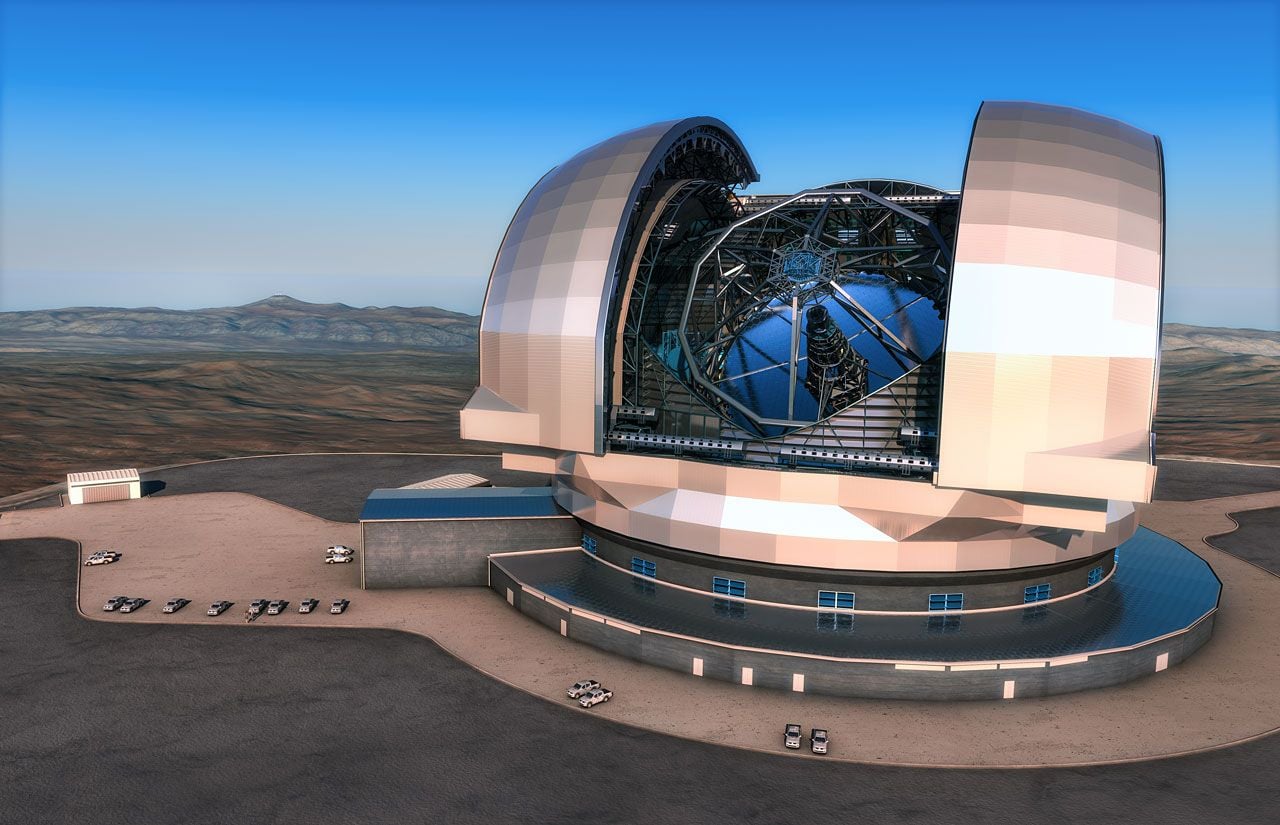 This artist's illustration shows the ESO's Extremely Large Telescope in the Atacama Desert in Chile. It's a 39 meter behemoth that will drive astronomical discoveries for decades. But a sky crowded with satellites will make its life difficult. Image Credit: ESO/L. Calçada
The European Southern Observatory (ESO) has made their thoughts known on the proliferation of satellites and how it affects astronomy. The ESO operates some of the most powerful existing and upcoming telescopes in the world in the Atacama Desert in Chile: The Very Large Telescope (VLT), the Atacama Large Millimeter/submillimeter Array (ALMA), the ESO 3.6-metre Telescope, and the ESO's upcoming flagship telescope, the Extremely Large Telescope (ELT).
In a new statement, the ESO condemns the Starmind project as a serious detriment to astronomical observations. And, unlike some other opponents, they've analyzed the situation in detail.
“As approved, this project would not only have profound consequences for astronomy, but also fundamentally alter the night sky for everyone on the planet. We demonstrated these impacts in an extensive technical analysis, and raised them in a response to the US FCC, as did other organisations worldwide. This approval highlights the urgent need for international mechanisms capable of assessing activities whose impacts extend far beyond national borders and affect a global common good,” said Andreas Kaufer, Director General at the European Southern Observatory (ESO).
Their technical analysis is peer-reviewed and was published in Astronomy and Astrophysics in March 2026.
"Large satellite constellations impact astronomy through both visible trails and the generation of diffuse and atmospherically scattered light. Quantification of this cumulative sky-background component is essential to assess the full ramifications of extant and proposed systems," the paper states.
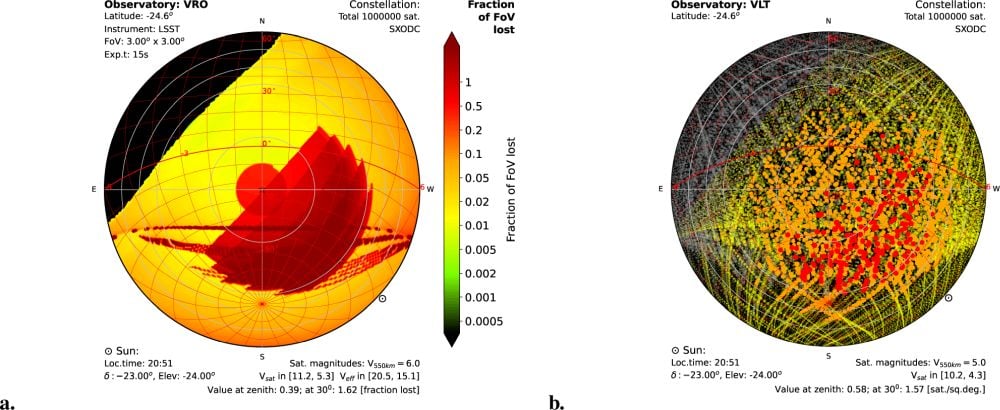 These panels show the effect of one million satellites (V500km = 6), representing the SpaceX Orbital Data Center constellation in slight violation of the V > 7 recommendation. (a) shows the fraction of the Field of View lost for the LSST camera at the Vera Rubin Observatory. (b) shows example positions of individual satellites. The grey dots represent invisible satellites in the Earth’s shadow, whereas the coloured dots represent illuminated satellites. The 1867 orange dots correspond to satellites brighter than V = 7, and the 247 red dots to satellites brighter than V = 5. For comparison, about 3000–4000 stars are this bright. Image Credit: Hainaut 2026. A&A Volume 712, August 2026 A241
"This study evaluates the effect of proposed constellations – ranging from current deployments to mega-constellations and very bright reflector concepts – on direct trail losses, diffuse background, and scattered sky brightness."
Here's what they found:
Constellations with up to about 60,000 member satellites have a negligible, but not imperceptible, effect on observations. But above that number, things change for the worse. "Conversely, mega-constellations with 106 satellites render trails pervasive, thereby affecting the majority of long exposures," they write. Long exposures are critical in modern astronomy, so the astronomers are taking the issue seriously.
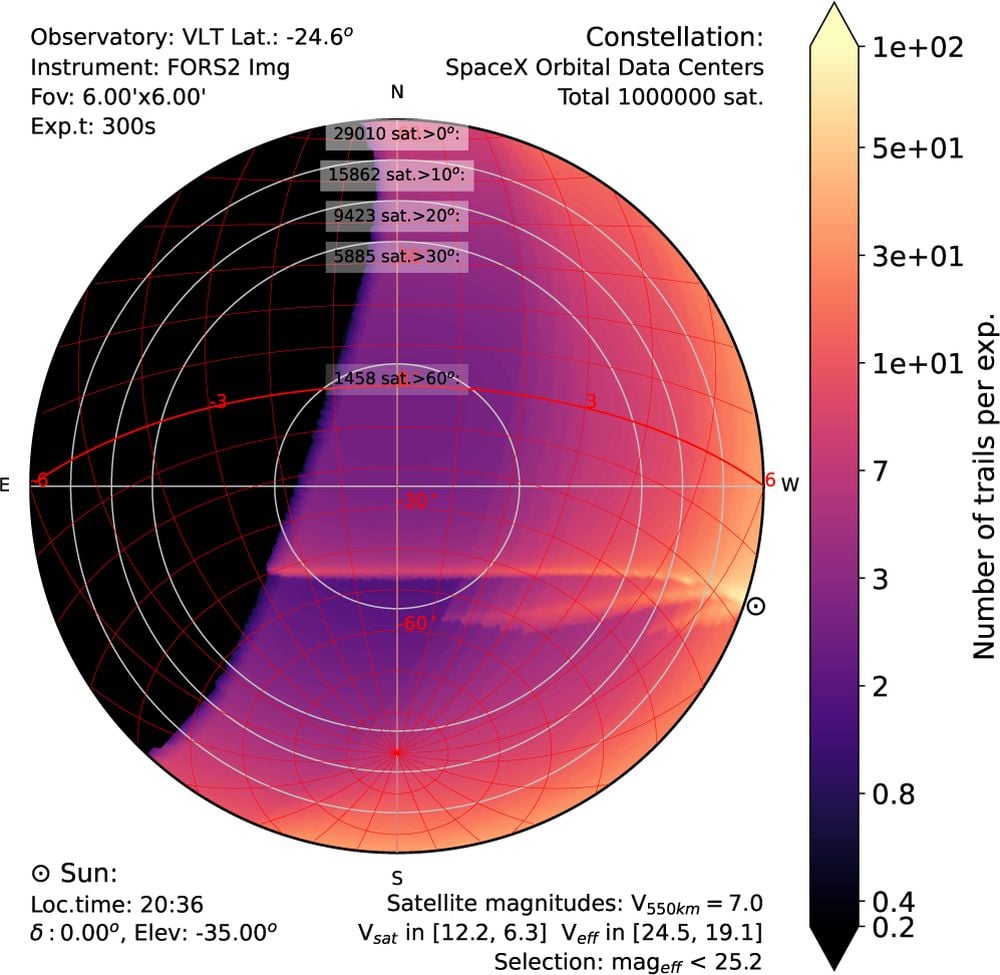 This figure illustrates the effect SpaceX’s one-million-satellite Orbital Data Center constellation on a 300-second exposure with the spectrograph at the Very Large Telescope. Even 1.3 h after the end of astronomical twilight, more than half the sky remains affected by satellite streaks, with an average of more than eight satellite trails per image at zenith. In some observations, more than 20 satellite trails will cross each image. The effect on a 15-second exposure with the 3° LSST camera at the Rubin observatory is similar. Image Credit: Hainaut 2026. A&A Volume 712, August 2026 A241
Long exposures are especially important when observing high-redshift objects or other faint objects. High-resolution spectroscopy and deep-time surveys also use long exposures. Astronomical telescopes can take short exposures and stack them to deal with some satellite light-streak pollution, but that has its limits.
"Bright satellites, such as spacecraft analogous to AST SpaceMobile, significantly impact saturating detectors even when their number is moderate. Extremely bright satellites pose a far more severe threat: a 5000-satellite Reflect Orbital-like constellation could elevate the scattered sky background by 20–30%, and a population of 50 000 could increase it by 200–300%," the ESO paper states.
The ESO's technical analysis said there are current proposals to launch 1.7 million new satellites into space, and many of them breach a critical threshold called V550km = 7. That figure indicates a satellite that can't be seen with the naked eye, so breaching that figure means it can be seen with the naked eye. That means that not only will we see them when we gaze upward, but astronomical telescope observations would be inundated with them. The ESO's analysis says dryly that they "would substantially degrade astronomical observations."
"Maintaining satellite brightness below V550km = 7 is important for all instruments but critical for safeguarding saturating instruments, such as the Rubin LSST camera, and for limiting sky-background pollution," the paper states.
Reflect Orbital has something other than AI or communications in mind. They intend to launch large reflecting satellites into orbit. Those satellites would reflect sunlight to customers on the ground. They could illuminate solar panel farms at night, or provide light to allow things like resource extraction to continue past nightfall. But things can always go wrong. Think of hackers or other malicious actors gaining control of an orbiting light source.
But the real problem astronomers face from Reflect Orbital is that their satellites would blow past the V550km = 7 threshold.
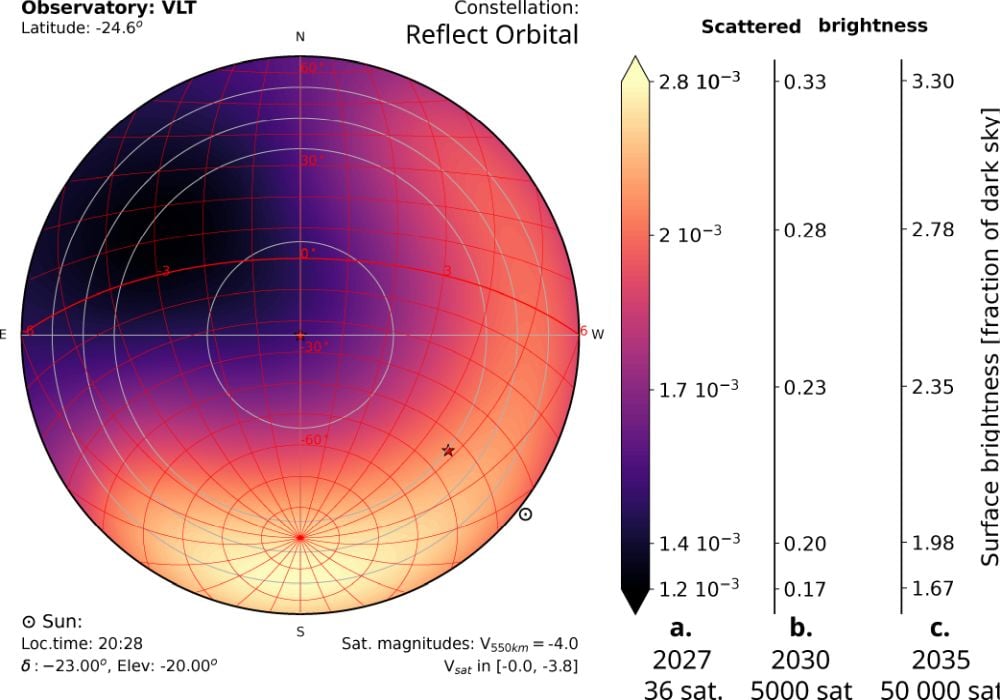 This figure shows scattered light as a fraction of the natural dark sky for 37 (a), 5000 (b), and 50 000 (c) extremely bright satellites (V500km = −4), representing the Reflect Orbital constellations envisaged for 2027, 2030, and 2035, respectively, as seen from outside their illuminating beam. Image Credit: Hainaut 2026. A&A Volume 712, August 2026 A241
Reflect Orbital's eventual 2035 constellation of 50,000 bright satellites would be catastrophic for the Vera Rubin and its LSST. "For the saturating LSST Camera, however, the effects of even a single satellite crossing its FoV will be devastating, compromising a very high fraction of the frame affected by that single trail. The 2030 constellation (5000 satellites) would ruin 3% (at zenith) to 12% (at 30° elevation) of the LSST FoV one hour after sunset. With the 2035 constellation (50 000 satellites), the losses would be catastrophic, about 30% at zenith to 100% at 30°: all LSST images would be entirely unusable," the ESO's paper states.
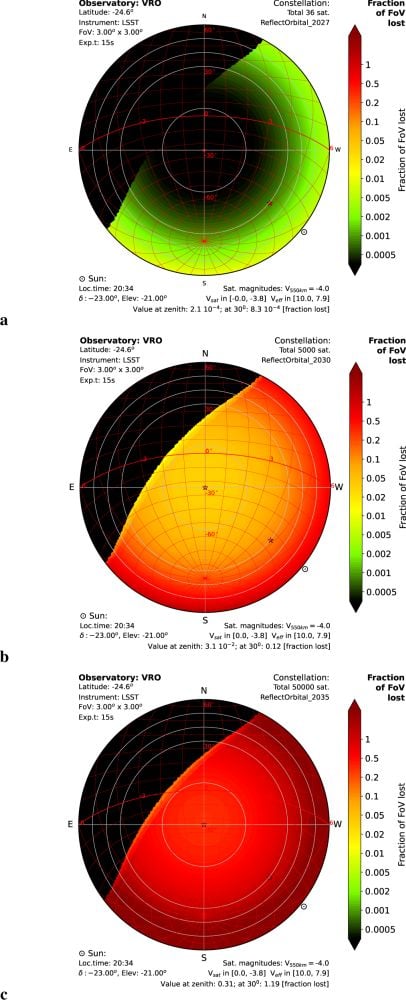 These panels show the fraction of exposures captured by the LSST that will be unusable because of Reflect Orbital's satellites. (a) is for 36 satellites in 2027, (b) is for 5,000 satellites in 2030, and (c) is for 50,000 satellites in 2035.
What does the ESO suggest?
"Even under this constraint, the total satellite population should remain below ∼100 000 satellites to ensure that field-of-view losses do not exceed typical technical downtime," they state.
Companies like SpaceX aren't blind to the problem. They're trying to make their satellites less reflective. But their impact on astronomy is just one outcome of the ongoing crowding of LEO. What about the proliferation of space junk? There are efforts to develop ways of mitigating the space junk problem, but they're way behind the massive number of satellites being launched. SpaceX says they have a plan, and the FCC approves it, but the plan is really just disposal by atmospheric re-entry.
Most people aren't too concerned with astronomical observations, except when one makes the news headlines. But some are concerned about reflecting sunlight down onto Earth at night as a business model. For astronomers, it could be catastrophic.
Far more people are concerned with AI intruding where they don't think it belongs. Do we really need AI in space?
Some are saying that Starmind will never be built, that it's part of the SpaceX/Elon Musk hype machine. But those are just some of the opinions out there, and they don't touch on regular citizens' concerns about the encroachment of AI and its infrastrcture into their lives.
Besides, SpaceX isn't the only company contemplating a satellite AI data processing system. Blue Origin is also considering an orbital data center satellite system. It's called Project Sunrise and would have 51,000 satellites.
We've been warned about the growing number of satellites for years now. In a 2021 paper, researchers warned us about the danger associated with "the adoption of a consumer electronic model applied to space assets." Consumer electronics are creating mountains of electronic waste that we're struggling to manage. The proliferation of satellites is adding to our pollution problem.
In the 2021 paper, the authors point out that "satellite re-entries from the Starlink mega-constellation alone could deposit more aluminum into Earth’s upper atmosphere than what is done through meteoroids; they could thus become the dominant source of high-altitude alumina." High-altitude alumina is bad because it may trigger chemical reactions that destroy ozone. And the alumina isn't destroyed itself, so it could drive multiple cycles of ozone destruction.
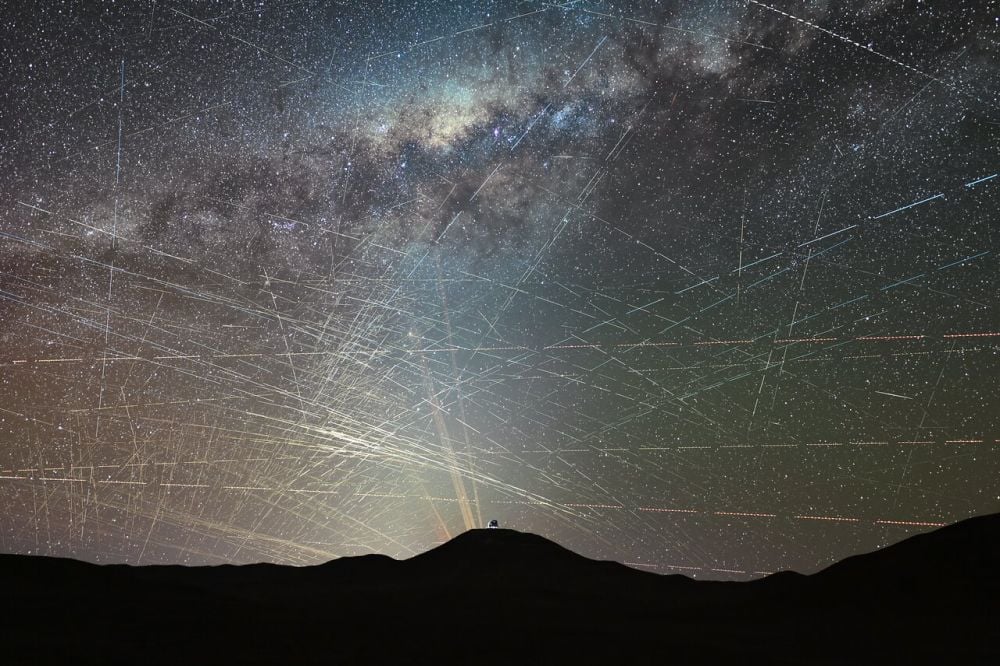
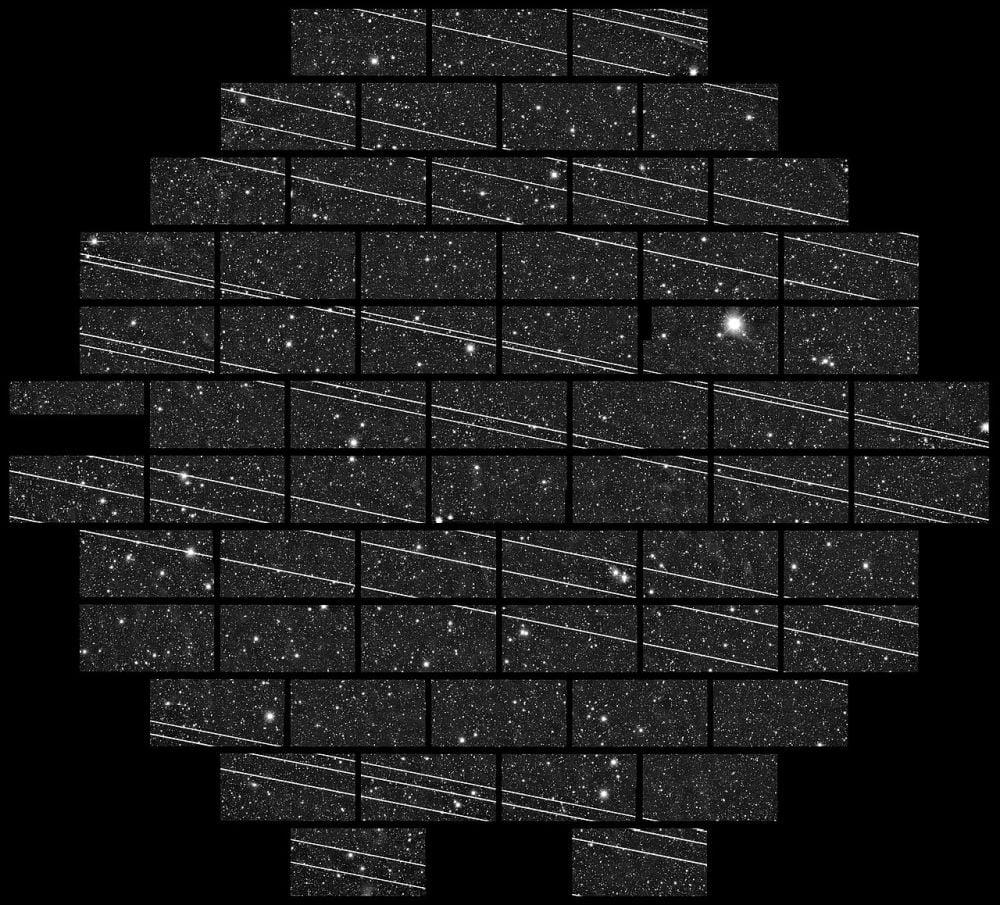 This image is a 333 second-exposure from the Blanco 4-meter telescope at the Cerro Tololo Inter-American Observatory. It shows at least 19 streaks created by the second batch of Starlink satellites launched in November 2019. Image Credit: NSF’s National Optical-Infrared Astronomy Research Laboratory/CTIO/AURA/DELVE, CC BY 4.0, via Wikimedia Commons
Crowding LEO with more satellites is fraught with problems. But our rapid and widespread adoption of AI in particular could be especially dangerous. AI data centers in space combine both problems into one. Implementing satellite AI systems may end up being a very bad decision, maybe humanity's last big, bad decision.
Who knows where this will go, and who knows if AI is going to destroy humanity. That type of thinking used to sound like an exaggerated science fiction nightmare, or an easily-dismissed, feverish thought experiment. But many AI experts say we're heading for trouble, we're moving too fast, and we're not building in safeguards. The people who build AI can't actually explain how it works. We all know about AI hallucinating and inventing facts, but AI has been caught scheming and deceiving, behaving one way outwardly while hiding its true intentions. That's truly alarming.
There's no denying that AI is a powerful tool. It's powering scientific discoveries and it's helping regular people every day. But that's just one side of it.
From a POTUSA who posted an AI video of himself wrestling a tiger—shortly after a real person was unfortunately killed by one—to armies of bots spreading political misinformation designed to undermine a nation's sovereignty, to financial scammers with a global reach, AI's presence is proving to be toxic. It ranges from mildly problematic to outright hostile. Bad actors are rapidly adopting this new, powerful tool, and using it to harmful effect.
It's amost impossible to deny that we're on the cusp of something historic. Humanity always struggles with new powerful tools because wisdom lags behind intelligence. It always has and it always will; the only way to acquire wisdom is through experience. Do we have enough wisdom to make careful decisions regarding AI?
At different times in history, angry mobs of citizens have been the only thing standing in the way of terrible ideas and actions. To place AI in space, beyond the reach of the angry mob and its pitchforks, may end up being a terrible mistake.