 Universe Today
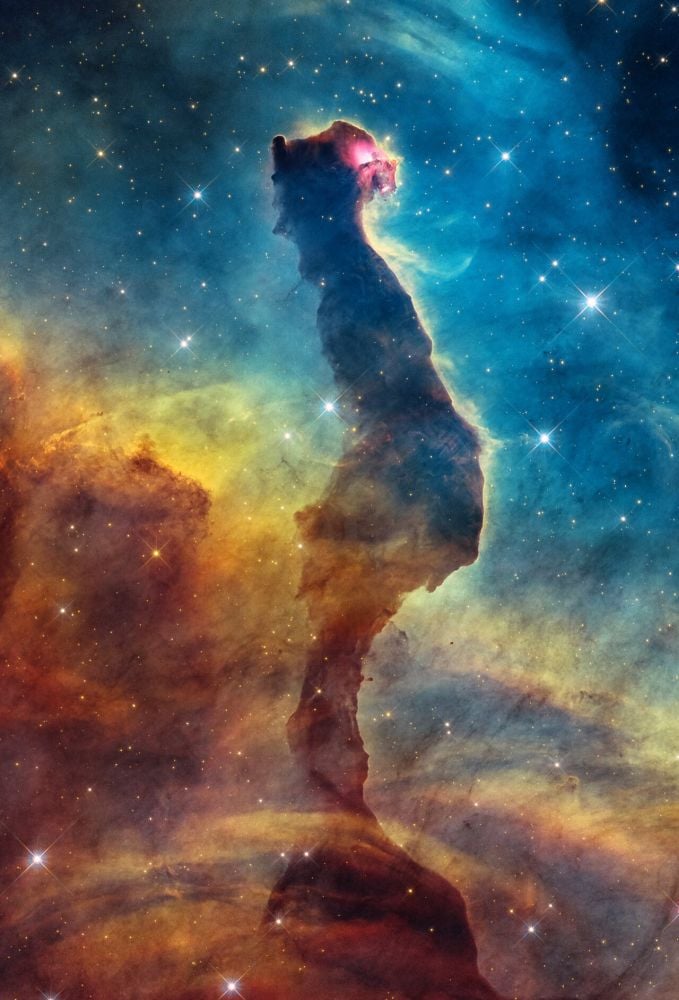
The Cat's Head nebula gets its name from its appearance: it looks like a cat sitting so that it's facing away from the viewer, with its head turned around on the top of its neck, highlighted by a star that looks like a glowing eye. The unusual shape is made of gas and dust carved and formed by the radiation of young stars.
It's a small part of the larger Carina Nebula, a complex star-forming region about 7,500 light years away. Recently, both the Hubble and the JWST cast their gaze on the Cat's Head in an effort to learn more about star formation, a constant research subject in astronomy.
The Carina Nebula hosts some of the most massive stars in the entire Milky Way in its Carina OB1 assocation. Of particular interest is Eta Carinae, a stellar system that hosts many stars, two of which have a combined luminosity more than 5 million times greater than the Sun. Eta Carinae is also known for being at the heart of the eerily creepy Homunculous Nebula, not visible in these images. Massive stars like the ones in Eta Carinae and their powerful radiation have a pronounced effect on the region, and on star formation itself.
Hubble's image of the Cat's Head is in visible light, while the JWST imaged it in both near and mid-infrared. Each of the images shows a different aspect of the Cat's Head.
The pillar that makes the Cat's Head is composed of thick, dark dust, so far resisting the onslaught of stellar wind and radiation from massive stars. The yellow outline on its right side is likely where photoevaporation is taking place, driven by the same powerful stars. The UV radiation is ionizing the gas on the rim, and will eventually evaporate it completely.
In astronomy images like these, different filters isolate different chemicals like sulphur, oxygen, and hydrogen. The ionization level of the chemicals, along with how highly they're energized and how much dust is present, all affect the colours. Whether we know which colours represent which chemicals or not, these images are awe-inspiring.
The massive stars in the region are also responsible for the arcs and shoals in the images, again caused by their powerful radiation and stellar winds.
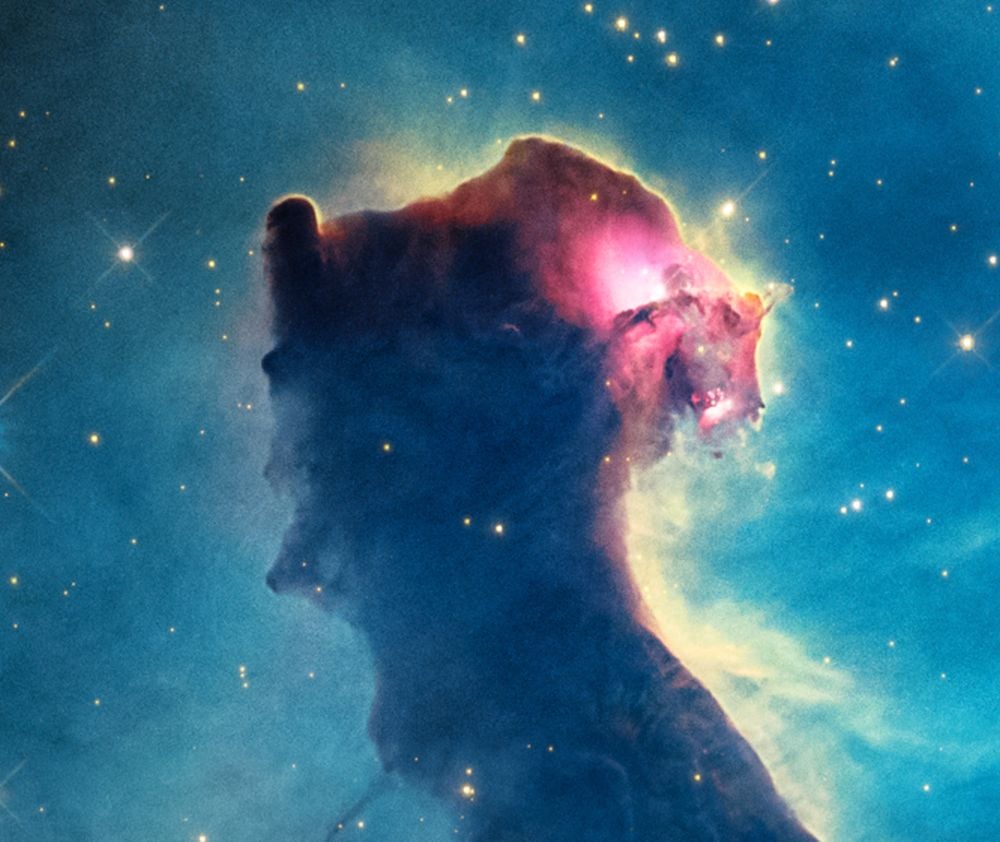 This zoomed-in portion of the Hubble's image highlights the "eyeball", likely a star in just the right position. Image Credit: NASA, ESA, STScI. Image Processing: J. Depasquale (STScI).
The JWST, as an infrared telescope, presents different, yet no less gorgeous, images of the Cat's Head. It's infrared instruments see things differently than the Hubble does. This gives the Cat's Head—already ethereal in the Hubble image—an even more ghostly, almost unreal appearance. Some parts of the Cat's Head in the JWST images appear to be only half-there, with background stars shining brightly through them.
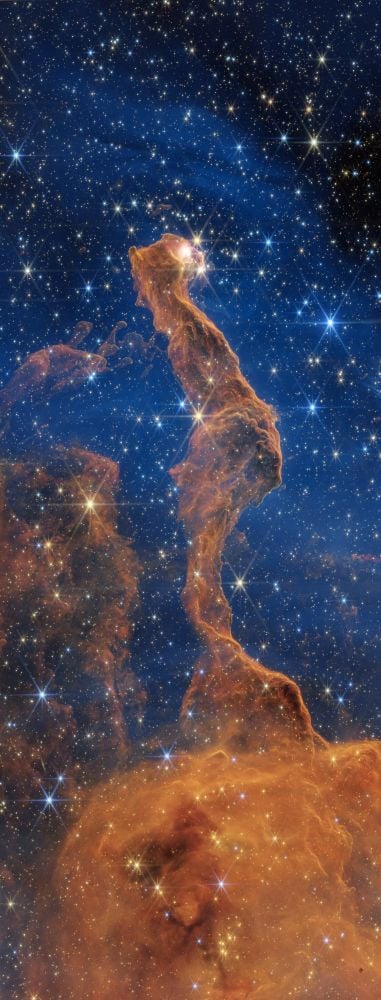 The JWST's near-infrared image doesn't show different chemical elements the same way the Hubble image does. Instead, it shows more of the stars themselves. Even background galaxies are visible beyond the Cat's Head, along with the black background of space. The JWST also shows how massive stars are shaping the region, with the wispy filaments on the images left side. Image Credit: NASA, ESA, CSA, STScI. Image Processing: J. Depasquale (STScI)
Some of the turbulence in the gas, driven by the massive stars, appears more substantial in the JWST image. The star that makes the Cat's Eye is also brighter, with less of its light blocked by dust in infrared.
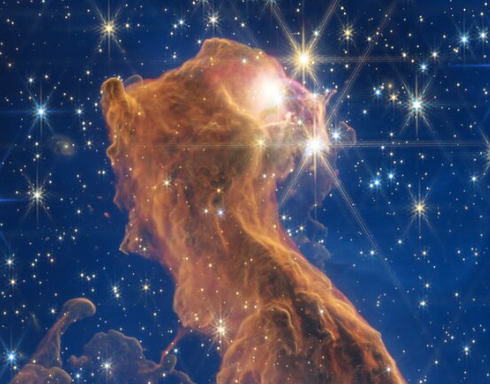 A zoomed-in JWST NIR image of the head in the Cat's Head Nebula. Image Credit: NASA, ESA, CSA, STScI. Image Processing: J. Depasquale (STScI)
In the JWST's mid-infrared image, the Cat's Head Nebula is transformed yet again. It's muted and ghost-sheet white, surrounded by pastel gas clouds punctuated with stars. The clouds look almost Earth-like in their white colour. This time, it's carbon molecules and warm dust emissions that take the stage. What is most likely an infant star pops into view in this image, embedded in thick dust that it's yet to dissipate, to the right of the head itself.
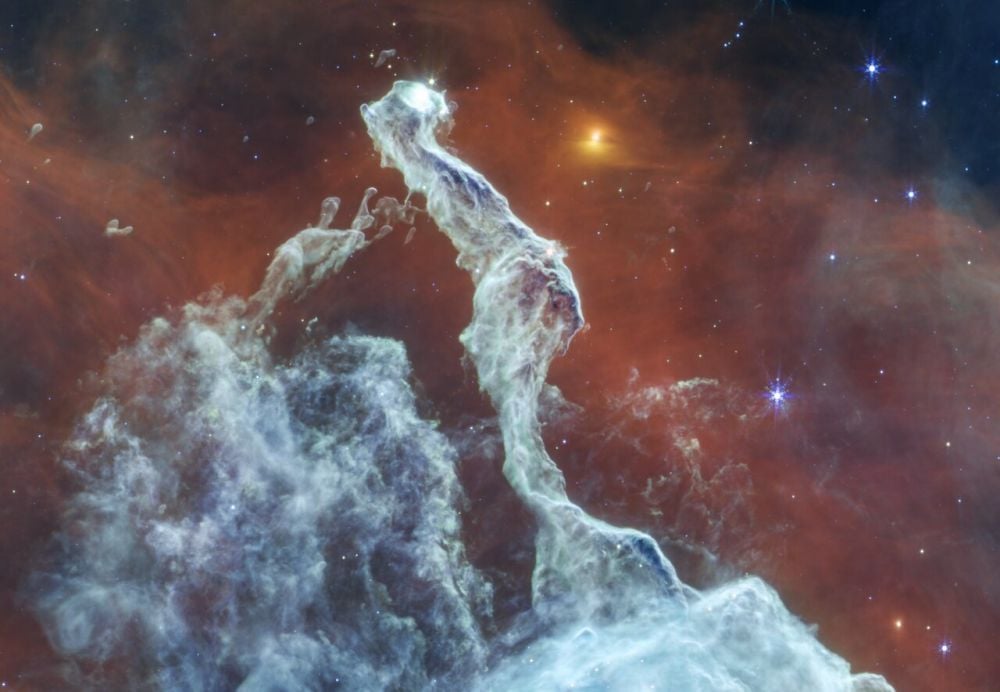 The white colour of the gas in this mid-infrared JWST image makes it look like Earthly clouds. Fewer stars are visible in the background, their light blocked out by the gas, which appears thicker. In the gas to the left, finer detail is visible in the gas clouds. Image Credit: NASA, ESA, CSA, STScI. Image Processing: J. Depasquale (STScI).
The head itself is muted in the MIR image, along with the rest of the nebula. It's eye, almost malevolent in the other images, blends in with the gas and is less striking.
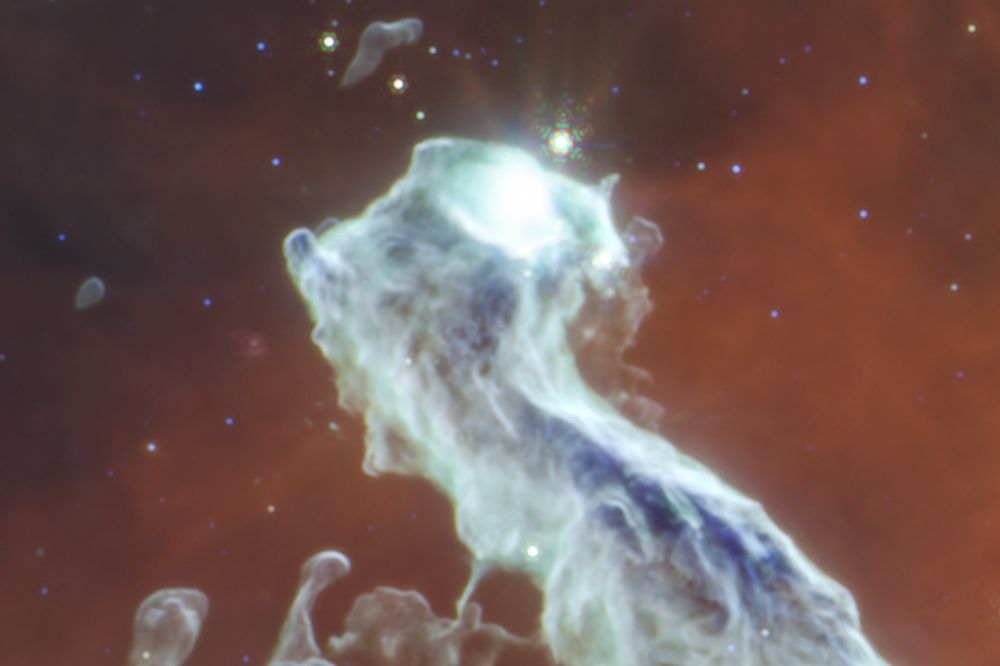 In this zoom-in of the MIR image, the edges are softened, and so are the colours. The star that makes they eye blends in with the gas in gradients of white. Globules below the head look like they're reaching for the head, rather than being blown back by stellar wind and radiation. The blackness of space is visible in the upper right, and a little in the upper left. Image Credit: NASA, ESA, CSA, STScI. Image Processing: J. Depasquale (STScI).
Though these images are easy to appreciate by almost anyone, their primary purpose is scientific. By emphasizing and de-emphasizing different aspects of the Cat's Head nebula, astronomers can see stars more clearly, along with the dust, the gas, and the chemistry. Together, they help researchers see the effects of stellar radiation and wind, called stellar feedback, on the ongoing process of star formation.
Stellar feedback can both encourage and stifle star formation, depending on circumstances. It's complicated, and it's an ongoing topic of astronomical study. One of the JWST's main, defining science themes is star formation, and images like these are one of the reasons it was built. The Hubble helps too, and illustrates how the gas, the dust, the metallicity, and the stars of different sizes and ages, all play a role. Those factors all interact in different ways, making it difficult to come up with concrete theories of how it all works.
These gorgeous images are more than eye candy to astronomers. They're working hard on understanding a process fundamental to the cosmos. Wrapped up in all this visual chaos and beauty, Nature's laws are defining how stars form. Astronomers' mission is to decipher it all.
Enjoying these images on their visual merit alone is our mission, if we accept it.

