 Universe Today
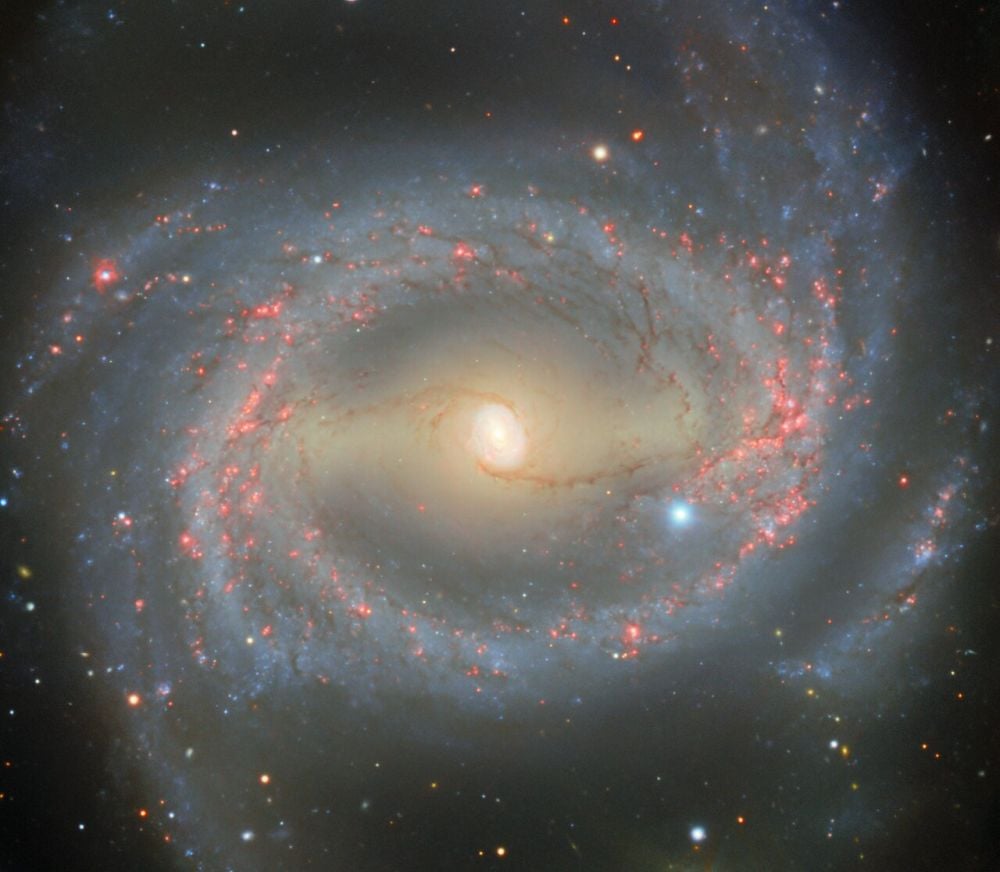
A new supernova has been spotted in NGC 1433, a spiral galaxy about 50 million light years away. That's pretty close for supernova observations, and it's an opportunity for detailed follow-up study. It's not a core-collapse supernova, where a massive star has burned through its fuel and collapses and explodes. It's a Type Ia supernova. That means it's happening in a binary star, where the exploding star is a white dwarf.
In type Ia supernova, a white dwarf, called the accretor star, draws material away from another star called the donor star. Material builds up on the surface of the white dwarf until it breaches the Chandrasekhar limit, about 1.44 solar masses. Then the white dwarf explodes and is obliterated. A type Ia supernova can also occur in a double white dwarf binary, where the two stars merge and explode.
This supernova is named SN 2026ahvu, where the suffix ahvu is a chronological identifier. It signifies that the supernova is the 41,855th transient discovered in 2026. But even though thousands of transients and supernovae have been found this year, this one is still particularly noteworthy for its relative proximity to Earth, and because it was detected early.
SN 2026ahvu was discovered on November 2nd by ATLAS, the Asteroid Terrestrial-impact Last Alert System. ATLAS is designed and optimized to detect incoming near-Earth Objects shortly before they reach Earth, but it can also detect other transients.
New transients are recorded on the Transient Name Server (TNS), a transient registry sanctioned by the International Astronomical Union (IAU). The TNS also hosts AstroNotes, where short notes are posted describing new transients when they're discovered.
The AstroNotes for SN 2026ahvu reads: "ATLAS operates with 4 x 0.5m telescopes in Hawaii (Haleakala and Mauna Loa), Chile (El Sauce) and South Africa (Sutherland), and a fifth unit in Tenerife, Canary Islands. We are robotically surveying the whole sky with a cadence of 1 day between -50 and +50 and 2 days in the polar regions, weather permitting. While carrying out the primary mission for Near-Earth Objects, we search for and publicly report stationary transients to the IAU Transient Name Server."
"We report a new transient source, most likely a supernova in the galaxy NGC 1433. We are submitting AstroNotes for transients that are either within 100 Mpc, or have some other interesting feature to bring to the community's attention, such as bright nuclear transients, slowly rising or rapidly fading objects."
In this case, the SN's brightness is rising, and that's important for observations. It gives astrophysicists an opportunity to observe the supernova from an earlier point in its evolution. When it was first discovered, its apparent magnitude was 17. A few days later, it was at 13.5. (Lower apparent magnitude means the object is brighter.)
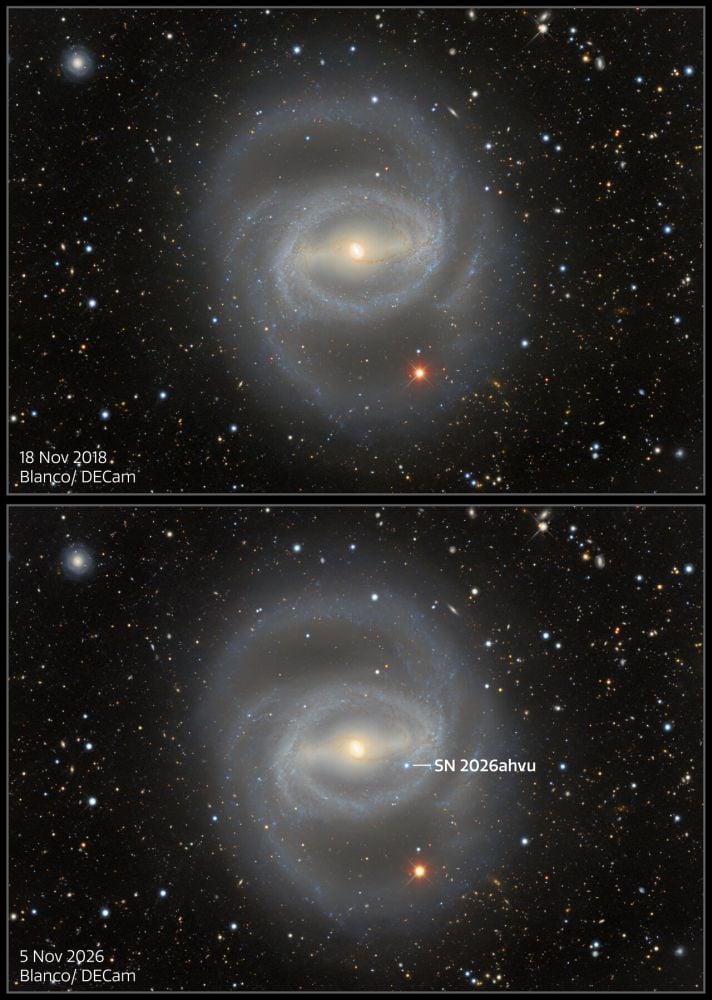 The Dark Energy Camera on the Víctor M. Blanco 4-meter Telescope captured these images of NGC 1433 before and after SN 2026ahvu exploded. The before images are from the Dark Energy Survey, DECam's primary job. The after image was taken after ATLAS detected the supernova and alerted other astronomers. The orange star below and to the right is a foreground Milky Way star. Image Credit: Dark Energy Survey/DOE/FNAL/DECam/CTIO/NOIRLab/NSF/AURA. http://creativecommons.org/licenses/by/4.0/. Acknowledgment: PIs: G. Narayan & T. Murphey (University of Illinois at Urbana-Champaign) Image processing: M. Zamani & D. de Martin (NSF NOIRLab)
When supernovae are detected, astronomers are alerted and other telescopes watch closely. In this case, there are new images of SN 2026ahvu from the Dark Energy Camera (DECam) and the Gemini South telescope.
Type Ia supernovae are typically brightest for about 6 months, but their brightness inevitably drops over time. Their peak brightness lasts several days and is powered by the decay of an unstable nickel isotope, Nickel-56 (56Ni.) Then the decay of ⁵⁶Co → ⁵⁶Fe creates a weaker tail of light.
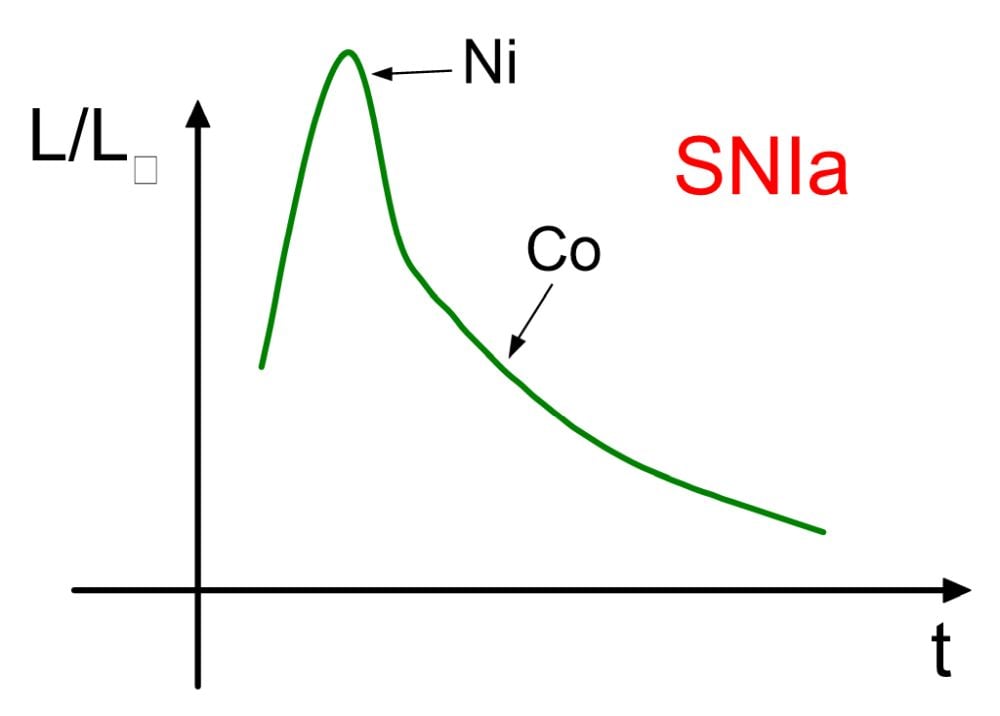 This simple schematic shows the typical light curve for a Type Ia supernova, relative to the Sun. The peak is primarily due to the decay of nickel-56 (56Ni), while the later stage is powered by 56-Cobalt to 56-Iron, which is stable. Image Credit: By Xenoforme~commonswiki (attribution as on the source page); SVG reconstruction: PJ Geest. - This file was derived from: SNIacurva.png, CC BY-SA 3.0, https://commons.wikimedia.org/wiki/Special:Redirect/page/201323073
About 2 or 3 months after the initial explosion, the ejecta will have thinned out and expanded enough to form a nebula. At that point, when astronomers look at the spectra, they're seeing the composition of the entire exploded star, not just its core. It's a fairly well-understood progression, but there's always room for more observations and more refinement.
Type Ia supernovae are important because they serve as standard candles in the cosmic distance ladder. It's the system astronomers use to find distances to celestial objects that are way too distant for more direct measurements like parallax. So the more opportunities they have to study Type Ia supernovae, the more accurate the cosmic distance ladder is.
Beyond their scientific importance, supernova remnants are among the most visually stunning objects that exist.
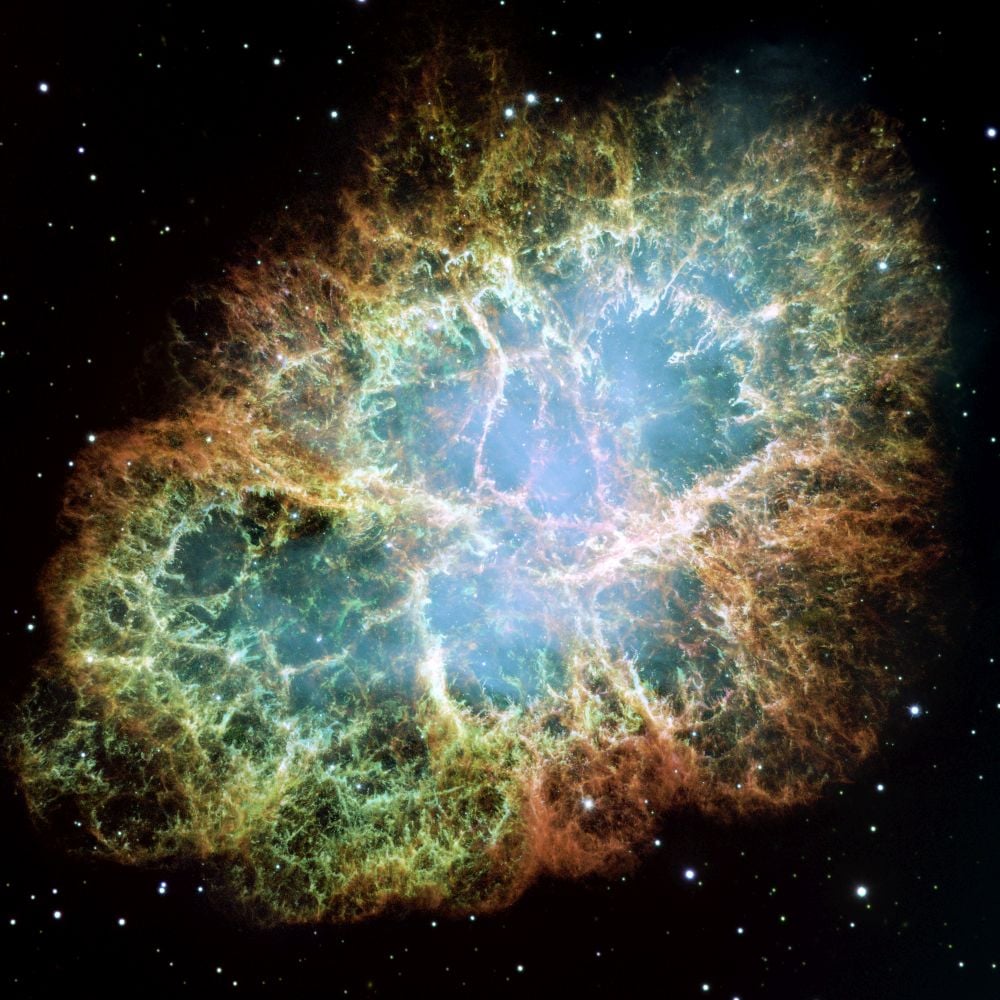 This is the Crab Nebula, probably the most well-known supernova remnant. The Hubble captured this image of the nebula, showing it less than 1,000 years after its progenitor exploded. So it's possible that our descendants will see something similar when they observe SN 2026ahvu reads a millennium from now. Image Credit: By NASA, ESA, J. Hester and A. Loll (Arizona State University) - A Giant Hubble Mosaic of the Crab Nebula, Public Domain, https://commons.wikimedia.org/wiki/Special:Redirect/page/516106
More images and observations, included detailed study of how the explosion's light changes over time, will follow. The supernova is also within reach of astrophotographers, so there could be some fantastic images arriving soon.