 Universe Today
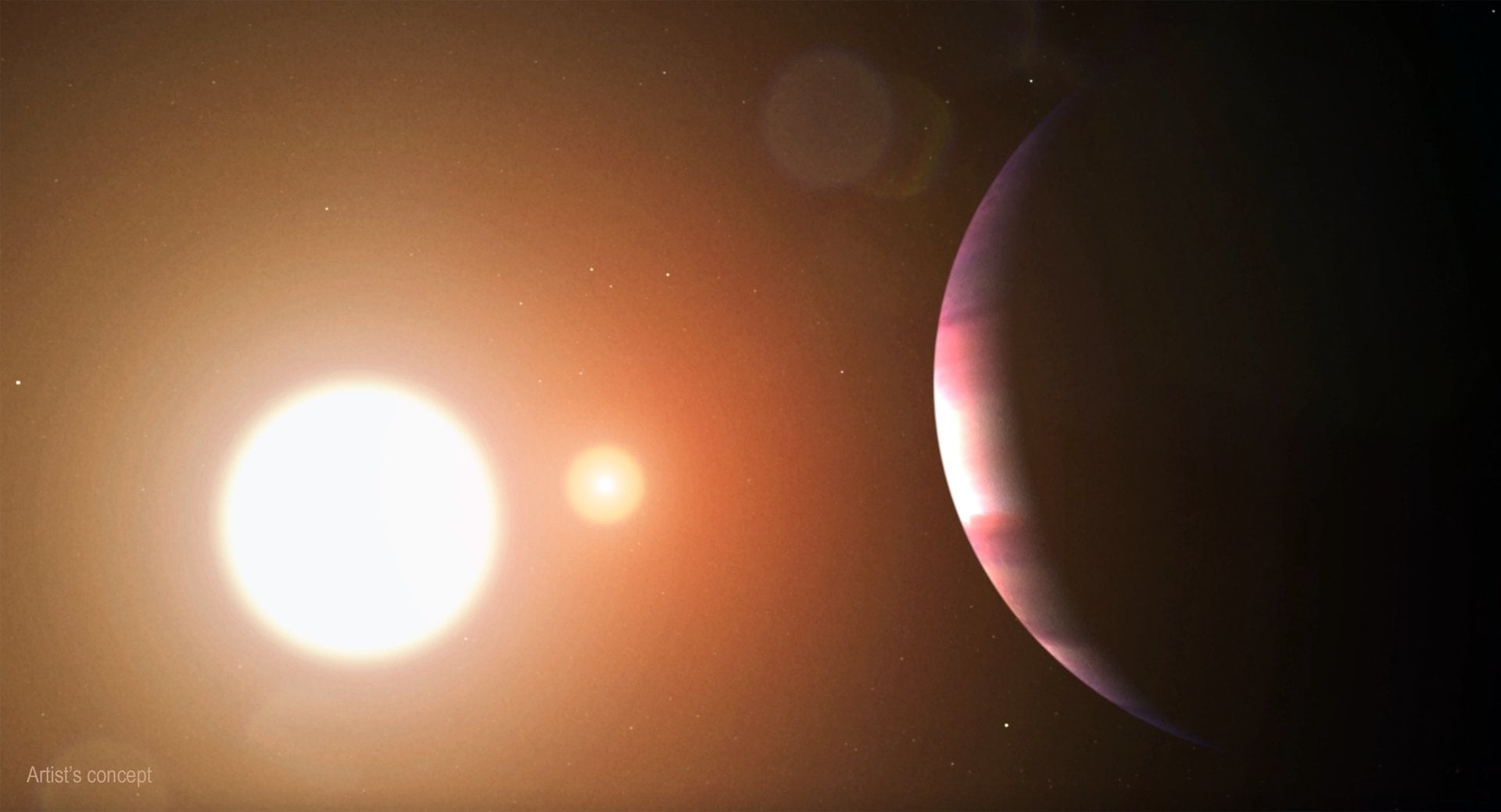
Our Sun is a loner. It lacks a stellar companion hurtling through interstellar space with it. But we’ve known for a long time that’s actually relatively rare - most stars have at least one gravitationally bound partner. Understanding how exactly those stars are related to each other is critical for observational campaigns - especially for those of exoplanets. So a new paper from researchers at the University of Madrid that categorizes almost every star within ten light years into companion categories is a welcome addition to the literature on the subject, and could be used to inform the next round of planet habitable planet hunting satellites.
The study looks at stars out to 10 parsecs (32.6 light years) away from the Sun. Why 10 parsecs? The farther out a star is, the harder it is to resolve whether or not it has a companion. Strictly limiting the distance to a reasonable way helps ensure the “completeness” of the survey, and lowers the probability that another starry companion was waiting in the wings.
Creating the survey involved creating a massive data set that combined the DR3 data release from the European Space Agency’s Gaia telescope and the Washington Double Star Catalogue, which holds decades of radial-velocity measurements. The final survey included 424 known stellar and sub-stellar objects in the 10-parsec bubble. Of those, 215 of them were bound up in 92 multiple star systems.
Fraser discusses the concept of multi-star systems.Of those 92 multiple star systems, 68 were doubles, with only a pair of stars, 19 were triples, 3 were quadruples, and 2 were rare and extremely complex quintuple star systems. But that wasn’t the only interesting thing that came out of the study - it found a striking relationship between mass and “relationship status”. If a star is more than half the mass of our Sun, it has a striking 41% chance of being paired up to at least one companion.
However, smaller stars don’t have the same pairing rituals. For the lowest-mass objects, such as red and brown dwarfs that weigh under 0.1 solar masses, the fraction in a multi-star system drops to 9%. In other words, the cosmic heavyweights seem to want to travel in packs, while the lightweights prefer to avoid entanglements.
Another interesting feature of the paper was the orbital period of some of these multi-star systems. Some tightly bound pairs orbit each other in a matter of days, while other widely separated stars take on the order of tens of millions of years to orbit each other. In the extremely far case, it might seem like the stars aren’t gravitationally bound at all, but the researchers painstakingly calculated the binding energies of the widely separated pairs, and confirmed they are, indeed, gravitationally bound to each other.
Fraser discusses the line between planet and star - it’s not as clear-cut as you may think.So why does that matter in the long run? The quick answer is it helps us understand the dynamics of star formation. But in doing so, it also helps us search for potentially habitable exoplanets. Companion stars are a massive nuisance when hunting for habitable planets. The gravitational tug of war they inflict on the host star can warp the readings for radial velocity research, one of the most common ways of finding exoplanets.
It only gets worse when the next generation of planet-hunting telescopes arrives on the scene. NASA’s Habitable Worlds Observatory (HWO) and ESA’s Larger Interferometer For Exoplanets (LIFE) are designed to directly image an Earth analogue. But if they sit for weeks staring at a particularly promising candidate, only to have their data ruined by the background of light noise from a previously unknown companion star, we will have wasted some of the most valuable scientific time on (or more accurately off) the planet.
The ultimate outcome of this new paper, then, is a vetted target list for these observatories. And it serves as a capstone of a series of three research papers the authors had been working on, which included a less detailed look at multi-star systems within 100 parsecs and a map of the boundaries between the widest known binaries. As we move on to understanding our local neighbor better, detailed work such as this will provide the underpinnings of our search for an alternative Earth nearby - then maybe we won’t feel so alone drifting through space, even if our Sun still is.
Learn More:
J. González-Payo et al. - Characterisation of all known multiple stellar systems within 10 pc
UT - This is How You Get Multiple Star Systems

