Universe Today
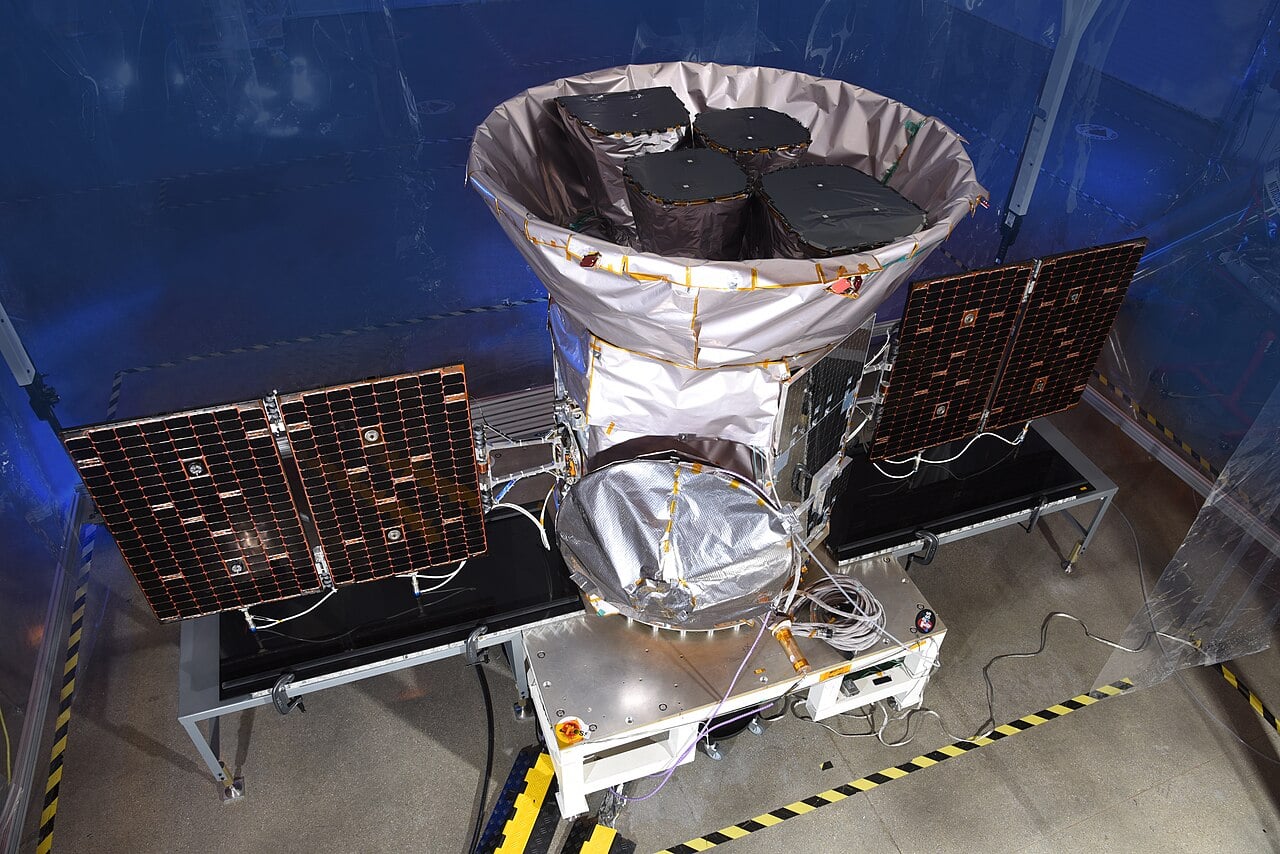
Most stars in the night sky are not alone. Despite appearances, the majority have companions locked in gravitational embrace, orbiting each other across the vast timescales of stellar life. Our own Sun is the exception rather than the rule. But even among multiple star systems, what a team of astronomers from NASA and Harvard have just described is genuinely unusual; three stars, arranged in a configuration so precisely aligned that it produces one of the most distinctive eclipse patterns ever recorded, and heading toward a gravitational reckoning that will reshape the system entirely.
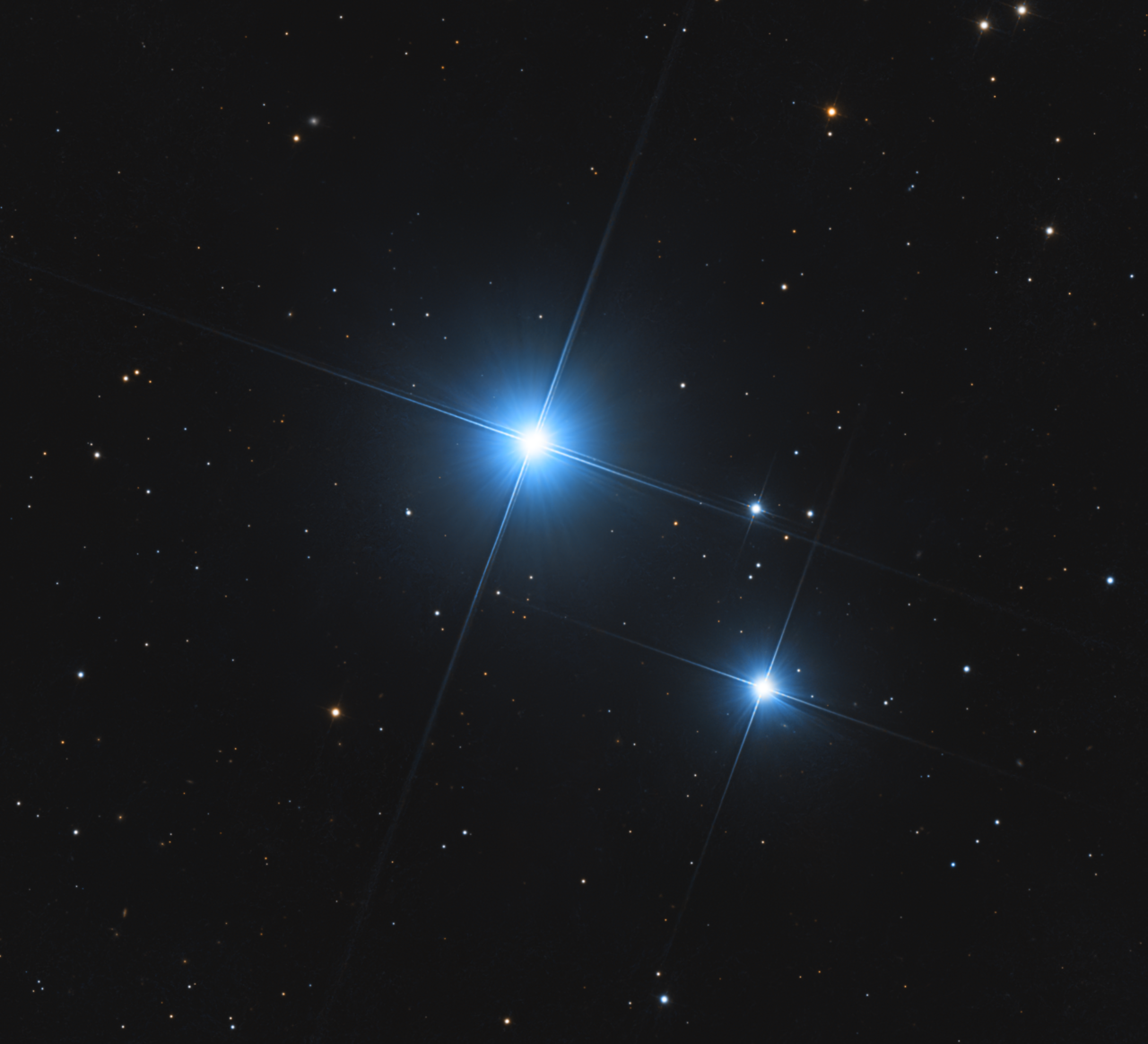 Many stars like Alcor and Mizar are part of binary or multiple star systems (Credit : Chuck Ayoub)
The system is known as TIC 295741342 and was discovered in data from NASA's TESS satellite. At its heart is an eclipsing binary, two stars, similar in mass to our Sun, orbiting each other every 4.75 days. Wrapped around them, in an orbit taking 412 days to complete, is a third star, a giant, its radius ten times that of the Sun, swollen and cooling as it burns through the later stages of its life. And here is what makes this system remarkable. All three are aligned in almost exactly the same plane, tilted by less than a third of a degree from perfect flatness. In the entire known catalogue of triple star systems, none has been found so precisely coplanar.
The result of that alignment, visible in the TESS data, is a light curve unlike almost anything else. As the inner binary completes its orbit and passes behind the giant outer star, it produces what the researchers describe as a “head and shoulders" eclipse, a distinctive double dip shape in the brightness record as first one inner star disappears behind the giant, then both vanish together at the deepest point, then one re-emerges. The shape alone is enough to tell astronomers exactly how much light each star is contributing to the system. The giant dominates at roughly 95% of the total brightness. Each of the inner pair contributes a mere 2 to 3%.
To build a complete picture of the system the team combined four years of spectroscopic observations, 48 separate measurements of the stars' velocities as they move with the TESS light curves and additional data across multiple wavelengths. Running the full analysis on a NASA supercomputer for roughly two days, the model converged on a solution that fits all the observations simultaneously. The only complication is that there are two equally good solutions, differing only in the evolutionary state of the giant outer star. In one, it is still ascending the red giant branch and swelling for the first time. In the other, it has already burned through that phase and is now on the horizontal branch, temporarily stable before the next expansion begins.
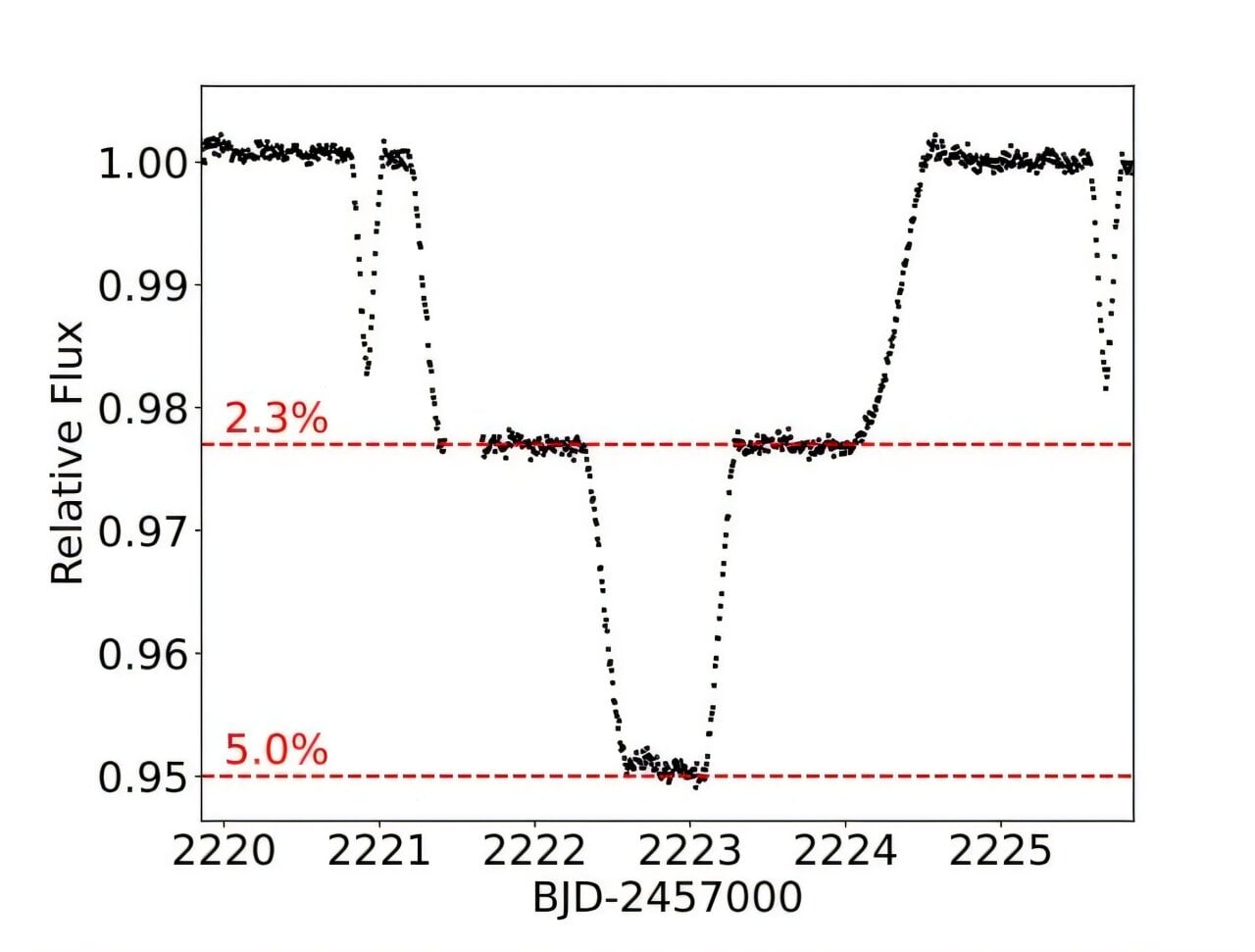 TIC 295741342 outer body eclipse. The TESS flux is shown in black points, with horizontal dashed red lines indicating the depths of the 'shoulders' and 'head' of the outer body eclipse, which substantially constrains the relative fluxes of the stars in the system in the TESS band (Credit: Powell et al)
Either way, the story ends the same. In somewhere between 54 and 129 million years from now, the giant will swell large enough to overflow what astronomers call its Roche lobe, the invisible gravitational boundary beyond which material no longer belongs to one star but gets pulled toward its neighbours. When that happens, mass will begin streaming from the giant toward the inner binary. Whether that transfer is stable and orderly, or catastrophic and violent, depends on conditions the team are currently unable to determine. The outcome could be anything from a gentle mass exchange to ejections, mergers, or a dramatic common envelope event in which the stars spiral toward each other inside a shared cocoon of gas.
The next chance to learn more comes on 1 September 2026, when the inner binary passes behind the giant again. The team is calling for observations within a three day window around that date. A new measurement of that eclipse shape would dramatically sharpen the model, narrow the uncertainty between the two solutions, and allow accurate predictions of the system's future for years to come.
Source : TIC 295741342: A Triply-Eclipsing Triple Star System with a Giant Tertiary