 Universe Today

The UK is actively trying to support the infrastructure to make it a significant player in the coming age of the space economy. It recently received 560 proposals to it’s National Space Innovation Program, and handed out £17M in grants to 17 different organizations following five main themes. One of those is an effort by the University of Leicester and The Welding Institute (TWI) to develop a robotic welder for use in repairing and manufacturing in space, as described by a new press release from the university.
Their project, known as the Intelligence SPace Arc-welding Robotic Kit (ISPARK) received £485,000 of grant money and another £75,000 in other funding to develop its novel robotic welding arm. According to the press release, this project directly aligns with the UK’s National Space Strategy - specifically in the In-Space Servicing, Assembly, and Manufacturing arena.
But there’s a reason space welding is still in the “research” stage and needs to be supported by government grants - it’s hard. Previous attempts have used Electron Beam or Laser welding, which work better in a vacuum because they aren’t reliant on a gas to transfer energy like arc welding does.
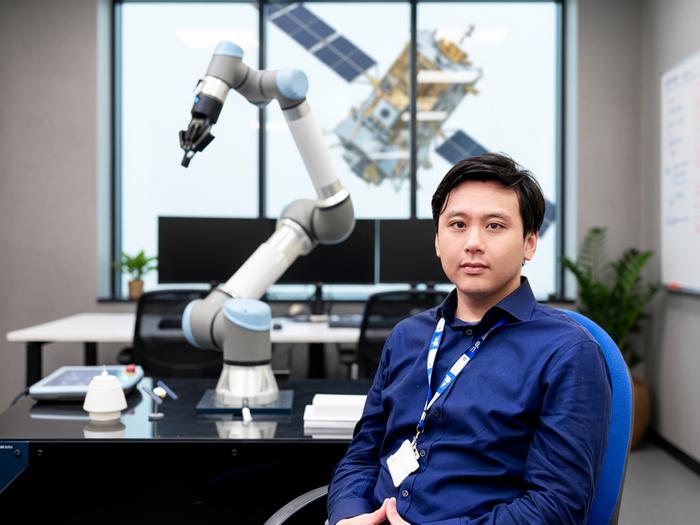 Dr. Daniel Ho, the Principal Investigator on ISPARK and a professor at the University of Leicester. Credit - University of Leicester
In 1969, during the Soyuz 6 mission, Soviet cosmonauts Valery Kubasov and Georgy Shonin used the “Vulkan” welding system, which included electron-beam, low-pressure plasma arc, and consumable electrode welding. They also managed to almost depressurize their entire capsule by accidentally cutting through a table and part of the inner hull of their spacecraft during the process. That would have been a pretty major set-back to the development of space welding.
Even with that near-failure, another attempt was made in 1984 when Svetlana Savitskaya became the first person to weld in open space, during the first ever space walk for a woman. She used a handheld electron beam welder called URI, and luckily didn’t cut through anything valuable, though operating the tool in a space suit proved how difficult it is for humans to operate these kinds of tools in bulky suits.
Electron beam welding is also less than ideal, as it requires extreme precision and requires a “cleaner” joint (i.e. one where the pieces fit together nicely) than traditional plasma welding. However, since plasma welding requires a gas to create the plasma arc it needs, it’s so far been impossible to do in the vacuum of space.
Enter ISPARK. It plans to use TWI’s welding expertise to de-risk some of the challenges facing plasma arc welding in a vacuum, while utilizing the University of Leicester’s robotics expertise (and their £100M space innovation hub) to develop a robotic system that doesn’t require humans floating in bulky space suits to weld.
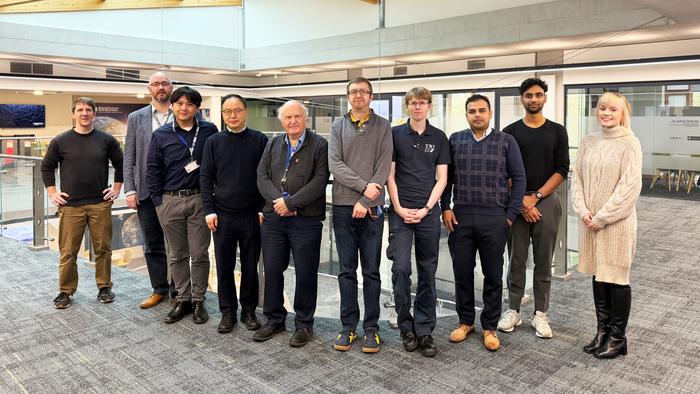 Members of the ISPARK team. Credit - University of Leicester
Their first step will be to develop a “digital twin” model of how the welds are expected to react in space. They’ll follow this up with trials in vacuum chambers here on Earth before eventually launching a system into space to fully validate it.
That’s a long way off though, and the UK Space Agency funding is only a first step in a multi-year (or potentially even decade) process. If the history of welding in space is any indication, it could be a very long time before we see consistent welding for manufacturing or repair in orbit. But the UK government’s support of this necessary piece of space economy infrastructure positions it well to be ready when the time (and technology) comes.
Learn More:
University of Leicester / EurekaAlert - New funding to develop technology for first robots to weld in space
UT - Space Shipyards Could Build Missions in Orbit
NASA - NASA to Transform In-Space Manufacturing with Laser Beam Welding Collaboration
UT - A Space Walking Robot Could Build a Giant Telescope in Space

