Universe Today
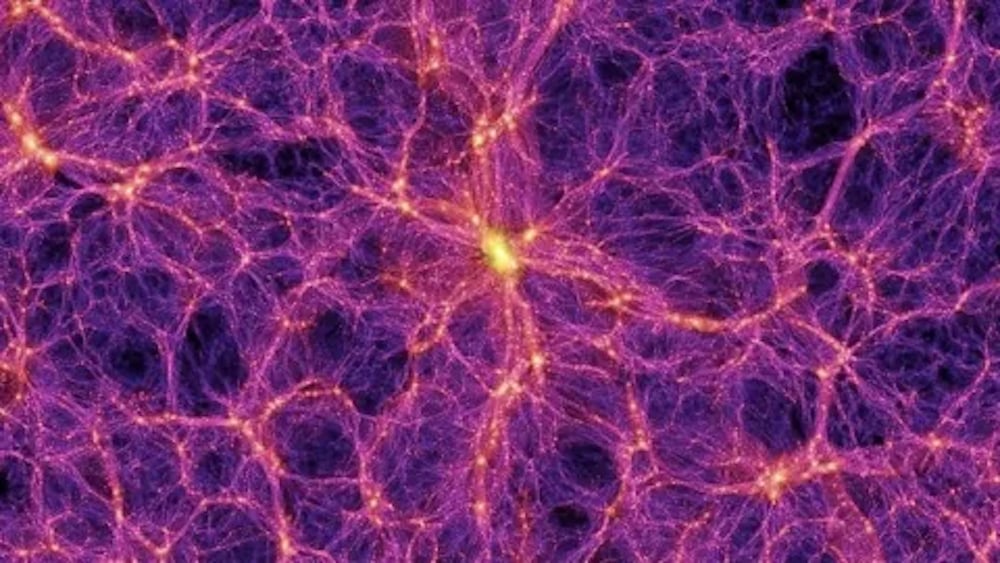
Cosmic filaments are the largest known structures in the universe, vast thread like formations of galaxies and dark matter that form a scaffolding upon which all smaller structures hang. These immense channels propel matter across hundreds of millions of light years, feeding gas into galaxies and shaping their evolution. Now, astronomers have caught one of these giant structures spinning.
 Computer simulation showing galaxy filaments, walls and voids form web-like structures (Credit :Andrew Pontzen)
An international team led by the University of Oxford discovered 14 hydrogen rich galaxies arranged in an impossibly thin line, just 5.5 million light years long but only 117,000 light years wide. This thin string of galaxies sits embedded within a much larger cosmic filament stretching roughly 50 million light years and containing over 280 galaxies. What makes this structure remarkable isn't just its size but its motion. The galaxies aren't randomly oriented. Instead, many are spinning in the same direction as the filament itself, and detailed analysis reveals something even more striking that the entire structure is rotating.
The evidence comes from examining how galaxies on either side of the filament's central spine move in opposite directions, the telltale signature of rotation. Using models of filament dynamics, researchers calculated a rotation velocity of 110 kilometres per second and estimated the radius of the filament's dense core at approximately 163,000 light years.
"You can liken it to the teacups ride at a theme park. Each galaxy is like a spinning teacup, but the whole platform, the cosmic filament, is rotating too.” Co-lead author Dr. Lyla Jung from Oxford's Department of Physics
This dual motion, individual galaxies spinning while the entire structure rotates, provides rare insight into how galaxies acquire their angular momentum. Current theories suggest that galaxies gain their spin from interactions with surrounding structures, but this discovery shows that large scale rotation can influence galaxy spins more strongly and for far longer than models predicted.
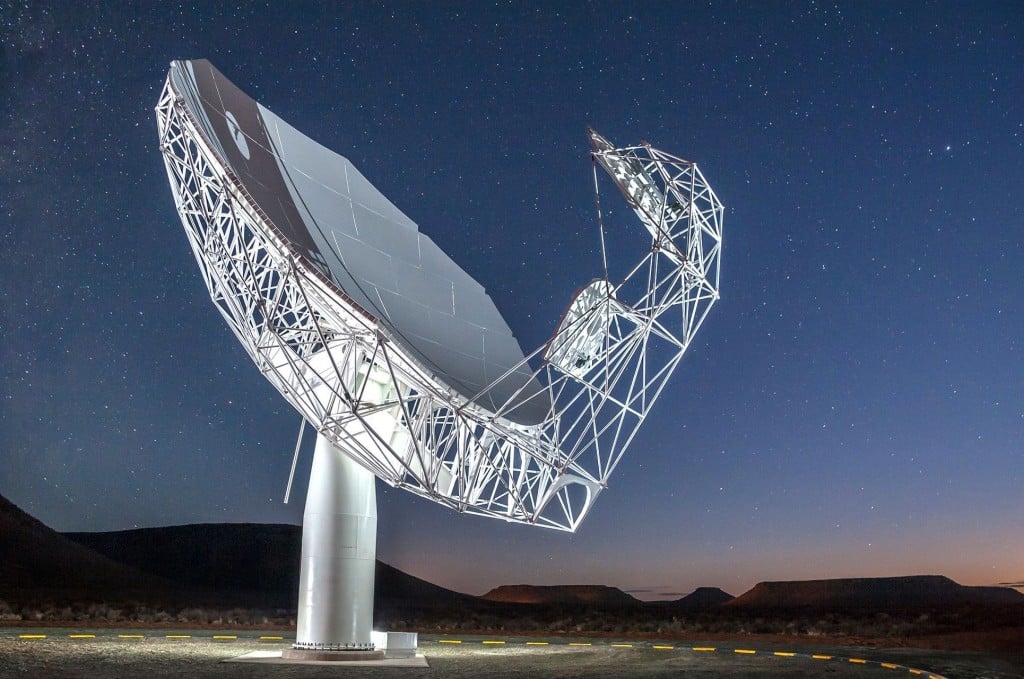 Artist impression of the South African MeerKAT Radio Telescope (Credit : Morganoshell)
The filament appears to be caught in an early stage of evolution. Its abundance of gas rich galaxies and low internal motion, a state astronomers call "dynamically cold," suggest it remains relatively undisturbed since formation. These hydrogen rich galaxies are particularly valuable for understanding gas flow along cosmic filaments. Atomic hydrogen, the raw fuel for star formation, is easily disturbed by motion, making it an excellent tracer of how material funnels through these routes into galaxies.
The discovery came from combining data from South Africa's MeerKAT radio telescope with optical observations from surveys mapping the Cosmic Web. This multi-wavelength approach revealed both the coherent spin alignment of galaxies and the bulk rotation of the structure itself, demonstrating how different telescopes working together can unveil phenomena invisible to any single instrument.
Source : Astronomers spot one of the largest spinning structures ever found in the Universe