 Universe Today
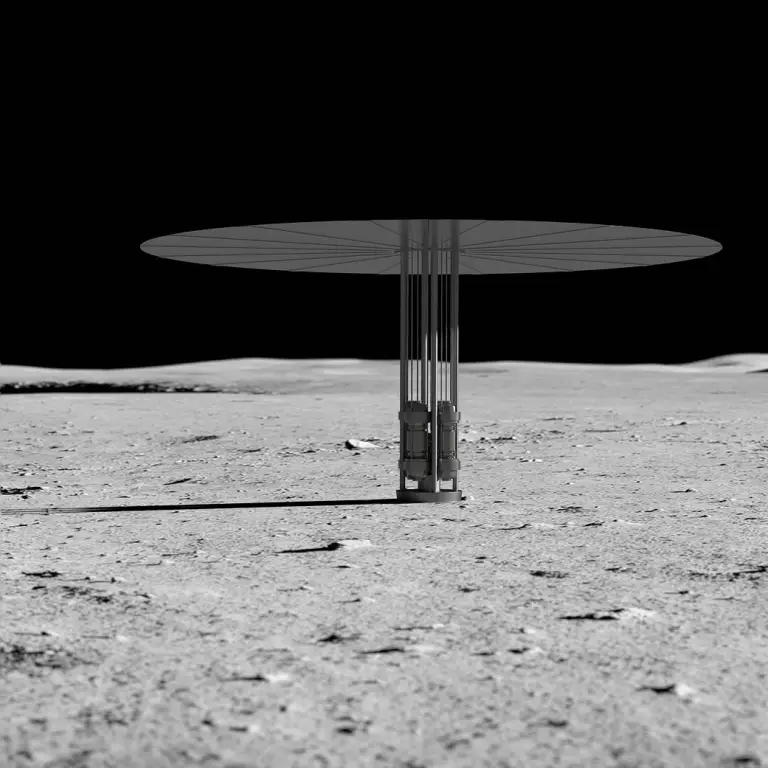
The US’s federally funded space program has been struggling of late. With the recent cancellation of the Mars Sample Return mission, and mass layoffs / resignations taking place at NASA, the general sense of a lack of morale at the agency is palpable, even from a distance. Jared Isaacman, the billionaire software entrepreneur and rocket enthusiast who was recently confirmed as NASA administrator during his second confirmation hearing, hopes to change that, and one of his priorities is pushing the Artemis missions for a permanent human presence on the Moon. However, at least one big technical hurdle remains before being able to do so - how to power a base during the two week long lunar night. A recent press release describes how NASA, and another branch of the federal government (the Department of Energy - DoE) hope to solve that problem - with a lunar-ready nuclear fission reactor.
The press release talks about a Memorandum of Understanding (MoU) to develop and deploy a fission reactor on the Moon by 2030. Typically, MoUs are completed between companies to clarify joint projects they are working on, so why exactly two different branches of the same overarching organization (the US Federal government) would need one is anyone’s guess. However, if nothing else, the MoU itself helps crystallize the goal of several rounds of research into this project.
The need is simple enough to understand. The Moon’s day lasts around a month, which means about half of that is spent in the lunar “night”. During that time frame, which can be estimated at about 14 days, there is no solar energy to speak of on the lunar surface. Nor is there any wind, nor fossil or biofuels of any kind to support the energy needs of a base in space. Attempting to store enough solar energy to support a base over that period in battery banks would be prohibitively expensive in terms of the weight required to ship to the Moon.
Fraser discusses the idea of nuclear reactors on the Moon.So, realistically, the only technical solution to this problem currently is a nuclear reactor. A fusion reactor is still some years away from implementation on Earth, and powering a base using exploding fusion warheads probably wouldn’t go over well with the taxpayers that would have to fund that project. That leaves two options - a radioisotope thermal generator (RTG) or a fission reactor.
RTGs have been the workhorses of rovers and other space-based platforms for decades. They use the energy emitted by isotopes decay to power their systems. Since they’ve been around for so long, they are safe, compact, and well-understood. However, while their power output is enough to power a rover or a satellite, scaling them up to the point where they could provide power to an entire base makes them relatively uncompetitive.
Which leaves fission as really the only option NASA and the DoE have to support their lunar base dreams. Luckily, they’ve known that for awhile, and have been supporting research on the topic for decades. More recently, NASA and the DoE rewarded three $5 million contracts to teams from industry led by Lockheed Martin, Westinghouse, and IX - a joint venture between Intuitive Machines and X-energy, which probably had its own MoU to define the responsibilities of each company.
Neil deGrasse Tyson explains why we need fission reactors on the lunar surface. Credit - StarTalk YouTube ChannelThe design goals of this project were to create a fission reactor that would fit inside a 12-foot diameter launch container and produce 40 kilowatts of power for at least ten years. That amount of power would be enough to run several small households - or hopefully an early lunar base. While the details of the commercial efforts this grant supported are private, the government appeared happy enough with the concepts to move forward with their official design and development, which is likely part of the intention with the MoU announced this week.
None of this is happening in a vacuum, though. Mr. Isaacman directly mentioned the Trump administration’s policy of American space superiority in the press release accompanying the MoU. That superiority is targeted directly at Russia and China, who have their own understanding to build a cooperative base on the Moon, including a potential nuclear reactor, by 2035. The ambitious timeline of 2030 for a reactor in the NASA plan, which is only four years from now to develop an entirely new nuclear reactor concept, is undoubtedly meant to undercut the Russian/Chinese efforts and prove that America is once again in the lead in the “new” space race.
Whether the agency, which has seen so many challenges lately, will be able to pull off that impressive release timeline remains to be seen. Mr. Isaacman is, after all, an entrepreneur, and has at least partially adopted the “move fast and break things” ideology that defines much of the New Space movement. But only one of the three concepts is being developed by companies that share in that mentality. Both companies involved in IX are relative newcomers to the governmental contracting field, whereas Lockheed Martin and Westinghouse have both been around for decades, and their staid approach to technology development is part of the reason New Space has adopted that mentality in the first place.
If they do manage to put a functional fission reactor on the Moon in four years, that will be an impressive feat. But anyone holding their breath for such an achievement is likely to be disappointed. There will eventually be a fission reactor on the Moon, but whether the US and its companies will be the first ones to do it, remains to be seen.
Learn More:
NASA - NASA, Department of Energy to Develop Lunar Surface Reactor by 2030
UT - NASA is One Step Closer to Deploying Fission Reactors on the Moon
UT - NASA is Building a Nuclear Reactor to Power Lunar and Martian Exploration!
UT - A New Fuel for Nuclear Power Systems Could Enable Missions to Mars and Beyond

