 Universe Today
When the new WEAVE spectrograph began science operations on the 4.2 meter William Herschel Telescope (WHT) in 2023, astronomers looked forward to its first five years. During this time, the telescope will be working on eight new simultaneous surveys of the sky. Before it could begin this work, the instrument went through a science verification phase. This important step demonstrates the instrument's capabilities and allows operators to refine its operations.
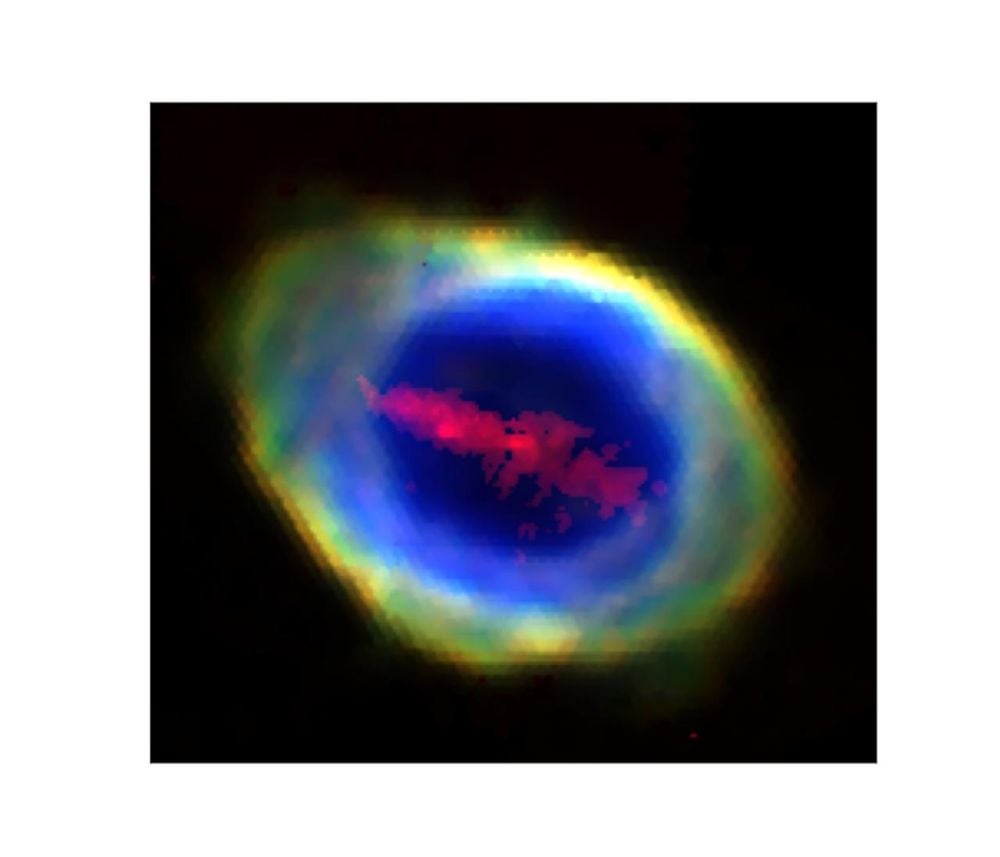
But WEAVE's (WHT Enhanced Area Velocity Explorer) science verification phase has delivered some convincing initial observations and scientific results. The instrument, which features a Large Integral Field Unit (LIFU), let astronomers obtain detailed spectra across the Ring Nebula's entire face—including in optical wavelengths—for the first time. The Ring Nebula is a well-studied object in astronomy. It's a planetary nebula consisting of the outer layers of gas shed by an aging star, with a white dwarf remnant in the center. These new observations revealed something peculiar never seen in a nebula before: a massive iron bar in the nebula's center. With this result, the new WEAVE instrument has already proven its worth.
The observations and results are in new research published in the Monthly Notices of the Royal Astronomical Society. The research is titled "WEAVE imaging spectroscopy of NGC 6720: an iron bar in the Ring," and the lead author is Roger Wesson. Wesson is from the School of Physics and Astronomy at Cardiff University, and is also associated with the University College of London.
"We present spatially resolved spectroscopic observations of the planetary nebula NGC 6720, the Ring Nebula, taken during the science verification phase of WEAVE, a new instrument mounted on the William Herschel Telescope on La Palma," the researchers write. WEAVE's LIFU allowed the astronomers to gather detailed spectra spanning from its bright inner regions all the way out to its faint, outer molecular halo. These outer halos are difficult to study and can be 1,000 times fainter than the inner regions of nebulae. The detailed observations of the outer halo are a testament to the instrument's effectiveness.
But the surprising result of these observations—and surprises are an important part of science—is the 'iron bar' that spans the nebula's center. "We report the discovery of emission from [Fe v] and [Fe vi] confined to a narrow ‘bar’ extending across the central regions of the nebula," the authors write. Only iron is in this shape, and the researchers found no evidence of other elements with the same morphology.
The iron bar is a cloud of plasma made up of ionized iron atoms. The total mass of the iron is comparable to the mass of Mars, and its length is about equal to 500 times the orbit of Pluto around the Sun.
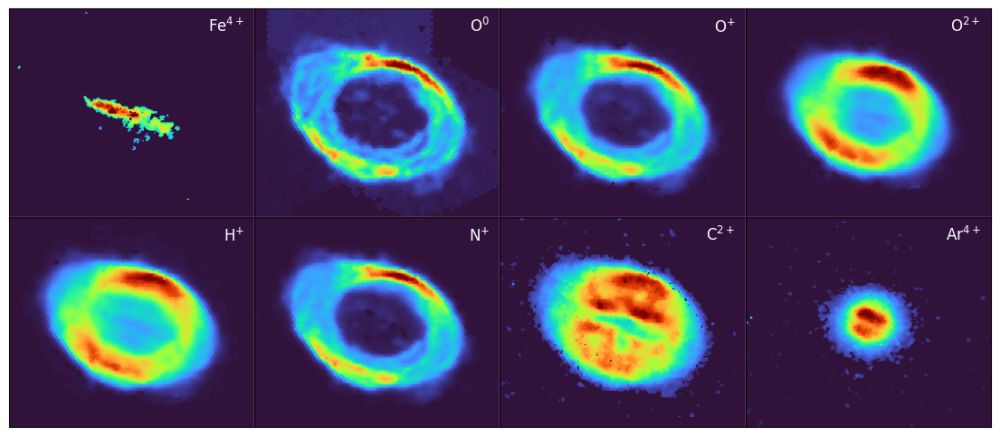 These are 8 separate emission-line images of the Ring Nebula. The colour in each panel tracks the brightness of emission, with brown-red being the most intense, shading through yellow and green to blue for the faintest emissions. While most of the emissions mirror the ring-shape that planetary nebulae are known for, the iron in the upper left panel is in the shape of a bar. Astronomers are puzzled by its presence and how it might have formed. Image Credit: Wesson et al. 2026. MNRAS
“Even though the Ring Nebula has been studied using many different telescopes and instruments, WEAVE has allowed us to observe it in a new way, providing so much more detail than before," lead author Wesson said in a press release. "By obtaining a spectrum continuously across the whole nebula, we can create images of the nebula at any wavelength and determine its chemical composition at any position."
“When we processed the data and scrolled through the images, one thing popped out as clear as anything – this previously unknown ‘bar’ of ionized iron atoms, in the middle of the familiar and iconic ring," Wesson added.
Planetary nebulae (PNe) have nothing to do with planets. They just seemed that way to early astronomers. Now we know that PNe like the Ring Nebula are formed by aging red giant stars that have cast off their outer layers. JWST observations of the Ring Nebula show that it has 10 concentric rings of material shed during the star's pulsations, each separated by about 280 years.
Given that understanding of PNe, it's not clear exactly how this iron bar could've formed. "The nature of the iron ‘bar’ in the Ring Nebula is unclear. While fast collimated outflows are commonly seen in planetary nebulae, and the bar appears jet-like in projection, the kinematic information shows that it is not a jet." the authors write in their research.
Part of the difficulty in determining the nature of the iron bar concerns the phenomenon of iron depletion. Iron in its gas phase in the nebula can condense into solid dust grains, which is called iron depletion.
This matters because the iron had to come from one of two sources: an AGB (Asymptotic Giant Branch) wind, or the central star wind. These winds are like two separate dying breaths of an aging star. The AGB wind is older and comes from an aging star as it turns into a red giant. The central star wind is younger, and comes from the hot leftover core of the AGB star. The important difference is their temperatures. The AGB wind is cool, while the central star wind is hot.
An AGB wind is cool enough for the iron plasma to condense and be depleted, while the central star wind is too hot. The problem is that while they can see the iron lines, the region is too hot to also see the hydrogen lines. Without the hydrogen lines, they can't really determine the extent of iron depletion from its ratio to hydrogen. So they aren't sure if the iron they see is depleted or not. That means they can't nail down which wind is involved in creating the iron bar.
 The JWST has observed the Ring Nebula and some of its images were used in this work to try to understand the iron bar. Each of the four panels was captured with one of the JWST's different filters. In three of them, the iron contours from WEAVE are outlined in blue. In the upper right panel, they're not. They were omitted to try to show the H2 emissions on either side of the bar region in an effort to try to understand iron depletion. Image Credit: Wesson et al. 2026. MNRAS
"How a component with a low or even zero gas-phase depletion of iron could be formed in the Ring Nebula is not clear," the authors write.
Zooming out from this, there are two broad explanations for the iron bar. One is that it reveals something new about how the central star ejected its material. The other is that the iron bar is the remnant of a planet that was vapourized and destroyed by the star as it expanded into a red giant.
Professor Janet Drew, one of the study's co-authors who is also based at UCL, explained what comes next in a press release. “We definitely need to know more – particularly whether any other chemical elements co-exist with the newly-detected iron, as this would probably tell us the right class of model to pursue. Right now, we are missing this important information,” she said.
These results are the first ones from a powerful new observational tool, and history shows that these new facilities uncover new features that were previously beyond detection. It's likely that though this is the first one, it's not the only one. So understanding this iron bar will rely partly on finding many more of them and subjecting them to deeper scientific scrutiny.
“It would be very surprising if the iron bar in the Ring is unique,.” said Dr. Wesson. “So hopefully, as we observe and analyse more nebulae created in the same way, we will discover more examples of this phenomenon, which will help us to understand where the iron comes from.”
Professor Scott Trager from the University of Groningen is a WEAVE Project Scientist and a co-author of the new research. “The discovery of this fascinating, previously unknown structure in a night-sky jewel, beloved by sky watchers across the Northern Hemisphere, demonstrates the amazing capabilities of WEAVE," Trager said. "We look forward to many more discoveries from this new instrument.”
"At present, there seem to be no obvious explanations that can account for the presence of the narrow ‘bar’ of [Fe v] and [Fe vi] emission seen in our WEAVE spectra to extend across the central regions of the Ring Nebula," the authors write in their research. "Fresh observations of this newly uncovered feature at much higher spectral resolution seem essential to make progress," they conclude.

