Universe Today
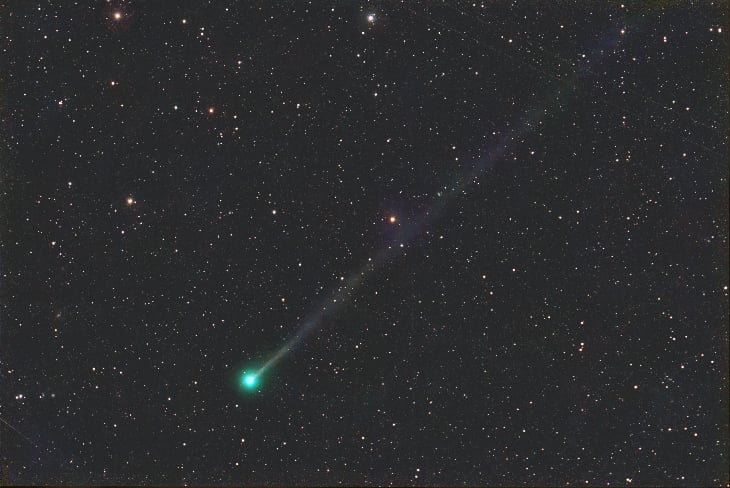
Early April could be an exciting time for sky watchers, as two comets take center stage: R3 Pan-STARRS and sungrazer A1 MAPS.
All eyes are on the inner solar system in April 2026, as two comets reach perihelion. One, Comet R3 Pan-STARRS we’ve known about since last year. Another, sungrazer A1 MAPS was just found as the first comet of 2026 and presents us with a big question: will it survive its blistering perihelion passage on Saturday, April 4th, or simply vaporize like the majority of sungrazers before it?
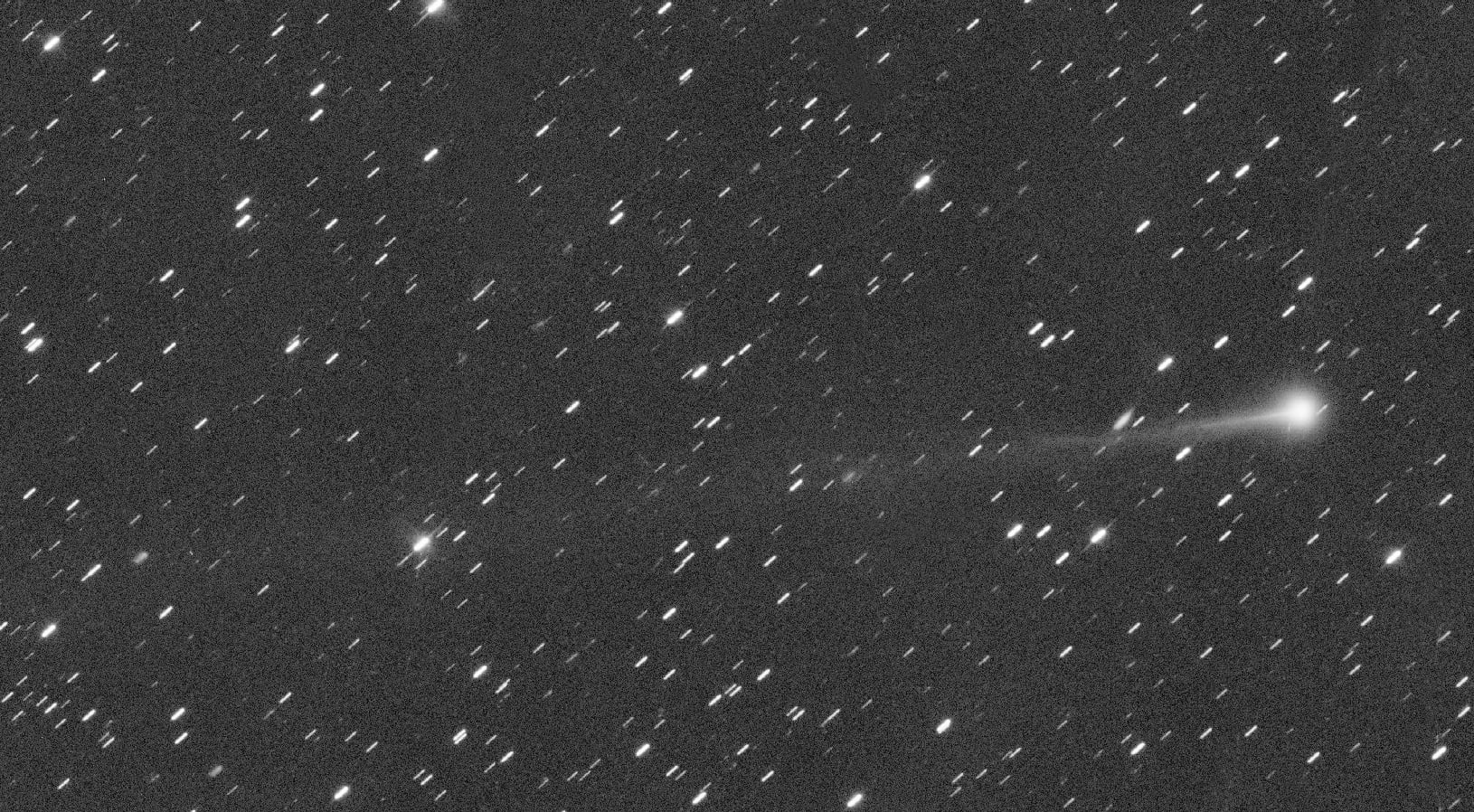 Comet A1 MAPS from March 22nd. Credit: Michael Jaeger/Gerald Rhemann.
Update on Comet A1 MAPS
We previously wrote for Universe Today about the back story for comet A1 MAPS). The find certainly made astronomers and sky watchers take notice, as it now holds the distinction as the most distant sungrazer discovered to date, at over 2 Astronomical Units (AU) from the Sun.
Since January, the comet has brightened, stalled, then brightened again, and currently sits at magnitude +6 and brightening ‘with a bullet’, low it the dusk sky as a tough catch below brilliant Venus. Measurements including observations made by re-tasking JWST to observe the comet place the nucleus for A1 MAPS in the 0.4 kilometer or smaller range, on the small end versus famous sungrazers in the past, such as 1965’s Ikeya-Seki.
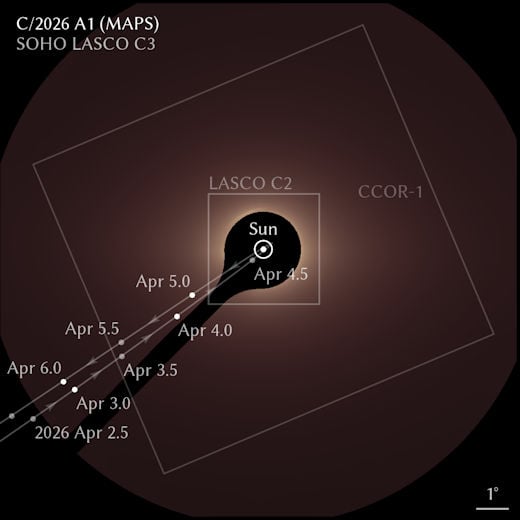 Comet A1 MAPS' expected track through the coronagraph views of CCOR-1 and SOHO. Credit: Qicheng Zhang.
What to Expect at Perihelion
Certainly, numbers aren’t on Comet A1 MAPS’ side. The comet reaches perihelion on Saturday, April 4th at 14:23 Universal Time (UT)/10:23 AM EDT, just 101,000 miles (~162,000 kilometers) from the surface of the Sun, threading the inner solar corona. That’s less than half the distance from the Earth to the Moon. The comet actually passes behind the Sun as seen from Earth on the 4th from 11:50-to-13:20 UT, then loops around and crosses (transits) in front of the solar disk from 13:55-to-15:20 UT, during perihelion. We’ll probably get a good look via SOHO after that to see what’s left of the comet.
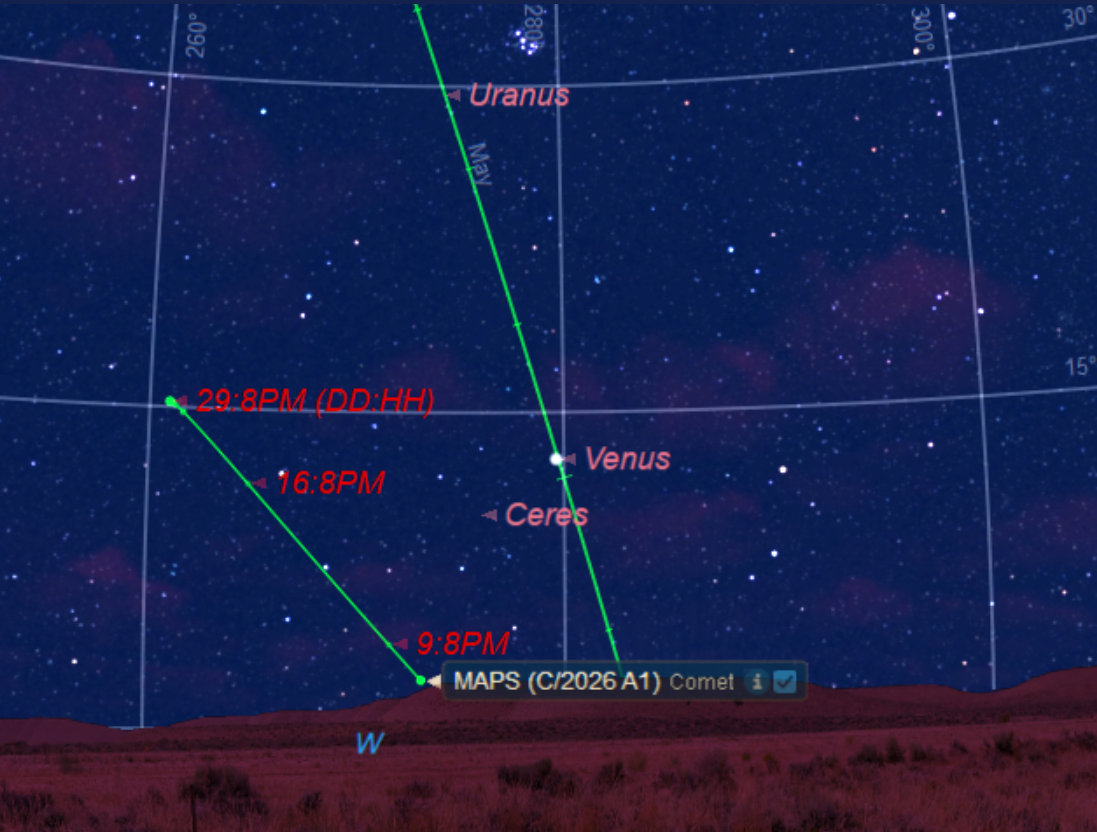 Comet A1 MAPS outbound in April (assuming it survives(!). Credit: Starry Night.
We have two possibilities for Comet A1 MAPS, each with their own possible pair of outcomes:
Scenario 1: breakup at perihelion. My money’s on this one, though I’d love to be wrong. In this case, like with the demise of Comet ISON back in 2013, the last days before perihelion will provide our final views of the comet.
Sub-scenario: Instead of a fizzle, a ‘headless comet’ that briefly survives perihelion before fading from view. W3 Lovejoy put on a similar show in 2011-2012.
Scenario 2: The comet survives perihelion and goes on to be a moderately bright dusk comet. Certainly, forward scattering may work in its favor, as we’re seeing the comet’s orbit nearly edge-on in early April.
Sub-scenario: The comet survives and goes on to be a great ‘daylight comet.’ It’s rare, but it has happened before. In this case, we’d have a comet topping negative magnitudes next week, rivaling Venus low in the western dusk sky. Keep in mind, the dust tail for Comet A1 MAPS would then precede before it as it heads out of the solar system. This option would stand the best chance for the general public to get a look at a fine comet for themselves. Again, it’s a long shot, but possible.
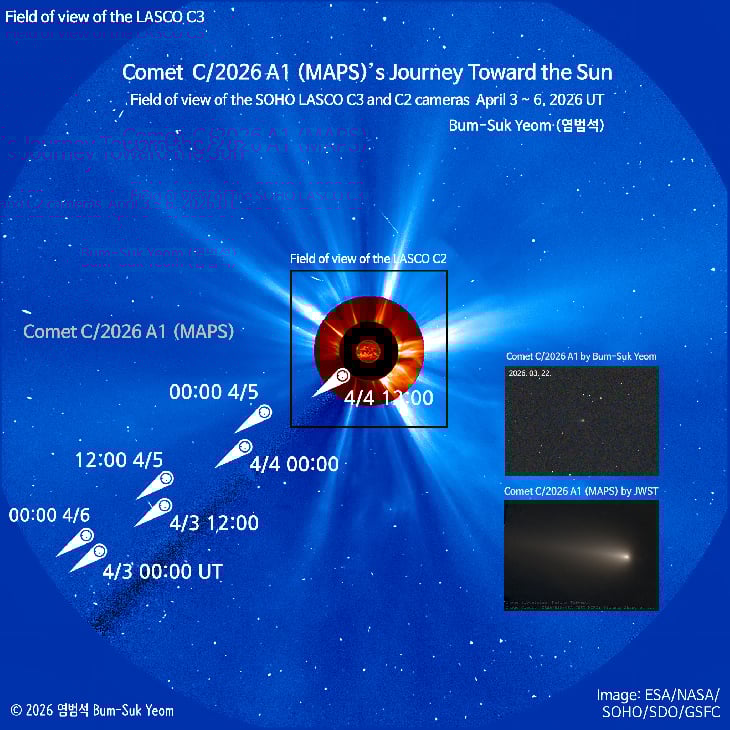 A1 MAPS SOHO journey. Credit: Bum-Suk Yeom.
A2 MAPS enters the field of view of SOHO LASCO C2 imager on April 2nd. As a pre-show, we had a small Kreutz sungrazer take the plunge on the final day of March:
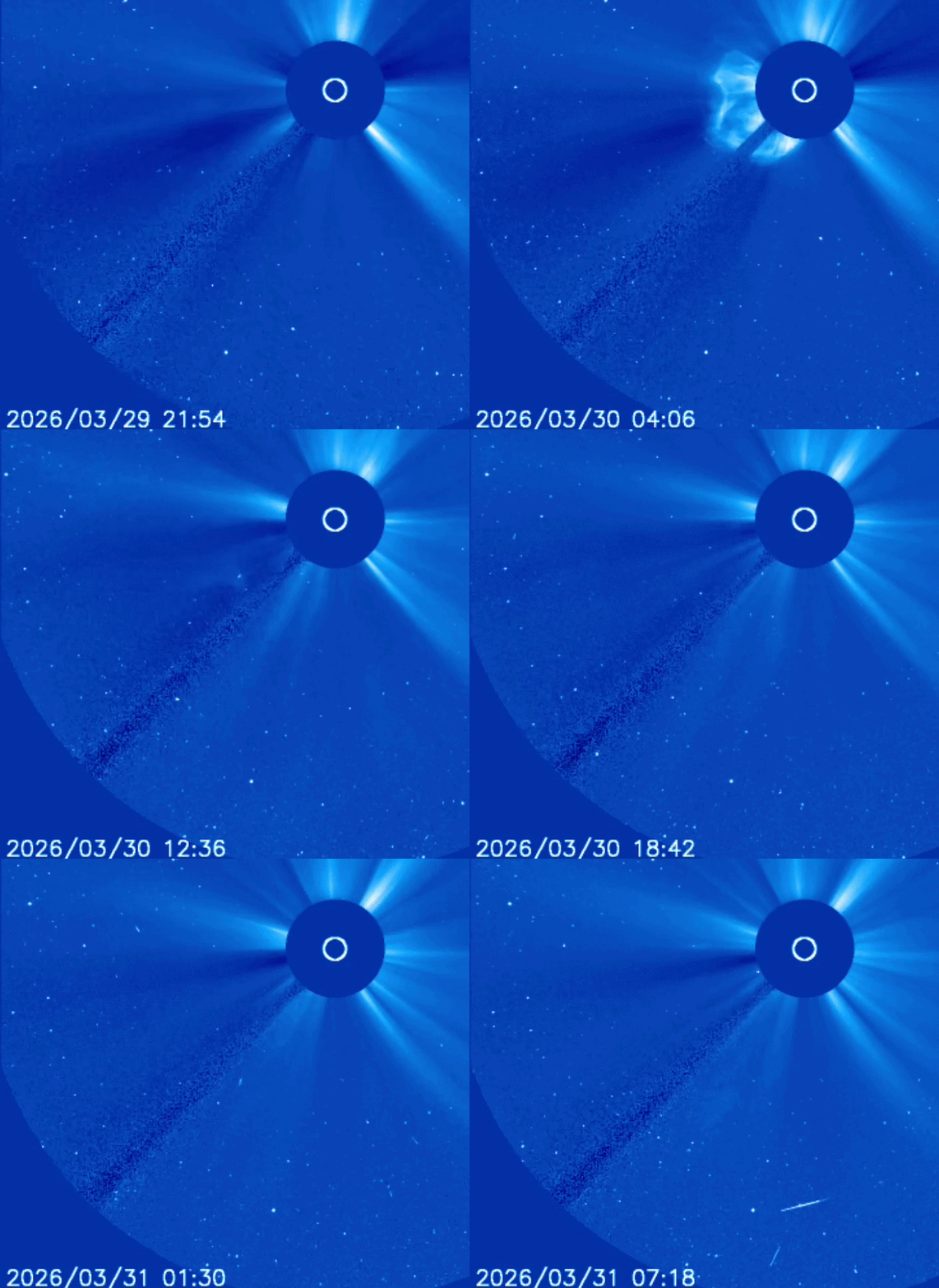 A doom'd sungrazer takes the plunge ahead of Comet A1 MAPS. Credit:NASA/ESA/SOHO.
Artemis II astronauts could also get a fine view of the comet, if they happen to be behind the Moon at the time.
It will eclipse most of the inner solar system.[image or embed]— Tony Dunn (@tony873004.bsky.social) March 29, 2026 at 2:19 PM
A1 MAPS is a member of the Kreutz group of sungrazers, a family of comets that broke apart from a larger progenitor long ago. Certainly, there’s more our there, awaiting discovery. On an ~1,800 year orbit, A1 MAPS could be a harbinger of more to come, years or decades from now.
Check out Nicolas Lefaudeux's in-depth analysis of Comet A1 MAPS.
Next up, unrelated comet C/2025 R3 Pan-STARRS is brightening ahead of expectations, for its own show in April.
Discovered by the Pan-STARRS all-sky survey on the night of September 8th, 2025, R3 Pan-STARRS is on a ~170,000 year orbit around the Sun inbound, destined for ejection from the solar system outbound. The comet was found just in time to make our list of top comets for 2026.
Currently a binocular comet at +6th magnitude, it may top out at +1st magnitude on closest Earth approach on April 26th a week after perihelion, but it’s also just 6 degrees from the Sun at the time.
Prospects in April
The time to track down R3 PanSTARRS is now. We’ve got about a week to see Comet R3 PanSTARRS at about 10-15 degrees above the eastern horizon at dawn crossing the Great Square of Pegasus, before taking the plunge sunward.
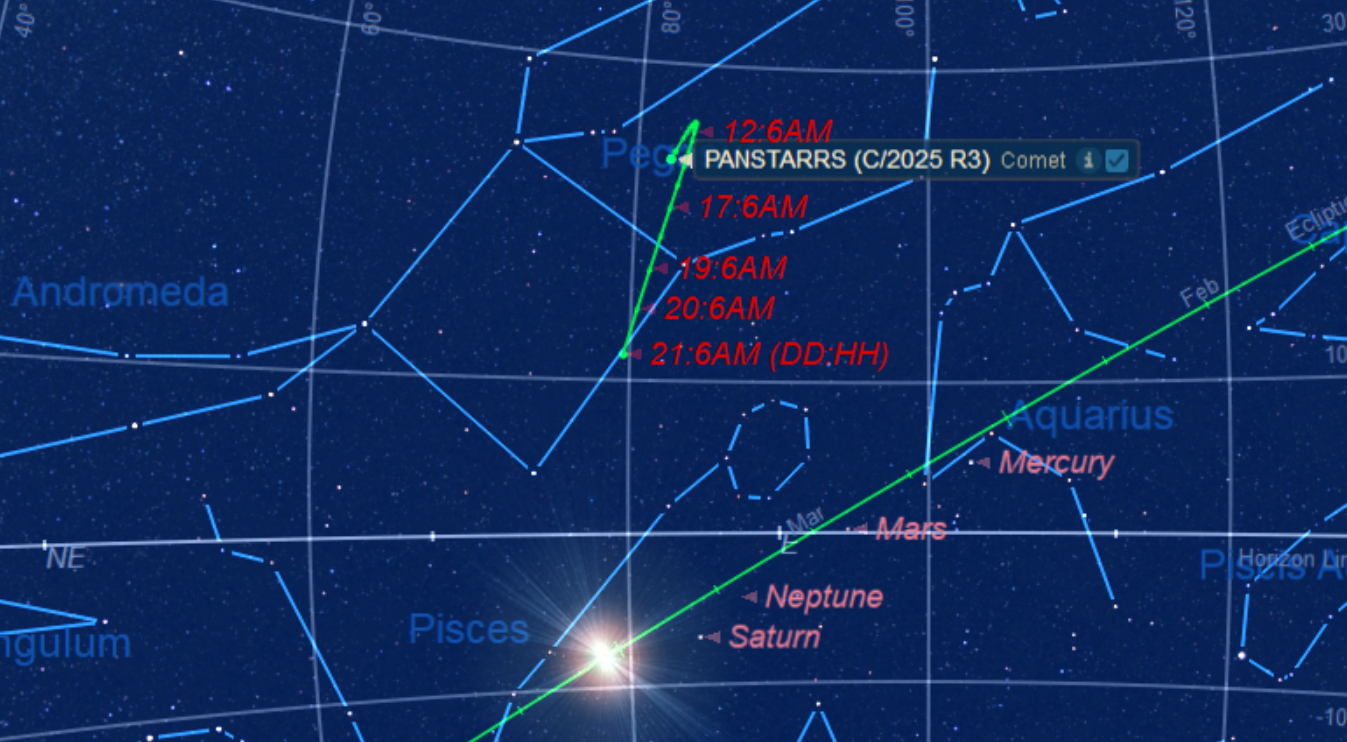 'Hang time,' for comet R3 Pan-STARRS at dawn from April 1st to the 21st. Credit: Starry Night.
R3 Pan-STARRS also transits SOHO’s view from April 23-26.
Post-perihelion in May is an even more bashful time for the comet, as it favors southern hemisphere viewers and crosses the constellation Eridanus into Orion, headed back out of the solar system in the direction of Lepus the Hare.
One thing’s for sure: we’ll be obsessively checking in on SOHO’s view come this weekend, to see if Comet A1 MAPS survives. If it does, it could be an interesting week for sky watchers ahead, both Earthbound and otherwise.