Universe Today
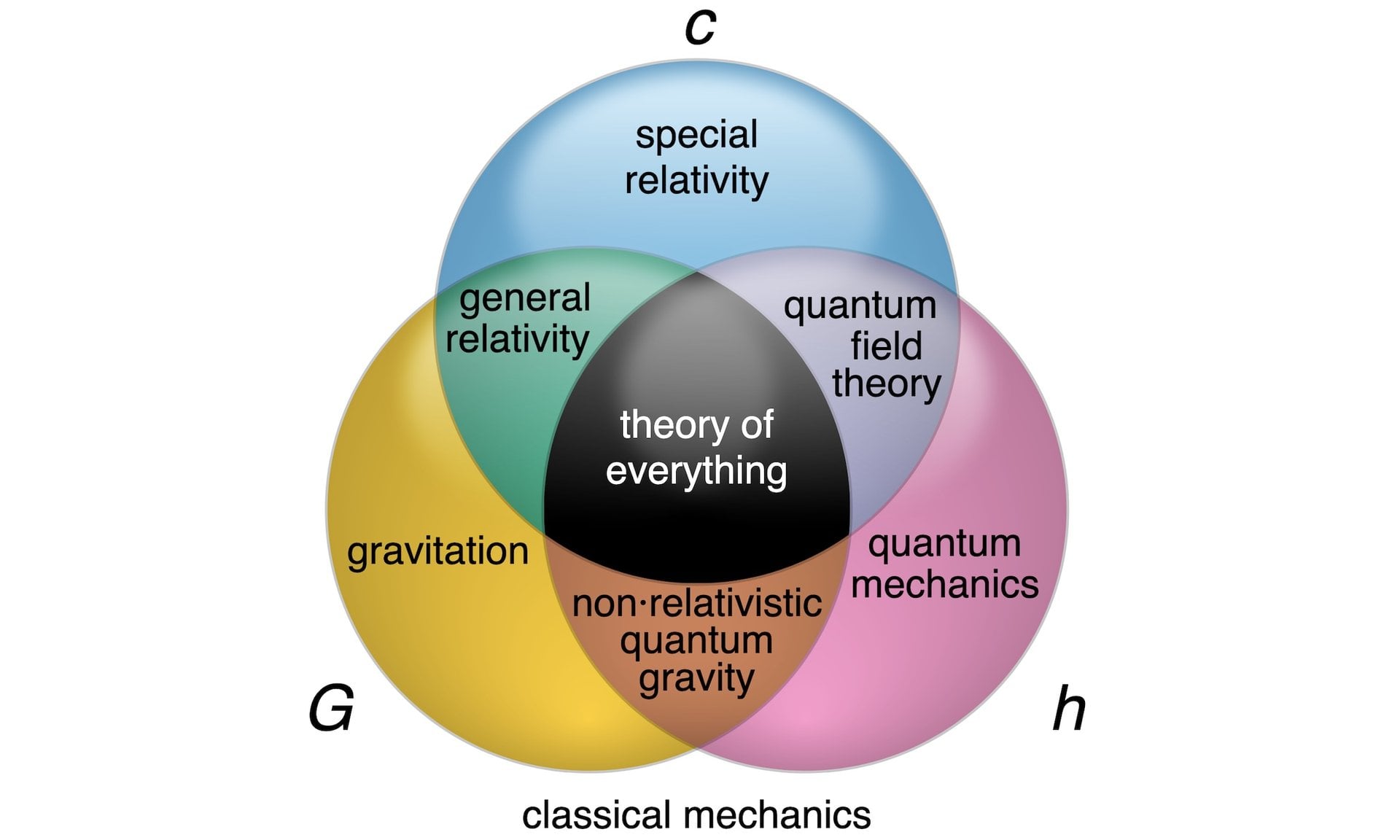
Modern cosmology is built upon three theoretical pillars: special relativity, Newtonian gravity, and quantum mechanics. Each is supported by a wealth of experimental evidence, but each describes the physical world in a way that contradicts the other two.
Quantum theory describes the tiny. Objects driven by the electromagnetic, the strong, and weak forces. The fuzzy world of atoms and molecules. Newton's model describes the huge. Galaxies, black holes, and the orbits of planets. Special relativity describes space and time. The background through which atoms, planets, and humans move and interact.
Any two of these theories can be unified into a consistent model. Connect special relativity with gravity, and you get general relativity, which describes how gravity is a warping of spacetime. Connect special relativity with quantum mechanics, and you get quantum field theory. Connect quantum mechanics and Newtonian gravity, and you get weak quantum gravity, which can describe how atoms and molecules behave in a weak gravitational field such as Earth's.
What we don't have is a theory that unifies all three. One of the major difficulties is the renormalization problem. For example, in special relativity matter can be converted to energy and energy to matter. In quantum theory, particles can spontaneously appear or disappear as virtual particles within the bounds of quantum uncertainty. When you connect the two, the virtual particles have energy, which triggers more virtual particles. If you try to calculate the total energy of all virtual particles, it blows up to infinity.
Fortunately, it is only the relative energy that matters. Through a mathematical process known as renormalization, you can cancel out the virtual energy of quantum particles to get the answer you need. But when you add gravity into the mix, this all breaks down. The energy of the virtual particles should warp spacetime, and without a fixed spacetime background, you can't renormalize.
Many approaches to quantum gravity have this problem and can't be renormalized. But one approach, known as quadratic quantum gravity, can be renormalized. Essentially the model adds quadratic terms to the Einstein field equations so that it can be renormalized like quantum field theory. The problem is that it also introduces a quantum field of "ghost particles." These particles don't appear in particle physics experiments, so quadratic quantum gravity isn't very popular. It's possible that the ghost particles are just too massive to appear in current particle physics experiments, but this makes the theory untestable.
Or so we thought.
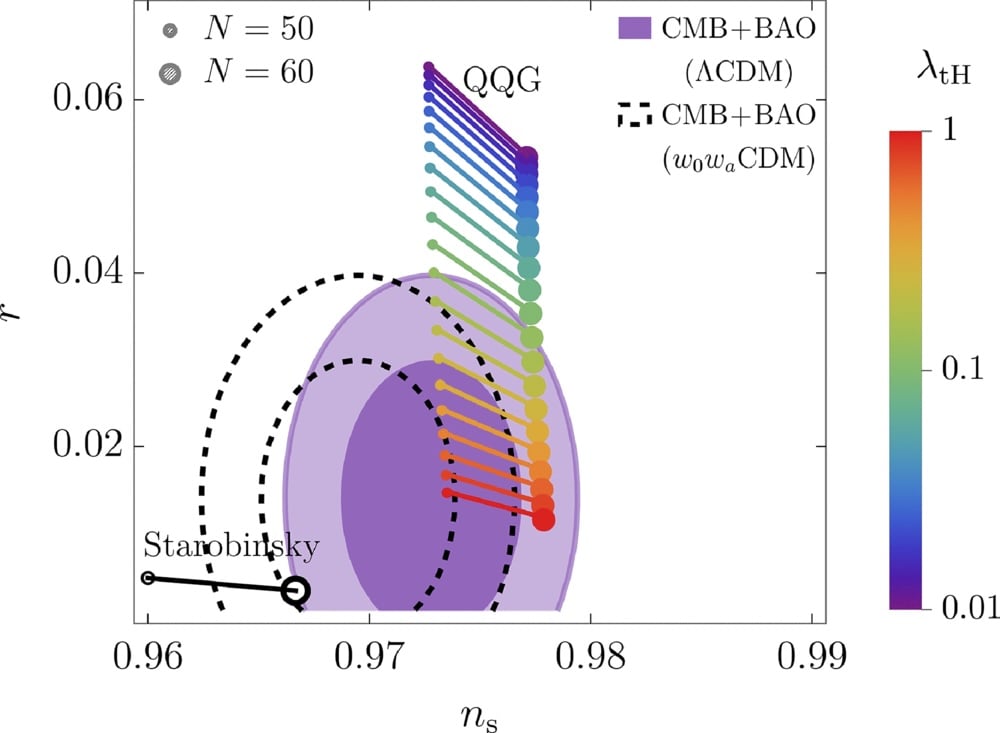 A comparison of the quadratic gravity model with observations. Credit: Liu, et al.
A new paper in The Physical Review Letters argues that quadratic quantum gravity is the reason the Universe expanded rapidly in its youth. The authors show that within quadratic quantum gravity, the quadratic terms drive cosmic expansion naturally. Once the cosmos undergoes its early expansion, the spacetime structure is dominated by the usual effects of general relativity.
The authors go on to demonstrate that the model also predicts a minimum level of background gravitational waves created during the inflationary period. These waves are too small to detect with current observatories, but they are in the range of future observatories such as LISA. So the model will be testable in time.
Reference: Liu, Ruolin, Jerome Quintin, and Niayesh Afshordi. "Ultraviolet Completion of the Big Bang in Quadratic Gravity." Physical Review Letters 136.11 (2026): 111501.