 Universe Today
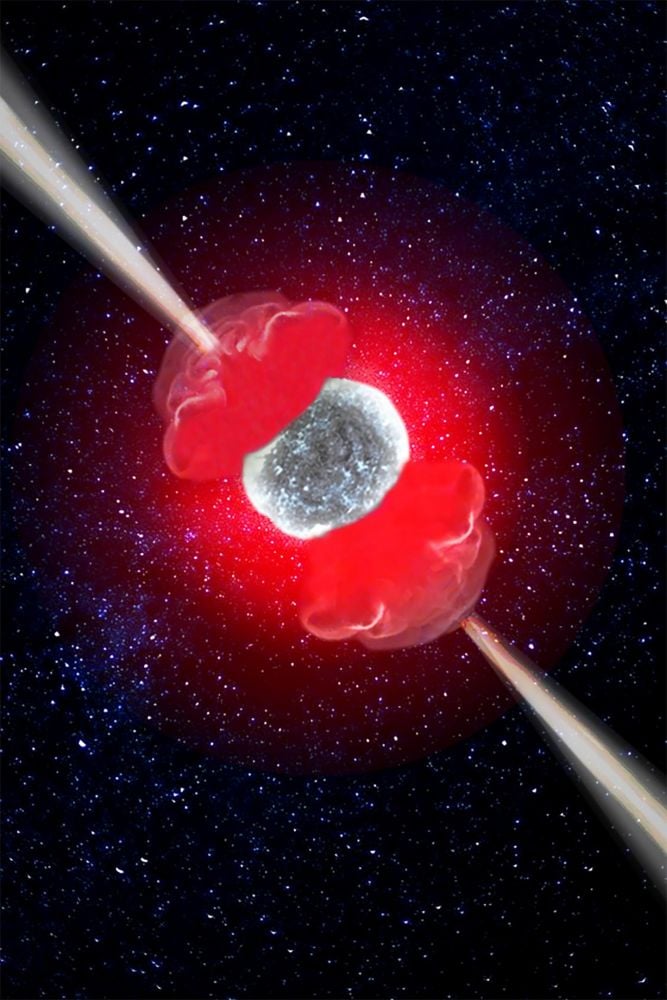
Massive stars meet their demise in powerful supernova explosions. These cataclysmic events light up the sky for months and are some of the most intensely studied phenomena in astronomy. There are different types of supernovae, and core-collapse supernovae make up about 70% of all supernovae.
The most energetic and most luminous type of core-collapse supernovae (CCSNe) are called hypernovae. Only stars greater than about 30 solar masses can explode as hypernovae. A hypernova (HN) is about 10 times more luminous than other CCSNe and eject material with extremely high kinetic energies. But evidence supporting the existence of HN has been thin.
When massive stars explode, they create astronomical metals that spread out into space. That material is taken up in the next generation of star formation. HN have been used to explain some unusual stars in the Milky Way's halo, as well as one found in the nearby Sculptor dwarf spheroidal galaxy. These stars are extremely metal-poor.
Astronomers thought that the unique low-metallicity of these stars was each caused by the explosion of one progenitor star. They also assumed that the gas from these explosions mixed evenly. To find the stars' progenitor, they compared the stars' chemical abundances to the yields of modelled SNe explosions.
When a star's metallicity didn't match with any type of normal supernova, they searched for another best-fitting model. In the cases of the stars in the Milky Way's halo, and in the Sculptor galaxy, hypernovae models were the best fit.
But that best fit relied on a particular understanding of hypernovae: that everything produce by the powerful explosion was mixed uniformly. Two new papers suggest that's not what happens, and that HNe aren't responsible for these low-metallicity stars. And since these stars are some of the best evidence for HN, the papers show that HNe may not even exist.
"All the evidence we see for hypernovae is suddenly gone." - Anmol Aggarwal, Mullard Space Science Laboratory, University College London.
For Universe Today readers that want to dig more deeply into this, the two papers are:
- "An unexplored enrichment stochasticity and its implications for stellar abundance patterns," published in Monthly Notices of the Royal Astronomical Society. The authors are Anmol Aggarwal, a PhD student at the Mullard Space Science Laboratory at University College London, and Dr. Ralph Schoenrich, also based at Mullard Space Science Laboratory at UCL.
- "Mixing stochasticity relinquishes evidence for magnetorotational hypernovae," also published in the Monthly Notices of the Royal Astronomical Society. The same authors also wrote this paper.
Stars with extremely low metallicity are important because they are similar to the very earliest stars in the Universe, when the cosmos hadn't yet been enriched with metals. They're the closest researchers can come to observing the Universe's first stars. "Widely assumed to be enriched by just one dying massive star, some of these metal-poor stars have abnormal chemical abundance ratios and have been taken to reflect a rare hypernova (with high explosion energy 1052 erg)," the authors write in the first paper.
In their second paper they point to recent work by other researchers showing that "the observed elemental abundance pattern of a halo star" fits with the yields of a hypernova explosion.
But their results counter that idea. In the first paper they explain that "their abundances are better explained by enrichment from a normal (less energetic) supernova accounting for inhomogeneous distribution of the ejecta."
In the second paper they "... show that the star’s peculiar abundance pattern is better fitted within the framework of mixing stochasticity with yields from a normal core-collapse supernova (ccSN; Energyexp ~1051 erg) and a neutron star merger (NSM)."
“If we look at a supernova today, the star’s materials are not spread evenly," Aggarwal said in a press release. "Oxygen might predominantly fly in one direction, sulphur in another. New stars might form from a mix of pieces of the supernova, not its overall mix of elements."
They used mathematical models to dig more deeply into this.
“We developed mathematical models that took account of this and found in all cases that stars with a very unusual mix of ingredients were most likely formed from ordinary supernovae," Aggarwal said. "All the evidence we see for hypernovae is suddenly gone.”
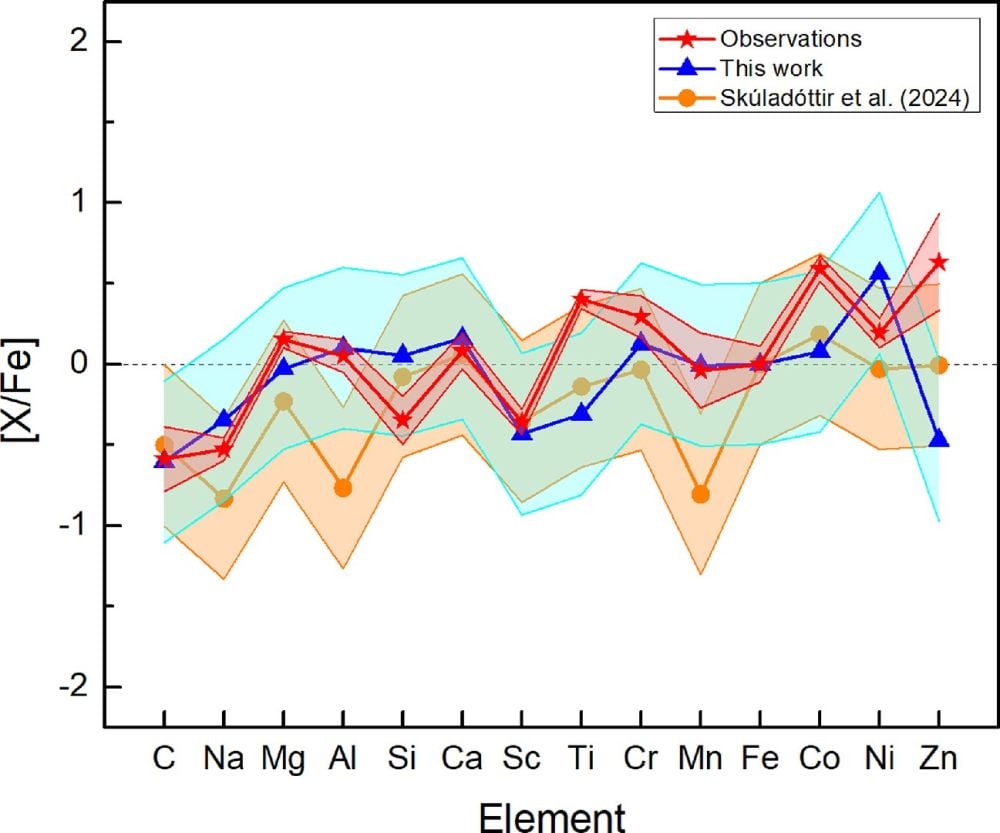 This figure from the first paper compares metallicity observations (red), the model results in this work (blue) and results from previous research (orange) suggesting HNe are responsible for low metallicity. The authors argue that their modelling, which is based on SNe not HNe, more closely match observations. Image Credit: Monthly Notices of the Royal Astronomical Society, Volume 548, Issue 2, May 2026, stag610, https://doi.org/10.1093/mnras/stag610
As an aging, massive star nears the end of its life of fusion, it forms layers of elements like layers of an onion. Heavier elements concentrate near the center, with lighter ones nearer the surface. Using their model, they examined how much of each element from each layer is required to fit the low-metallicity stars.
"The main message from this study is that more care needs to be taken when inferring particular explosion mechanisms from single low-metallicity stars with peculiar abundances: while the field uses the widespread assumption that one metal-poor star is enriched by the mix of yields from a single super/hypernova, we advocate instead for enrichment by fractions of a supernova," the authors write in their first paper.
While the first paper focused on three stars previously explained by hypernovae, and now overturned, the second paper looked at a more particular star. It's a red giant in the Milky Way's halo that exhibits a particularly unusual chemical make-up. While SNe are known to produce heavy elements, they don't produce all of them. Some, like uranium and silver, are produced in neutron star mergers, or in extremely magnetic stars that explode as HNe.
Previous research argued that this red giant couldn't have formed from a NS merger because it's so metal-poor. It had to have formed, the research suggested, from more primordial material that lacked metal enrichment. That same research also used a model of the Milky Way wherein the galaxy's ISM was quickly enriched with heavy elements. That means that not enough time had passed for neutron stars to form and collide. Ergo, an NS merger couldn't have been responsible, and a HN must have been the progenitor,
But Aggarwal and Schoenrich's research countered that. Not only is the red giant in question travelling extremely rapidly, it's also moving in the opposite direction to most other stars in the galaxy. The authors say that this star must have formed in a dwarf galaxy that eventually merged with the MW. In these small galaxies, stars form more slowly, millions of years after the Big Bang and later than other stars of the same population. In these low-mass galaxies, exploding stars also send their metal-enriched gas out into the intergalactic medium, where it's less likely to be taken up by subsequent stars, at least not as quickly.
The researchers' mathematical models also showed that this unusual red giant star didn't require a HN. Instead, it likely formed from a NS merger and a standard core collapse supernova.
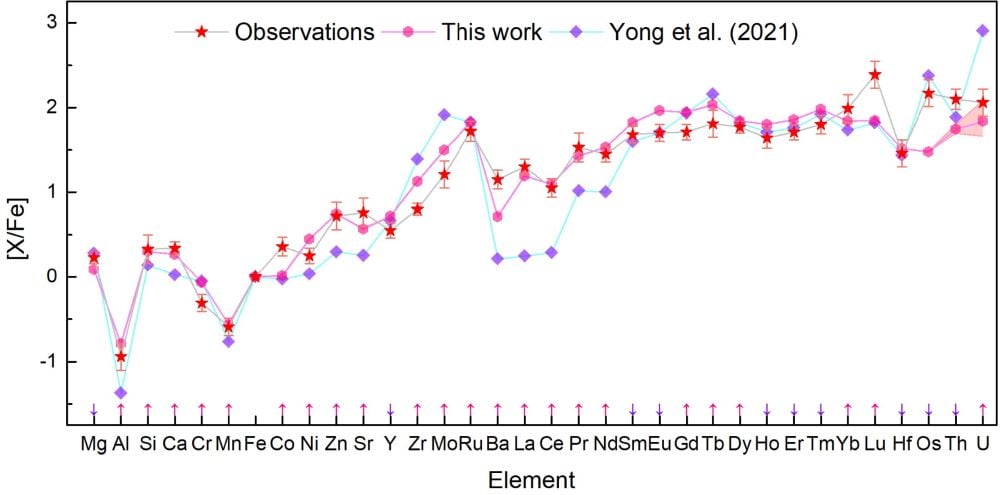 This figure compares observations of the unusual red giant in the Milky Way (red) with results from this research (pink) and results from previous research (purple.) The authors argue that their model, which doesn't require a hypernova, more closely match observations. Image Credit: Monthly Notices of the Royal Astronomical Society, Volume 551, Issue 2, September 2026, stag1512, https://doi.org/10.1093/mnras/stag1512
"Our reanalysis changes the interpretation of this peculiar star," the authors write in their second paper. "Previously thought to be clear evidence for enrichment by a magnetorotational hypernova, our new fit favours combined contributions from a normal SN and an NSM, providing a significantly better match to the data."
In their second paper, the authors also make an important, cautionary point. While showing that HNe are not required to explain these stars, that doesn't necessarily meant that SNe and NSM are the sole causes of these stars. "So, while our statistics favour this SN and NSM combination over the previously considered hypernova case, we do not preclude other scenarios," they conclude.
The key to all of this is concerns how well material in a SN explosion is mixed as its spread out into space.
"We still don’t know how well the supernova material gets mixed before it forms new stars," Schoenrich said. "That is despite decades of work in this area. Our research suggests some mixing goes on, but incomplete mixing."
“We need to take this into account in our models of how chemicals evolve in galaxies and of how the interstellar medium works," Schoenrich said.