 Universe Today
In the near future, powerful new telescopes will power a big leap in exoplanet science. Telescopes like the Extremely Large Telescope, the Giant Magellan Telescope, and the Habitable Worlds Observatory will take us beyond exoplanet detection. They'll allow direct imaging of exoplanets, atmospheric spectroscopy, and more precise radial velocity. Beyond that, they may very well detect biosignatures on rocky planets, especially around nearby M dwarfs, if there are any.
But observing time on these powerful instruments will be in extremely high demand. Astronomers who request observing time for their research have to make a strong case. Part of that case is knowing what to target. That requires detailed advance preparation.
New research led by astronomers from the University of Michigan is part of that advance work. They used radial velocity to target a nearby binary star system and searched for terrestrial planets that would be ideal targets for more observations with more powerful upcoming telescopes. This work is especially relevant since so many stars in the Milky Way are binary stars. The transit detection method can struggle to detect exoplanets around binary stars. The radial velocity method is stronger in these systems.
Their results are published in The Astrophysical Journal in a paper titled "A Century of Radial-velocity and Astrometric Monitoring of 70 Oph AB: New PFS Data and Constraints on Possible Planetary Companions." The lead author is Yiting Li, a postdoctoral researcher in the Department of Astronomy at the University of Michigan.
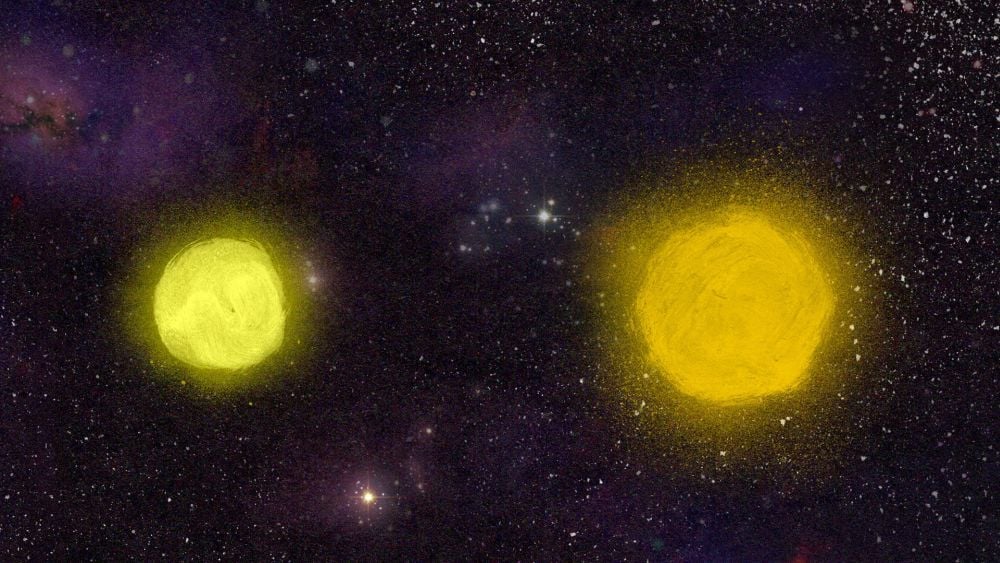
Both stars in 70 Oph AB are main sequence stars about 6.2 billion years old. 70 Oph A has about 0.89 solar masses and 70 Oph B has about 0.73 solar masses. They're not quite Sun-like stars because they're less massive and cooler. Of the two, 70 Oph A is more Sun-like.
"At a distance of 5.1 pc, the 70 Oph AB binary star system is one of the most favorable targets for future direct imaging and astrometry missions surveying mature, terrestrial planets," the authors write. The researchers used the 6.5 m Magellan II Clay Telescope in Chile and its Planet Finder Spectrograph (PFS) to capture new radial velocity data from the stars in 70 Oph AB. During 2025, they collected 499 measurements of 70 Oph A and 334 measurements of 70 Oph B. They combined these new RV measurements with archival RV data and spectrometry that spanned decades. 27 years of RV baseline data for Oph A was especially important.
Despite finding variable radial velocity measurements in the stars, they ruled exoplanets out as the cause.
"We find that the long-term RV variability of both components is consistent with stellar activity modulated by rotation periods, and we detect no coherent planetary signals in either component," they write.
While it's disappointing to find no planets there, this result is still scientifically valuable. A null result like this is still data, and the more data points there are, the more exoplanet science can advance.
“It’s a mix of disappointment and excitement,” lead author Li said in a press release. “We’re finding out that there isn’t a Jupiter-sized planet, but we’re also opening the latest chapter on this historic system.”
This work also means that 70 Oph A and B's orbits are now some of the most well-understood in the sky. The researchers achieved a new degree of sensitivity in their search, which showed that wobbles in the system are due to stellar activity, not orbiting planets. The research was aimed at massive, Jupiter-size planets, and the results place limits on the size of any exoplanets in the system, and ruled them out, within certain limits. "We place upper limits on any planets orbit in the plane of the binary," the authors explain.
For 70 Oph A, the results exclude Jupiter-mass exoplanets inside about 5 au. For 70 Oph B, exoplanets with ~0.25-0.3 Jupiter masses are excluded inside 0.5 au.
But the data does allow for Saturn-mass planets or smaller to follow stable orbits around 70 Oph A out to about 2.5 au.
“The new limit enables us to design optimum search strategies in the future,” said Michael Meyer, a senior co-author and chair of the U-M astronomy department. “In fact, the University of Michigan is part of a team studying a space mission called SHERA that will focus on binaries, where this system is one of a handful of targets. 70 Oph AB will certainly be a target of flagship missions, such as NASA’s Habitable World Observatory.”
“Yiting assembled an absolutely huge amount of data from all over the world and carefully explored all possibilities,” Meyer said. “It’s a cautionary tale about how stellar activity can mimic planet signals using the radial velocity.”
This work has implications for habitability studies. Using more than a century of RV and astrometry data, the orbits of 70 Oph A and 70 B are now very tightly constrained. Their dynamical masses are now known very precisely. This means that 70 Oph AB is now one the best-characterized nearby solar-type binaries.
"This is especially valuable for habitability studies in binary stars, where even modest changes in eccentricity or periastron distance can substantially modify the extent of long-term stable zones," the authors write. "70 Oph AB presents a unique opportunity for the search and characterization of habitable planets in binary systems." They add that "70 Oph is one of the nearest binaries where the HZ can be spatially resolved."
It would be unusual to find no planets in the 70 Oph AB system, given what we now know about exoplanet numbers. So even though none were found, the results may only intensify the effort to find the ones that are likely there. The results show that an Earth-sized exoplanet could still reside there.
“The study sets an upper limit, not a ban, on planets,” Li said. “Given how prevalent planets are in our universe and in the Milky Way, I would wager that we’ll find there are other planets there.”
"If stellar binaries can host Earth-like planets, 70 Oph is one of the best places to look," the authors conclude.