Universe Today
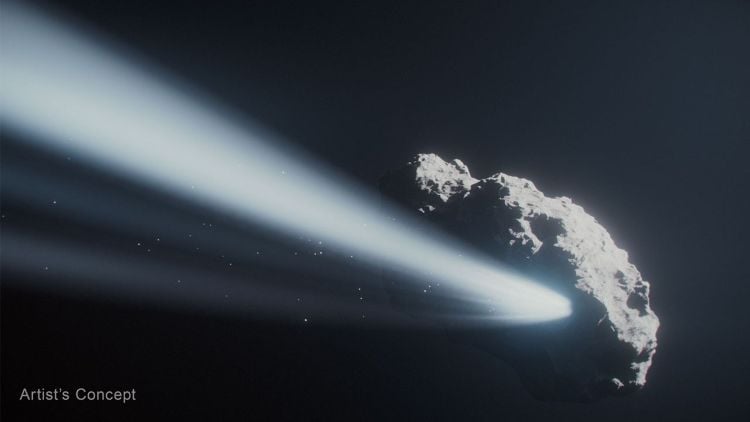
Comets are known for providing breathtaking observations of their long and shiny tails when they travel too close to the Sun. This happens because comets are made of ice and primarily orbit far from the Sun, but as their icy core heats up it evaporates, resulting in the aforementioned breathtaking observations. But while evaporating comets make for great public photos, scientists who study comets are focused on these snowballs of gas and dust and how they are remnants of the origins of the solar system about 4.6 billion years ago.
Now, a lone researcher from the University of California, Los Angeles (UCLA) has introduced an exciting new finding for comets, as they announced the first-ever discovery of comet that is spinning in reverse. The discovery was made using data obtained from NASA’s Hubble Space Telescope, which found that 41P/Tuttle-Giacobini-Kresák (aka 41P) exhibited a reverse spin during its closest approach to the Sun, also called perihelion, in 2017. The findings were recently published in March 2026 in The Astronomical Journal and hypothesized that outgassing jets could be responsible for 41P’s spin, slowing, stopping, and then completely reversing direction.
“Jets of gas streaming off the surface can act like small thrusters,” said Dr. David Jewitt, who is a Distinguished Professor in the Department of Earth, Planetary, and Space Sciences at UCLA and the study’s sole author. “If those jets are unevenly distributed, they can dramatically change how a comet, especially a small one, rotates. It’s like pushing a merry-go-round. If it’s turning in one direction, and then you push against that, you can slow it and reverse it.”
Along with its reverse spin, 41P’s surface was also found to be less active in 2017 compared to prior observations, specifically compared to its 2001 perihelion. This finding is also intriguing as comet surfaces tend to take centuries or longer to experience changes, while these changes took a quarter of a century. Computer models indicate that at its present spin rate, 41P is hypothesized to eventually rip itself apart from the forces caused by the spinning.
The study estimates that the 41P’s nucleus, which is a comet’s dirty central core that emits the long tail during evaporation, could only last another few decades compared to the average lifetime of 1,000 years. While Hubble estimates 41P’s nucleus is about 1 kilometer (0.6 miles) in diameter, the study concludes by stating 41P could either be emitting unusually large amounts of outgassing compared to most comets or 41P is a chunk that broke off long ago from a much larger comet.
While 41P originates from the Kuiper Belt, the comet’s orbit takes it to the inner solar system every 5.4 years, which is known as a short-period comet. 41P is a member of about 4,000 to 5,000 comets that have been cataloged traveling from far reaches of the solar system like the Kuiper Belt to the inner solar system where the planets orbit. The Kuiper Belt is located about 30 to 50 astronomical units (AU) from the Sun and is estimated to have trillions of comets, which could contain rocks as old as the solar system.
A region even farther out that the Kuiper Belt is the Oort Cloud, whose outer region is located approximately 100,000 AU from the Sun, or approximately halfway to the nearest star, Proxima Centauri, while its inner region is located approximately 2,000 to 5,000 AU from the Sun. Like the Kuiper Belt, the Oort Cloud is estimated to have trillions of comets, but these are known as long-period comets meaning they take much longer to travel to the inner solar system and travel back out.
What new insights into comet 41P/Tuttle-Giacobini-Kresák and other reverse-spinning comets will researchers make in the coming years and decades? Only time will tell, and this is why we science!
As always, keep doing science & keep looking up!