Universe Today
Exoplanet atmospheres have become prima targets for astrobiologists in the search for life beyond Earth. This is because exoplanet surfaces can’t be directly imaged yet, so astronomers must get creative with how to search for signs of life, also called biosignatures. Presently, powerful ground- and space-based telescopes like the Atacama Large Millimeter Array (ALMA) and NASA’s James Webb Space Telescope (JWST) are improving in their ability to observe and analyze exoplanet atmospheres. But did these atmospheres form and evolve, and what could this mean for the search for life beyond Earth?
Now, a team of researchers from the United States and United Kingdom discuss a new method for studying the evolution of exoplanet atmospheres. Through a white paper draft posted on arXiv, the researchers propose the mission concept Nautilus Space Observatory, also called the Nautilus Deep Space Observatory (NDSO) which they suggest could revolutionize not only how exoplanets are studied, but how space telescopes operate in the future. For the purposes of this specific white paper, the researchers opted to focus on exoplanet and exoplanetary atmospheres formation and evolution.
The proposed Nautilus Space Observatory will consist of a constellation of space telescopes whose design and deployment are meant to be both fast and simple while having large enough diameters to conduct groundbreaking science. The white paper discusses several scientific objectives that could be accomplished by Nautilus, including better understanding the timescales for exoplanets evolving into sub-Neptunes and super-Earths.
Super-Earths and sub-Neptunes are the most common exoplanet types, with scientists estimating that between 30 to 50 percent of Sun-like stars have at least one of these exoplanet types orbiting it. Other scientific objectives include studying timescales of atmospheric mass loss, carbon-oxygen ratio, and when helium-dominated exoplanets evolve. Timescales include from the time of a protoplanetary disk between 0-10 million years old and as far as 4.6 billion years old when planets are fully mature.
The white paper notes, “Answering these questions requires the high spatial resolution, broad-wavelength coverage, large effective area, and parallelized multiple units that Nautilus provides. By isolating the physical processes that govern the evolution of planets and their atmospheres, these science objectives directly support NASA’s Cosmic Origins and Exoplanet Exploration Programs.”
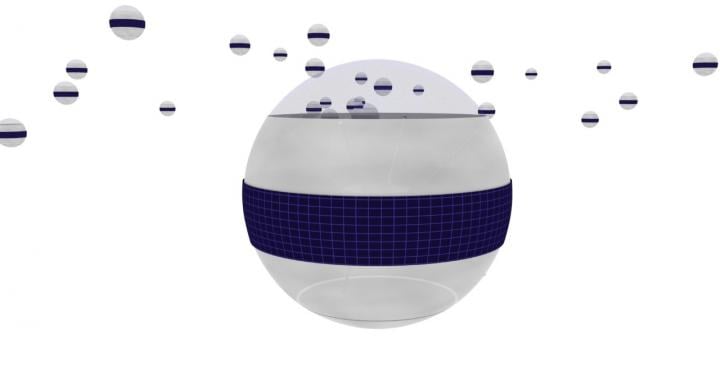
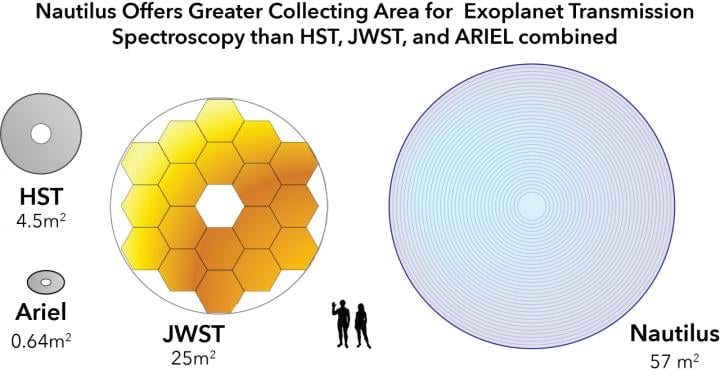
Led by the University of Arizona and proposed in the late 2010s, Nautilus is slated to consist of 35 space telescopes with a total size and diameter lens of 14 meters (46 feet) and 8.5 meters (28 feet). It is these lenses that will guide the optics of Nautilus, which could improve observations as current ground- and space-based telescopes used mirrors to collect light for their observations. The total light collecting power of Nautilus is more than double the size of JWST, more than 10 times the size of the Hubble Space Telescope, and almost 100 times as large as the proposed European Space Agency’s Ariel telescope. Along with the 8.5-meter lens, each Nautilus unit will consist of an instrument package, solar panel, and a Mylar balloon.
 Credit: Nautilus team
As noted, this white paper supports NASA’s Cosmic Origins and Exoplanet Exploration Programs, which are two separate programs with Cosmic Origins meant to better understand the origins of the universe and the Exoplanet Exploration Program is the primary driver for studying exoplanets, their systems, and their formation and evolution, including their atmospheres. This white paper also comes as the number of NASA-confirmed exoplanets is just shy of 6,300 with just under 2,200 being Neptune-like (sub-Neptunes) and just over 1,800 being super-Earths. Like most white papers, next steps include turning a concept into reality, with current prototypes being much smaller than the desired 8.5-meter lens.
How will the Nautilus Space Observatory help scientists gain new insights into exoplanet atmospheres in the coming years and decades? Only time will tell, and this is why we science!
As always, keep doing science & keep looking up!