Universe Today
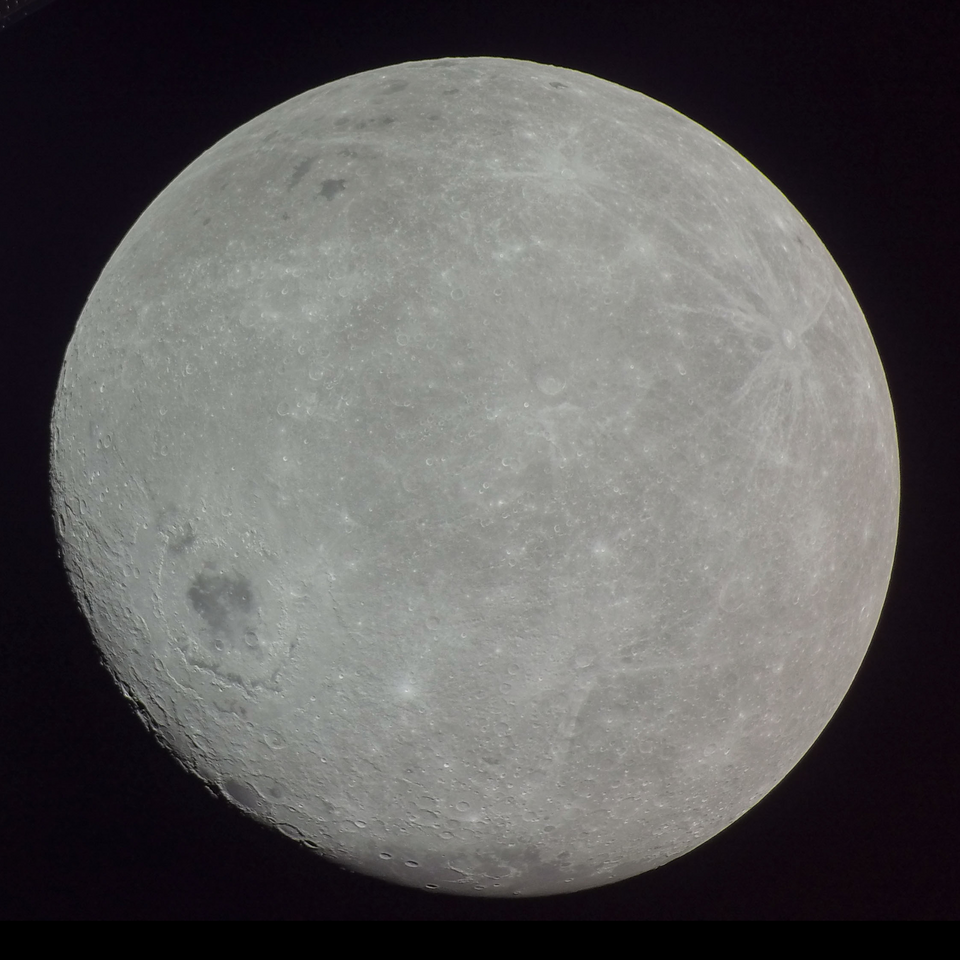
The worlds of the Solar System offer up exciting and (so far) mostly pristine places for planetary scientists to study. As space missions continue to travel to Mars, Europa, asteroids, and other worlds, questions arise about keeping them safe for continued exploration and observations.
In recent decades, scientists voiced concerns, for example, about the possibility of somehow "infecting" Jupiter or Saturn, or their moons with Earth microbes carried on our spacecraft. Or, that probes coming back from other places might bring infectious organisms back to Earth. Mars also came in for scrutiny in the 1960s and 1970s when NASA was planning such missions as the Viking probes to Mars. So, the idea of protecting other worlds is not a new one. Such concerns led to the development of planetary protection protocols. The main goals of these guidelines, as outlined by NASA's Office of Safety and Mission Assurance, are:
-
Carefully control forward contamination of other worlds by terrestrial organisms and organic materials carried by spacecraft to guarantee the integrity of the search and study of extraterrestrial life, if it exists.
-
Rigorously preclude backward contamination of Earth by extraterrestrial life or bioactive molecules in returned samples from habitable worlds in order to prevent potentially harmful consequences for humans and the Earth’s biosphere.
Debating the Future Use of Other Worlds
Those protocols protect other worlds, but what about preserving places such as the Moon as bases for astronomers and cosmologists to study the Universe? With the near future holding the possibility of more probes and humans landing on the Moon, scientists and others have raised questions about what should be preserved there as future science labs and habitats are planned. Lunar exploration and preservation was the topic of a July 21 debate held by the Royal Astronomical Society in Birmingham, England. It was part of a conference on lunar governance, and after the debate, 76 percent of attendees indicated their support for scientific preservation of the Moon.
The panel of scientists debating the questions around lunar exploration included Dr. Jonathan McDowell, Professor Joe Silk, Professor Martin Ward, Dr. Nikita Chu and Dr. Manual Salvoldi. They explored the question: "Should the lunar far side remain a protected scientific environment, or should commercial activity be allowed alongside research?"
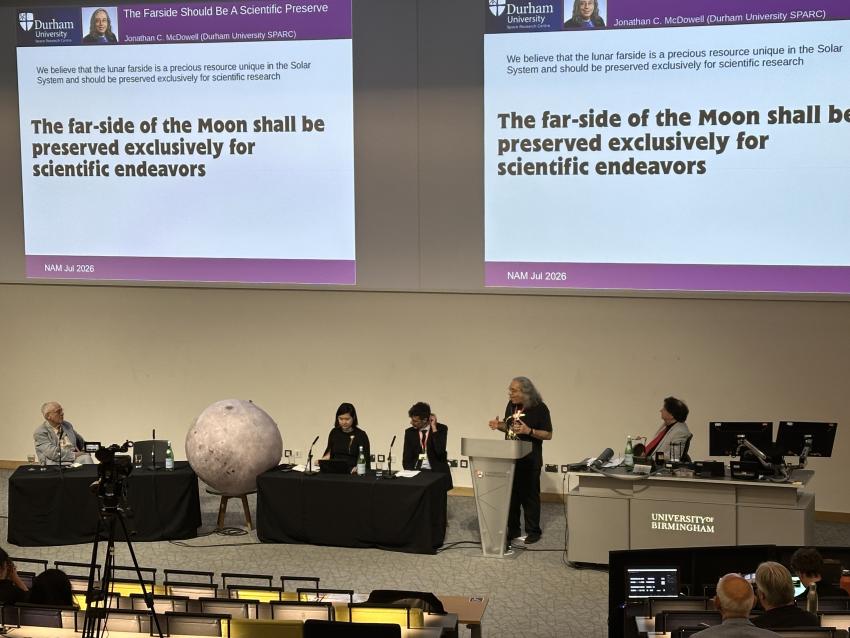 Astrophysicist Dr Jonathan McDowell stressed that what we do on the Moon today will set a precedent for preserving parts of the entire Solar System as we move out into it. Courtesy: Royal Astronomical Society
Ambitious mission plans for laboratories and habitats are long-term goals, and there are certainly institutions with interests in exploiting the Moon for its resources. The lunar far side, however, offers something rare: an environment where radio signals from Earth don't exist, and there's no artificial light to mess with telescope viewing. That rare region raises a different protection question from those focused on microbial pollution of other worlds. According to Jonathan McDowell, the time to plan for scientific use of the Far Side is now. "Is the whole Solar System up for grabs," he asked at the debate, "Or are we going to have nature reserves and science reserves, where we don't mine all the asteroids and don't turn all of Mars into a theme park?"
Science from the Moon
McDowell and Dr. Silk argued in favor of preserving the Far Side as much as possible for science. They pointed out that it's a prime location for radio telescopes to operate free of interference from Earth's "radio pollution". Installations in that region could perform science currently nearly impossible to do from Earth, including detecting faint emissions from the earliest ages of the Universe.
The Far Side offers a haven for interferometers, observatories, and gravitational wave detectors. That's because it's an incredibly stable environment to measure extraordinarily small distortions in space-time that give rare insights into the origins of the Universe. In addition, the dark lunar night gives a perfect platform for optical astronomy observatories on the Far Side. While the astronomy community has some of the darkest areas on Earth reserved for observations, those are increasingly threatened by light pollution as well as the rapidly growing number of satellite constellations (such as Starlink, GPS, GLONASS, OneWeb and upcoming swarms of orbiting communications and other equipment). It's only a matter of time before truly dark skies needed for ever-deeper studies of the Universe will be curtailed on Earth. It makes sense, then, that the Moon would be attractive to astronomers for a wide variety of multi-messenger observatories.
The Time to Claim Observatory Territory is Now
During the debate, Professor Silk pointed out that laying claim to pristine areas on the Moon for observation should start now, so that future generations of astronomers will have access to observatories. "I think it's important to preserve the far side for the ultimate science, which will be decades in the future," he said. "We have to plan ahead, and the reason is very simply that these are some of the most important questions that humanity has ever posed: Are we alone in the Universe, and how did the universe begin?"
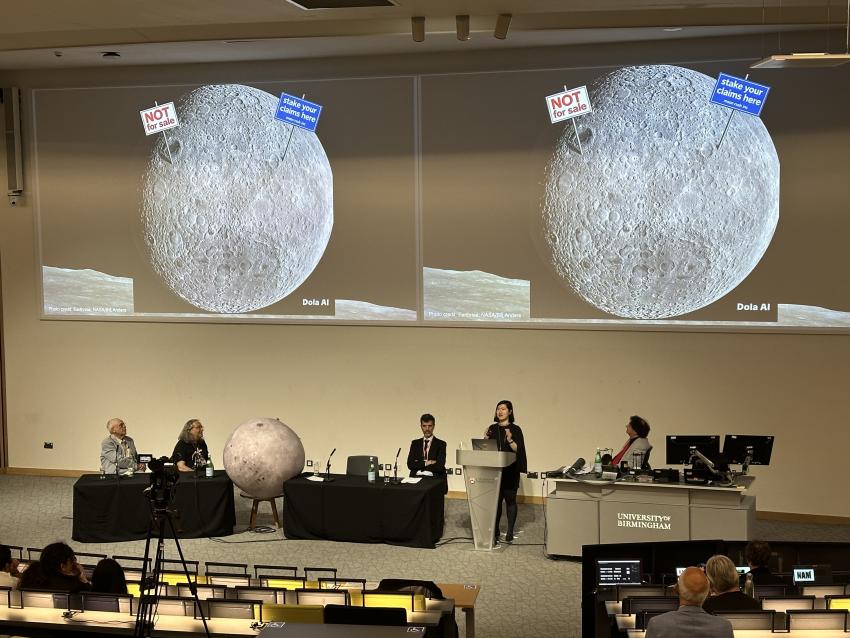 Dr Nikita Chiu argued that commercial and scientific activities can coexist under appropriate governance. Courtesy: Royal Astronomical Society
The chance to answer the really big questions in astronomy and cosmology may be lost if the Far Side sustains any kind of development, according to Silk and McDowell. Landing sites, communication satellite pollution, artificial lights, and more. Those could permanently degrade the unique environment that currently makes the Far Side so valuable for science. According to McDowell, decisions made over the next few years would set a precedent that shapes humanity's wider relationship with the Solar System. "What we do now and in the next few years to preserve science on the Moon is going to be critical not just to the future of science on the Moon, but to the future of science and the environment throughout the Solar System," he said.
For More Information
NAM 2026 Debate: Should the Far Side of the Moon be Reserved for Science?