 Universe Today
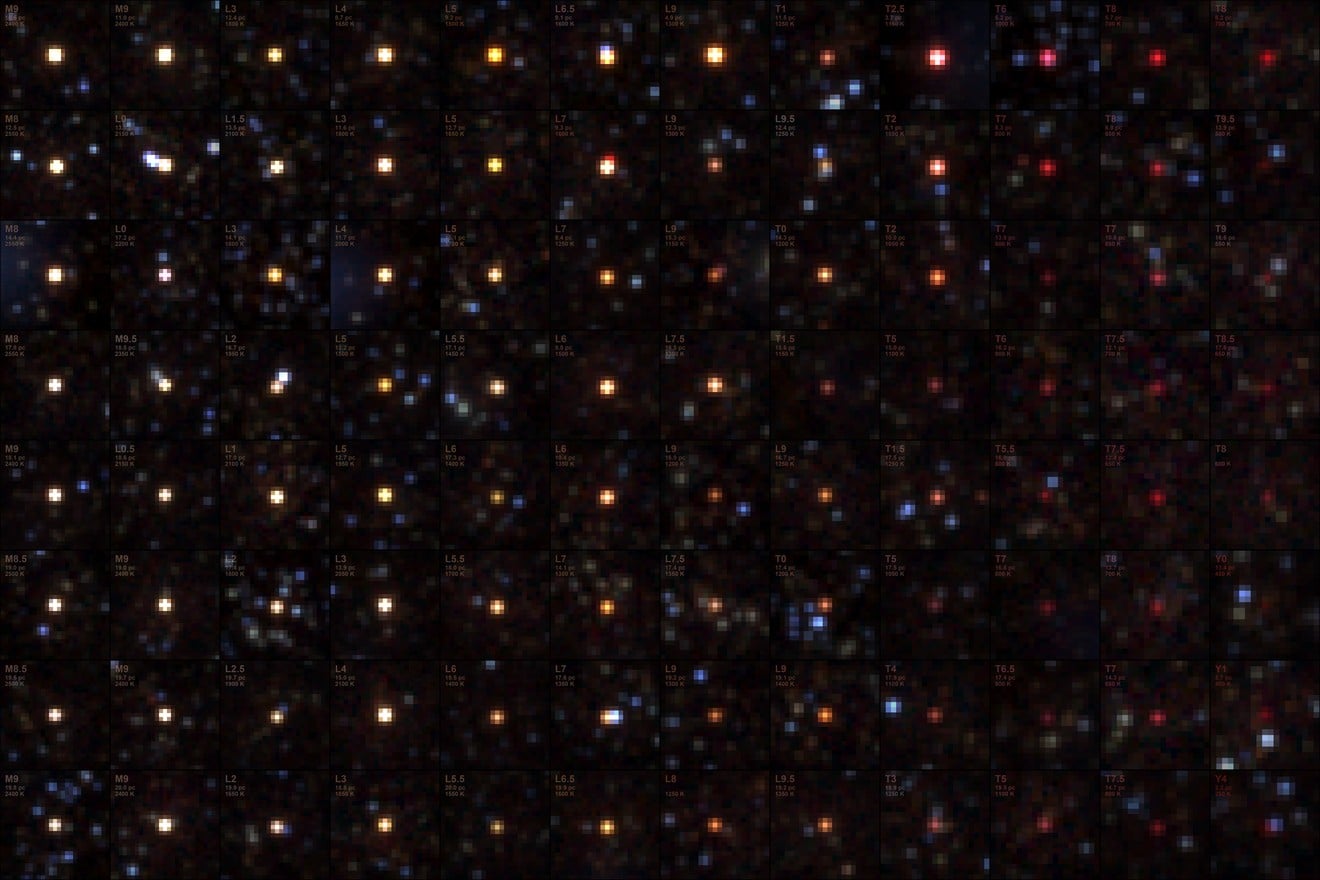
Brown dwarfs are the black (or brown?) sheep of astronomy. They’re too big to be considered a traditional gas planet, but they are too small to have started nuclear fusion and made the full transition to star-hood. They also change dramatically over time, cooling, shrinking, and spinning faster as they age. Or at least we think they do - our models of the atmospheres of these celestial objects aren’t the best, according to a new paper in The Astrophysical Journal Letters by a team led by Zafar Rustamkulov at Caltech and NASA’s Jet Propulsion Laboratory.
Given that they aren’t bright like stars, brown dwarfs are relatively hard to find, but light does filter out from their hot interior. As it passes through its upper atmosphere, the molecules there absorb specific wavelengths. This allows astronomers to perform spectroscopy on it, analyzing the dips and peaks of brightness at different wavelengths that represent the telltale signs of methane, water vapor, or carbon monoxide.
In the past, astronomers used the broadband filters on survey telescopes like 2MASS and WISE. While they did give a picture, it wasn’t a complete one - their resolution was too low. You could make out the general color palette, but the individual brushstrokes were lost.
Fraser talks about dark matter in brown dwarfsLuckily, the Spectro-Photometer for the History of the Universe, Epoch of Reionization, and Ices Explorer (SPHEREx), which entered service in May 2025, is a game changer for exactly this kind of study. It maps the entire sky in 102 continuous wavelength channels, ranging from wavelengths of 0.75 microns up to 5 microns, which covers 80% of the heat energy released by brown dwarfs as infrared light.
Rustamkulov and his team used that SPHEREx data to compile a high-fidelity sequence of 33 nearby brown dwarfs between 7 and 100 light years away from Earth. They cover the three coolest spectral classes of these objects - L dwarfs, which hover around 2,200℃, T dwarfs, which lie between 700 and 1,000℃, and Y dwarfs, which can dip down to a frigid -20℃. They also accounted for brown dwarfs with low gravity and low metallicity, in an effort to capture as many different combinations of features as they could.
With the SPHEREx spectra in hand, they then compared its findings to five leading theoretical brown dwarf atmosphere models: Sonora Diamondback, Sonora Elf Owl, BT-Settl, ATMO2020, and ATMO2020++. Each makes different assumptions about how the atmospheres would behave. None of them seemed to be correct.
Fraser talks about low mass, low energy stars.Notably, they struggled to match a series of near-infrared flux peaks between 1 and 2.5 microns, and missed a critical “opacity window” at around 4.0 microns where light can easily escape the atmosphere. They also predicted sizes for these failed stars that were completely physically unrealistic, and sometimes off by as much as 20-50%. And they appeared to do so simply to make up for the model’s poor understanding of the underlying chemistry.
They did get some things right, though. The researchers originally developed a series of custom spectral indices that focused on how carbon shifts in the atmosphere between carbon monoxide, carbon dioxide, and methane. In the data, there was a very clear trajectory - as brown dwarfs cool below 1,000 K, the amount of carbon monoxide drops off sharply and methane begins to take over. This match one of the models - Sonora Elf Owl - well, when it used weak vertical mixing. If that is what happens on brown dwarfs, it would contrast with giant planets like Jupiter, where strong churning of its atmosphere is an everyday feature.
Though brown dwarfs themselves might be isolated, the results of this work isn’t only about them. Actually, the fact that they are isolated make them excellent test beds for what happens to large objects that isn’t caused by a host star. But until we improve our models to better match the observed spectra of these objects, it will be difficult to apply that improved understanding to other, more traditional exoplanets.
SPHEREx is just getting started, though, and its cataloging thousands of additional brown dwarfs during its two year all-sky survey. That should provide modelers with the empirical roadmaps they need to refine their code and fix their physics. Keep an eye out for dramatically improved models of these sub-stellar wanderers in the near future.
Learn More:
NASA - NASA’s SPHEREx Telescope Sees Menagerie of Brown Dwarfs
Z. Rustamkuvlov et al - SPHEREx 0.75–5 μm Spectra for a Sequence of Nearby Brown Dwarfs
UT - Webb Searches for Brown Dwarfs in a Stunning Star-Forming Region