Universe Today
A strong foundation is key for any building construction, and this doesn’t just apply to construction on Earth. As humanity slowly expands throughout the many worlds of our solar system, and possibly beyond, understanding the planetary surfaces is key to constructing long-lasting habitats beyond Earth. Thus, it’s only natural this venture begins with our own Moon, which is the target of a permanent lunar south pole base by NASA. While the Moon is covered by a thin layer of dust, also called regolith, it’s vital for engineers to know the thickness of this regolith to know the safest locations to construct future lunar habitats and buildings.
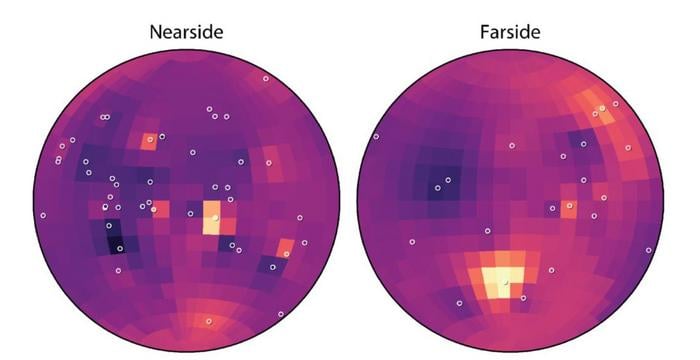
Now, a team of researchers from Brown University might be making a large contribution to future lunar bases, as they investigated the thickness of the lunar regolith across the entire lunar surface, whose findings were recently published in The Planetary Science Journal. While scientists have long hypothesized that the regolith is thinner in the dark, volcanic regions (called lunar mare or maria for singular or plural, respectively) and thicker in the brighter lunar highland regions, global data regarding the exact regolith thickness has remained a mystery.
To accomplish this, the researchers analyzed data regarding 346 fresh impact craters across 13 areas throughout the lunar maria and highland regions. The primary motivation of the study was to place a numerical thickness of the regolith and produce an open-source database that can be potentially used for lunar infrastructure development. In the end, the researchers found that the mare regolith was about 4 meters (13 feet) thick while the highlands regolith was about 6 meters (20 feet) thick.
“For example, in a situation where you want to build a Moon base, thinner regolith could make it easier to reach more competent material for foundations, depending on the construction method,” said Dr. Andrea Rajšić, who is a research scientist at Brown University and lead author of the study. “On the other hand, if you’re thinking about resources utilization, there may be a lot of useful things trapped in the regolith — like water ice or helium-3.”
As noted, this study comes as NASA has ambitious plans to build a permanent Moon base near the lunar south pole. This is because the region is home to a myriad of craters whose depths have never seen sunlight, known as the permanently shadowed regions, and are located at both poles. What makes this unique is these craters have displayed evidence for harboring scores of water ice that have accumulated potentially for billions of years. Harvesting water ice from beneath the lunar regolith would be done using a practice known as in situ resource utilization (ISRU), also called “living off the land”, and could potentially result in substantial reductions in financial and logistical burdens of shipping water from Earth.
The researchers note how this study establishes a strong foundation (no pun intended) for uses beyond just the Moon, potentially using it for other “airless bodies”, as it states. While not mentioned in the study, this might include Mercury, Mars’ moons Phobos and Deimos, Jupiter’s moons Europa, Ganymede, and Callisto (since Io and volcanically active), and even several of Saturn’s moons, or beyond. While Mars has long been an eventual target for human exploration, its weather patterns, specifically dust storms, constantly rearrange the regolith, thus making regolith thickness estimates difficult, or even impossible.
What new insights into the lunar regolith and how it could aid in building future lunar bases will researchers make in the coming years and decades? Only time will tell, and this is why we science!
As always, keep doing science & keep looking up!