Universe Today
Jupiter’s moon, Io, is the most volcanically active planetary body in the solar system, boasting hundreds of active volcanoes spewing molten lava into space. This occurs from a process called tidal heating where Jupiter’s massive gravity constantly stretches and compresses the much smaller moon during the latter’s non-circular orbit. However, a lesser-known fact is that Io’s volcanic gases fuel Jupiter’s aurorae by traveling along Jupiter’s magnetic field lines, resulting in Jupiter’s bright aurorae observed by spacecraft and Earth-based telescopes. But what if this same phenomenon could be used to detect Io-like exomoons, also called exo-Ios, orbiting Jupiter-like exoplanets?
Now, an international team of researchers might be one step closer to answering this question as they introduced a novel method for potentially detecting and confirming the existence of exo-Ios. The findings for this study were recently accepted for publication in The Astronomical Journal and holds the potential to help scientists identify and detect exo-Ios and possibly other exomoons, too.
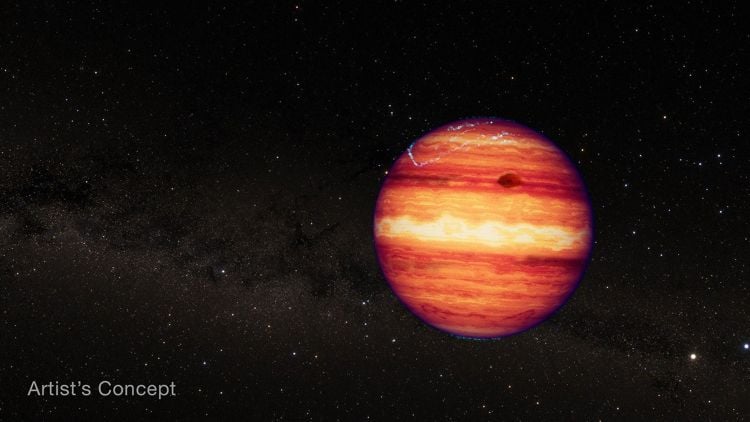
For the study, the researchers analyzed transit auroral data obtained from NASA’s James Webb Space Telescope (JWST) about exoplanet SIMP 0136+0933, which is located about 20 light-years from Earth, is about 12.7 Jupiter masses, and completes one rotation in only 2.4 hours. For context, the planet Jupiter takes slightly under 10 hours to rotate once on its axis. The reason the researchers analyzed auroral data was to ascertain if a volcanically active exomoon could be “feeding” SIMP 0136+0933’s aurorae like Io is hypothesized to feed Jupiter’s aurorae.
SIMP 0136+0933’s aurorae data was obtained when it transited, or passed in front of, its host star, and produced what’s called a light curve that JWST analyzed. In the end, the researchers found that SIMP 0136+0933 could potentially possess an exomoon with estimated success rates of detecting an exo-Io or even an exo-Ganymede at 66 and 93 percent, respectively.
The study notes in its conclusions, “Although the existing light curves demonstrate that the transit technique is capable of detecting exosatellites analogous to Io in the aurorally active SIMP 0136+0933 system, the duration of the archival data is insufficient to place meaningful constraints on the presence of a transiting satellite. We conclude that JWST light curves spanning ∼1.5 days for ∼4-12 known aurorally active super-Jupiters would be needed to place meaningful statistical constraints whether Io analogs are commonly present in these systems.”
Along with being designated as a “super-Jupiter”, SIMP 0136+0933 is designated as a free-floating planetary-mass object. This is different from being designated as a rogue planet since scientists label it as sitting at the boundary of being too small to be a star and too large to become a planet. Although, describing SIMP 0136+0933 as a rogue planet is still acceptable. When it was first discovered in 2006, SIMP 0136+0933 was first designated as a brown dwarf star as part of a cluster of stars about 200 million years old. Brown dwarf stars are also called a “failed star” because they didn’t become large enough to produce nuclear fusion. However, follow-up observations on SIMP 0136+0933 revealed to be only 12.7 times Jupiter’s mass, making it too small to be a failed star.
This study comes as the scientific community has yet to 100 percent definitively confirm the existence of an exomoon, though several unconfirmed exomoon candidates have been identified. These include potential exomoon candidates orbiting WASP-49 b, Kepler-1625 b, Kepler-1708 b, and HD 206893 b. The reason exomoons are so hard to detect is simply due to their significantly smaller size compared to exoplanets and are analogous to microscopic dots in the bright glares of far-away stars.
What new insights into volcanic exo-Ios and other exomoons will researchers make in the coming years and decades? Only time will tell, and this is why we science!
As always, keep doing science & keep looking up!