 Universe Today
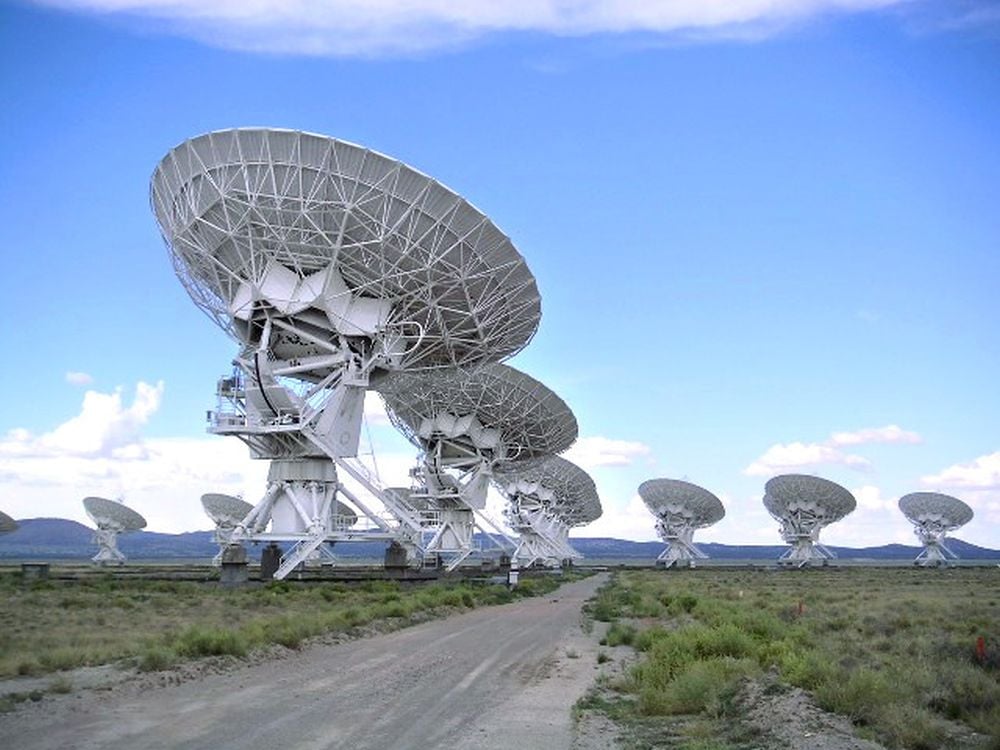
The Karl G. Jansky Very Large Array (VLA) is an array of 28 25-meter radio dishes in New Mexico. Each of the telescopes is mounted on rails, and by shifting the radiotelescopes around, the VLA can be reconfigured. This can change how the interferometer is used for greater angular resolution or surface brightness detection in different parts of the sky.
The VLA has made observations of objects like protoplanetary disks, black holes, and even how gas moves around near the center of the Milky Way. But one of its greatest feats is the Very Large Array Sky Survey (VLASS), a massive radio survey of the sky recently completed in February 2026. It covered 80% of the sky in three epochs, allowing for the detection of transients. VLASS created about 2 petabytes of data, making it the largest survey the VLA has ever done.
What's important about VLASS is that its resolution is equal to that of optical and other surveys. It's now the highest-resolution radio survey ever taken.
“With VLASS, we now have a radio map of the sky that matches the resolution of modern optical and infrared surveys,” said Amy Kimball, VLASS Head of Operations. “This opens the door to truly multiwavelength discoveries at a level of detail that was not previously possible,” she said in a press release.
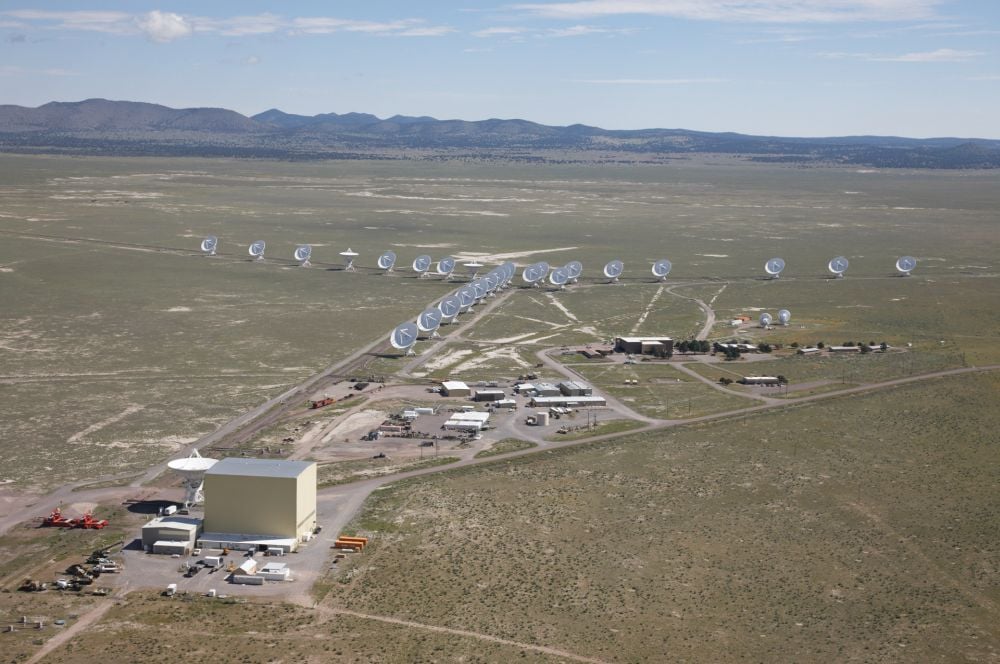 This aerial image of the VLA shows it in its Y-shaped array, also called its B configuration. The configuration can be changed for sharper resolution or for other reasons, and the antennae are shifted around every three or four months to target different parts of the sky. Image Credit: NRAO/AUI/NSF
The VLA has completed other surveys, but in a way, this one was necessary because of the growing power of our optical and infrared telescopes and their surveys. A 2020 paper explained the purpose and the design of the VLASS. It's titled "The Karl G. Jansky Very Large Array Sky Survey (VLASS). Science Case and Survey Design," and it was published in Publications of the Astronomical Society of the Pacific. The lead author is Mark Lacy of the National Radio Astronomy Observatory.
"A new radio survey with the VLA was further motivated by major surveys now being undertaken in the optical and near-infrared," the paper stated. "Large-format detectors in these regimes have greatly expanded the capabilities of surveys, making the combination of depth and frequent re-observation possible over tens of thousands of square degrees." The VLASS complements these surveys, giving astronomers and astrophysicists new capabilities to study and characterize stellar populations and galaxy populations at a new level of detail.
The VLASS has four main science themes:
- Hidden Explosions and Transient Events, including supernovae, gamma-ray bursts, and other short-lived phenomena.
- Faraday Tomography of the Magnetic Sky, using polarization data to map magnetic fields across cosmic environments.
- Imaging Galaxies through Time and Space, tracing the evolution of galaxies and active galactic nuclei.
- The New Milky Way, revealing previously unseen structures and sources within our own galaxy.
The VLASS required about 6,500 hours of observing time to complete and will have the benefit of upgraded instruments and electronics. Half of the visible sky was observed four times, and the other half was observed three times. This program created deep observations of the sky while also allowing the detection of transients.
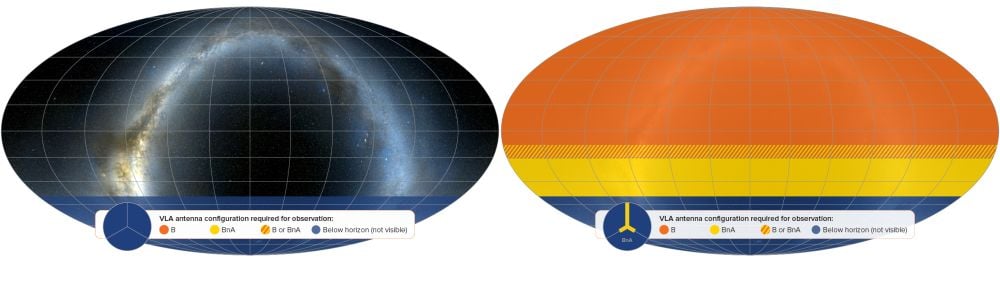 These panels show the VLASS's sky coverage and what antenna configurations were used for different regions. The B configuration gives very sharp resolution, while the BnA configuration extends that resolution to objects near the southern horizon. Image Credit: NRAO
Astronomical surveys have scientific staying power. Their data is foundational and touches all areas of astronomical and astrophysical research. The VLA has completed two other surveys, the NRAO VLA Sky Survey (NVSS), and the Faint Images of the Radio Sky at Twenty Centimeters (FIRST). It's been almost 20 years since they were completed, and they're still cited frequently.
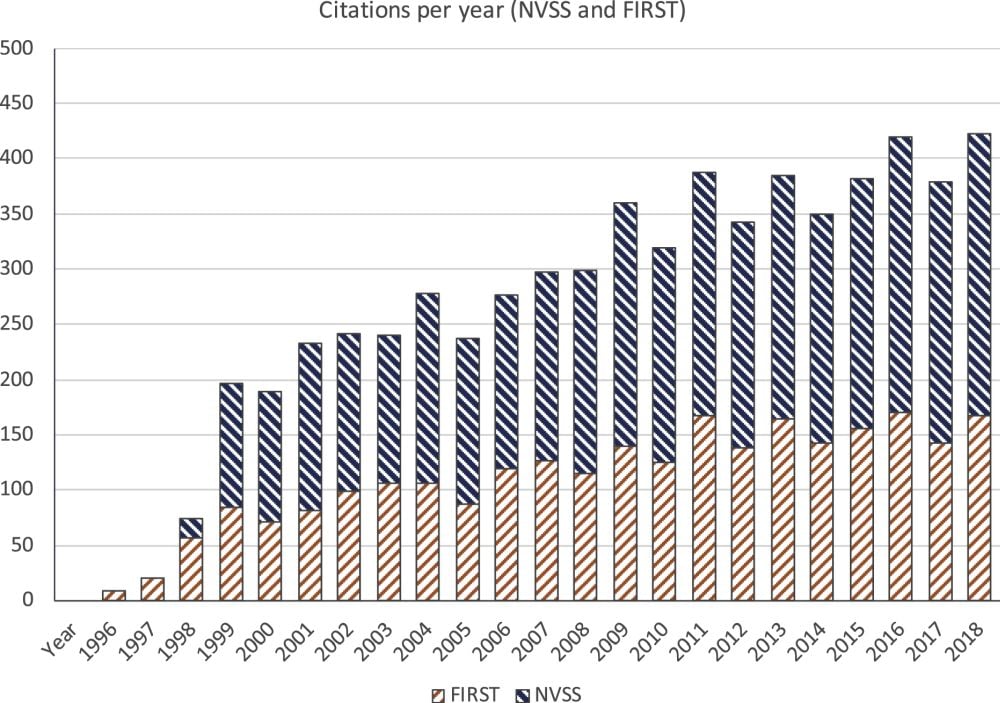 This figure shows how many times the VLA's two previous surveys have been cited up until 2018. The NRAO VLA Sky Survey (NVSS) was completed in 1996, and the Faint Images of the Radio Sky at Twenty Centimeters (FIRST) was completed in 2011. Image Credit: Lacy et al. 2020. PASP.
“VLASS is not just a survey, it is a long-term investment in the future of astrophysics,” said Mark Lacy, VLASS Project Director. “Its combination of depth, coverage, and accessibility ensures that it will remain a foundational resource for the community.”

