 Universe Today
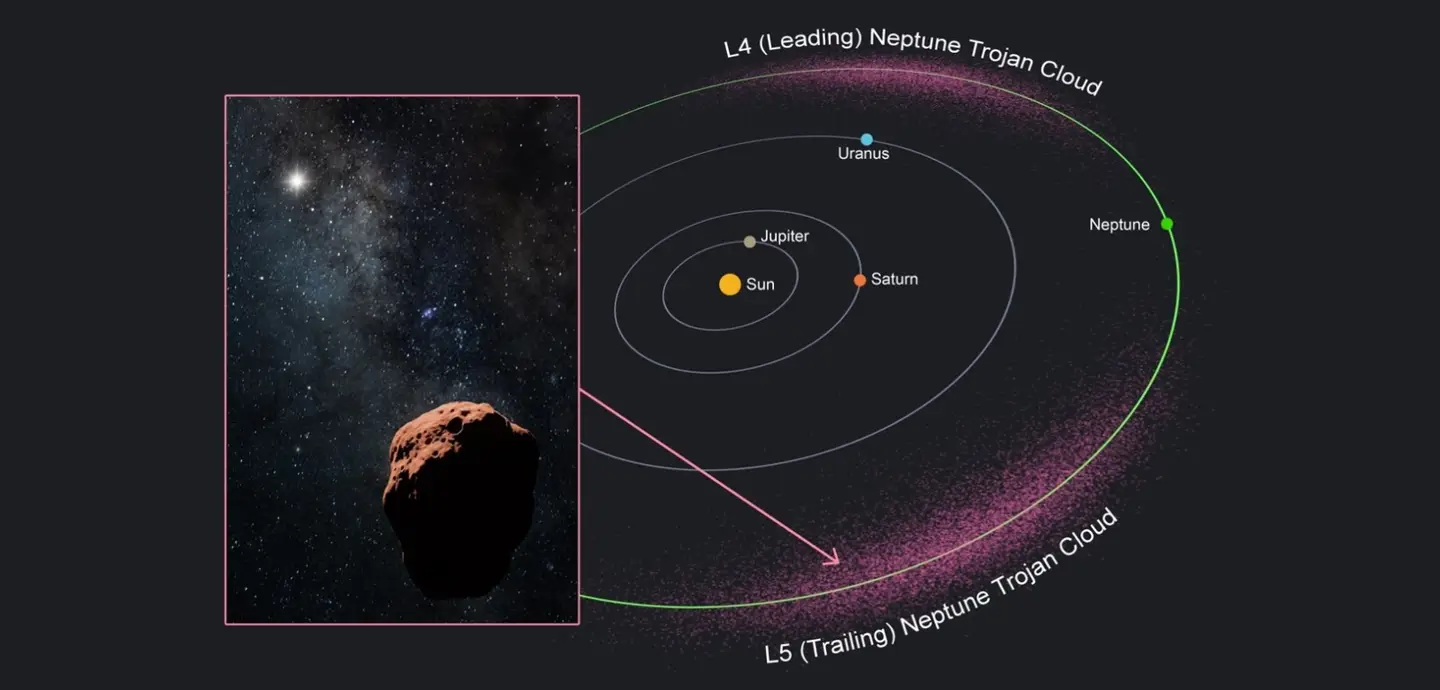
An international team led by researchers at Queen's University Belfast has made a discovery that has eluded astronomers for decades. Beginning in 1906, telescope observations revealed a population of asteroids leading and trailing Jupiter, which came to be known as the "Trojan" and "Greek" populations. Since then, astronomers have discovered similar "families" orbiting Saturn and Uranus, but not Neptune. Thanks to the Queen's-led team, the mystery of the missing Trojans has now been resolved!
As detailed in a paper that appeared in The Astrophysical Journal Letters, the team found these distant icy bodies by analyzing data from the Vera C. Rubin Observatory, the next-generation telescope perched high atop the Andes in Chile. Thanks to Rubin's sharp optics and ability to rapidly survey the night sky (the fastest of any ground-based telescope), the team identified two asteroids and a candidate as permanent members of Neptune's trailing Trojans.
The team was led by Dr. Meg Schwamb, an astronomer and lecturer at the Astrophysics Research Centre, Queen's University Belfast (QUB). She was joined by researchers from the Instituto de Astronomia, Geofísica e Ciências Atmosféricas (IAG), the Planetary Science Institute (PSI), the DiRAC Institute, the Michigan Institute for Data and AI in Society (MIDAS), JHUAPL, the NSF's NOIRLAB, and multiple universities worldwide.
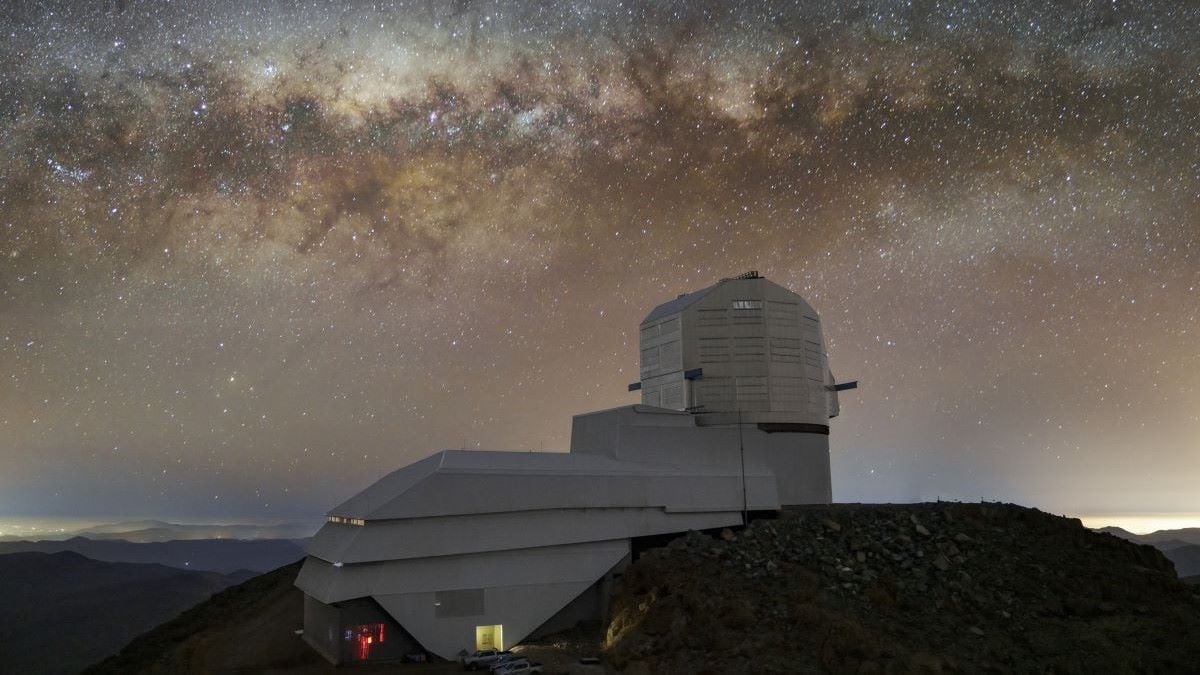 The Vera C. Rubin Observatory's LSST survey will help scientists create a census of Solar System objects. Credit: Rubin Observatory/NOIRLab/NSF/AURA H.
The Vera C. Rubin Observatory combines the resolution of its 8.4-meter Simony Survey Telescope with the LSST Camera, the largest digital camera ever built. Having commenced operations in June 2025, Rubin is currently conducting the largest survey of the southern sky - the Legacy Survey of Space and Time (LSST). At the same time, it is mapping the northern sky to create an ultra-wide, ultra-high-definition time-lapse record of the cosmos.
Through these surveys, Rubin will provide new insight into the mysteries of the cosmos, including Dark Matter and Dark Energy. It will map the Milky Way and its faint satellite galaxies, detect transient phenomena (supernovae, variable stars, rogue planets, etc.) and create an inventory of objects in the Solar System. This last objective was what drew Schwamb and her team to analyze data from Rubin's early test observations last year.
After combining this massive trove of data, the team identified the objects as primordial members of the elusive trailing Neptune Trojan population. "Early data from Rubin Observatory is already expanding our knowledge of the solar system's 'small bodies,' including asteroids, comets, and other minor planets," Schwamb explained in a QUB press release. "And these early observations have provided our clearest view yet of Neptune's trailing Trojan cloud."
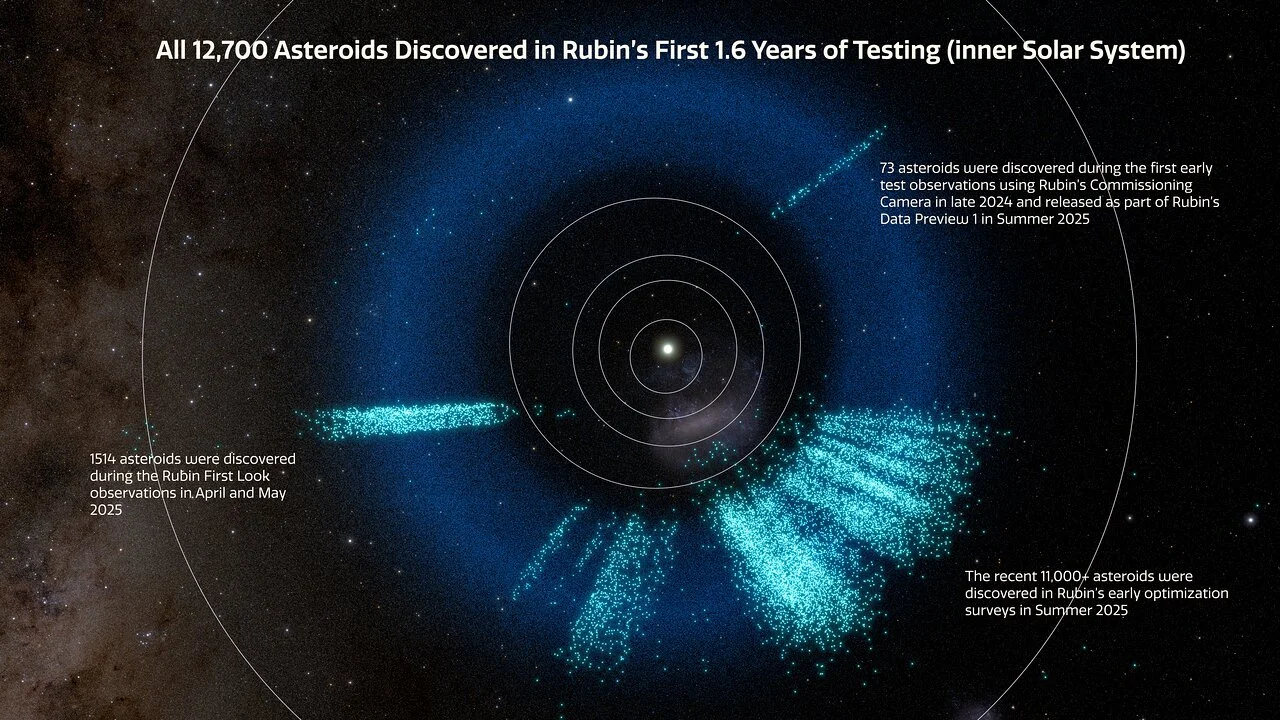 A rendering of the inner Solar System showing the asteroids discovered by Rubin in light teal. Known asteroids are dark blue. Credit: NSF–DOE Vera C. Rubin Observatory/NSF NOIRLab/SLAC/AURA/R/NASA/Goddard/ESA/Gaia/DPAC
Previously, astronomers struggled to find Neptune's Trojan populations because of the difficulty of spotting such distant, faint objects as they moved across the night sky. For the past ten years, the Trojans have been crowded in a region of the sky that placed them in front of the Milky Way's center (relative to Earth-based observers), an extremely dense and bright part of the night sky that obscured any tiny light sources in the foreground. Said Schwamb:
The Trailing Cloud has now begun to move out of this region of sky and combined with the Rubin Observatory's unmatched depth and sky coverage, we've been able to double the number of known objects in this population on long-lived orbits. These discoveries offer a glimpse of just how transformative Rubin's data will be, with even more exciting findings expected in the years ahead.
The Rubin Observatory obtained images of these objects using different filters, which allowed Dr. Schwamb and her team to show that the Trojans leading and trailing Neptune have similar surfaces. As Rubin continues the LSST survey over the next nine years, it is expected to discover tens to hundreds of Neptune Trojans in both its leading and trailing population, plus tens of thousands of icy bodies in the Trans-Neptunian Region and Kuiper Belt.
Further Reading: Queen's University, The Astrophysical Journal Letters**