 Universe Today
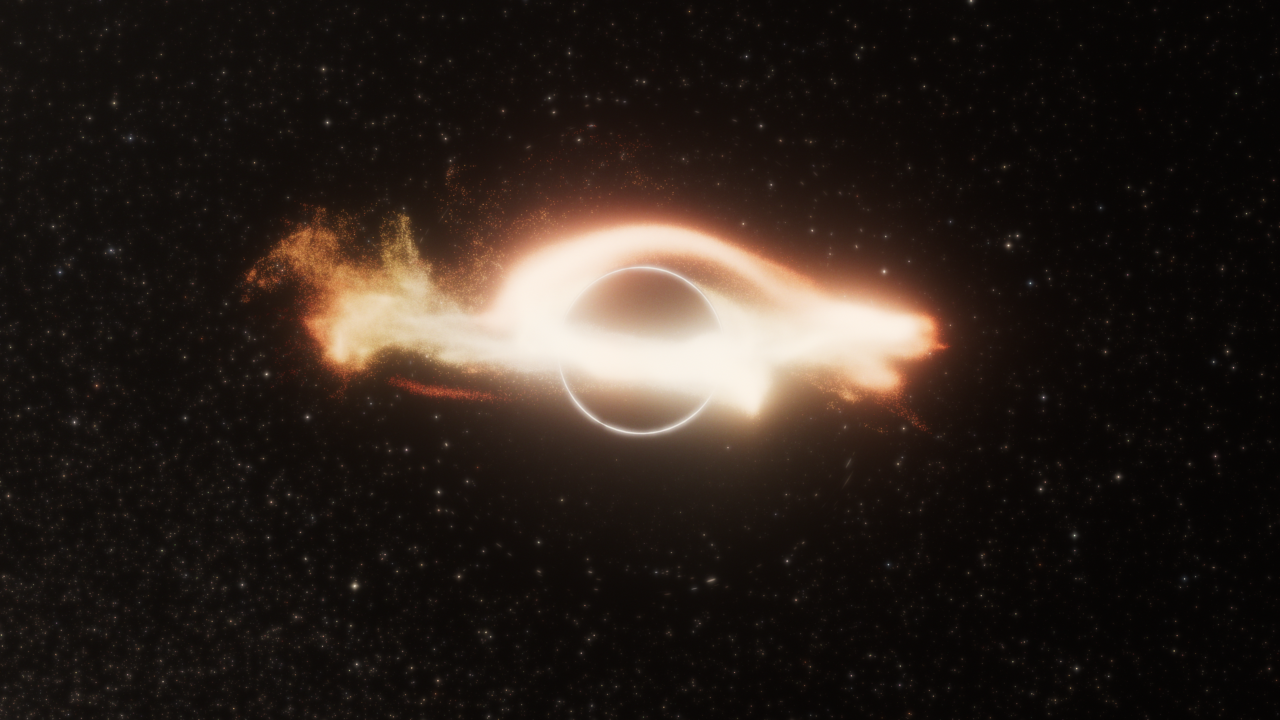
We all know that black holes can collide. It has happened since black holes began to form, early in cosmic time. The result is always a clash that gives off gravitational waves and a giant bang. Since black holes have such strong gravity, it's almost impossible to imagine a way that any force could break one apart. Yet, that's the task that a group of scientists in Europe set for themselves.
In a study of possible mechanisms for black hole fragmentation, Francesco Sannino of the University of Naples Federico II in Italy and the Quantum Field Theory Center at the University of Southern Denmark, along with Giacomo Cacciapaglia (Laboratoire de Physique Théorique et Hautes Énergies) and Manuel Del Piano and Vania Vellucci, both from the Quantum Field Theory Center, conducted a series of calculations showing that under the right conditions, a black hole could split up into two black holes. It's an unusual possibility, to say the least, but the team has calculated what needs to happen if such an event were to occur.
The two pieces would have to stay apart, according to Sannino. "The two resulting black holes must also be able to separate rather than immediately fall back together. When we include this requirement, the window largely closes again, except possibly for black holes rotating close to their maximum possible rate," he said. If such a split-up could happen, the event horizon of the black hole would form a trouser-like shape as the split-up proceeded. Essentially, it would form two legs of a pair of pants, which is why the team called it a "pair-of-pants topology."
Could This Happen?
That's one possibility for what happens if/when a black hole splits into pieces. No one has seen such an event (yet), so it's still largely theoretical. There's one major impediment, however. That's called entropy, the measure of how many different microscopic ways a physical system can be arranged while still appearing the same from the outside. For example, a rock's shape can remain solid and static until some outside force changes it, such as heating. In the case of an ordinary, non-rotating black hole, breaking it into two pieces would reduce its entropy and make the process thermodynamically unlikely.
 The black hole at the centre of M87. It has a measured spin, so theoretically, if conditions were right, it could break apart, according to a new study. Credit: Event Horizon Telescope Collaboration
However, let's say we have a rotating black hole, spinning very rapidly. According to the team, such a system could break up into two pieces. However, they have to separate quickly, or risk falling back together. So, it turns out it could happen if both black holes have to keep rotating as fast as they possibly can (or close to it). But what would cause the split to occur? The answer lies in the rotation. It alters the relationship between black hole mass, its angular momentum as it spins, and entropy. It's possible that change could lead to the black hole fragmenting. If so, then the next steps are for the black hole "twins" to move apart and retain the momentum and speed of the original.
Focusing just on black holes, it seems pretty unlikely that such events have happened, but they don't want to say it's never happened. According to Sannino, the possibility is there, but in specific cases. "We cannot yet give a single probability for a black hole to split. It depends on how gravity behaves beyond Einstein’s theory, and we are working to quantify this," he explained. "We expect small primordial black holes to be more prone to splitting than much larger astrophysical black holes. We may detect a split indirectly: gamma-ray telescopes such as Fermi-LAT can search for signals from tiny black-hole fragments that might form during mergers."