 Universe Today
Mars is the subject of an ongoing, decades-long effort to understand its past. Its potential ancient habitability drives that effort. More than 20 missions have been sent to its surface (though many didn't survive the entry and landing). Two are operating there currently, Curiosity and Perserverance, and multiple orbiters scan the planet's surface from above.
Clues to Mars' past are in its rock, and the more ancient a piece of rock, the deeper the clues it can contain about the planet's ancient past. Visiting Mars with rovers is only one way to access the planet's rock. Fortunately, some chunks of Mars have been sent to Earth. Violent impacts have sent chunks of Mars rock into space, where they've eventually found their way to Earth as meteorites.
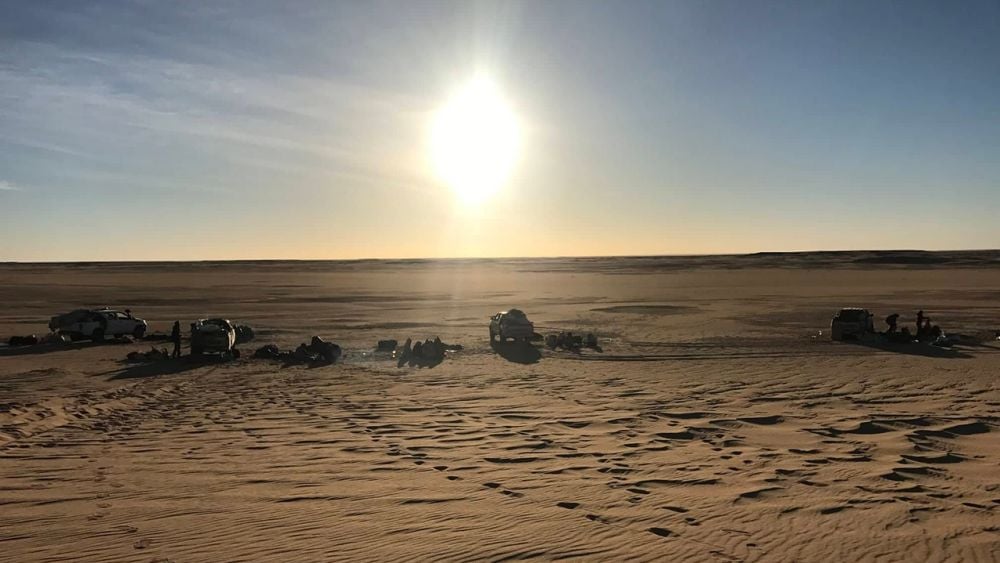
A Martian meteorite named Black Beauty set the standard for ancient meteorites from Mars when it was found in 2011. Most meteorites are found in deserts or in snowy/icy areas simply because they're more easily seen, and Black Beauty (Northwest Africa 7034, or NWA 7034) was found by nomads in the Western Sahara. Portions of it are about 4.43 billion years old, and Mars is about 4.5, maybe 4.6 billion years old. So Black Beauty is extremely ancient.
The Sahara Desert has yielded other ancient Martian meteorites, including Teghaza 001 (Teg 001), found in Mali in 2022. New research uncovered some unusual properties in Teg 001, and they're presented in new research.
The research is titled "A Martian meteorite that formed ≳4.1 billion years ago samples Mars’ early crust and mantle," and it's published in the journal Science. The lead author is Yang Liu from NASA's Jet Propulsion Laboratory at the California Institute of Technology. Scientist Carl Agee, director and curator at the University of New Mexico’s Institute of Meteoritics (IOM), also played a leading role in the work.
"This sample probably came from an environment on Mars that was more Earth-like." - Carl Agee, University of New Mexico.
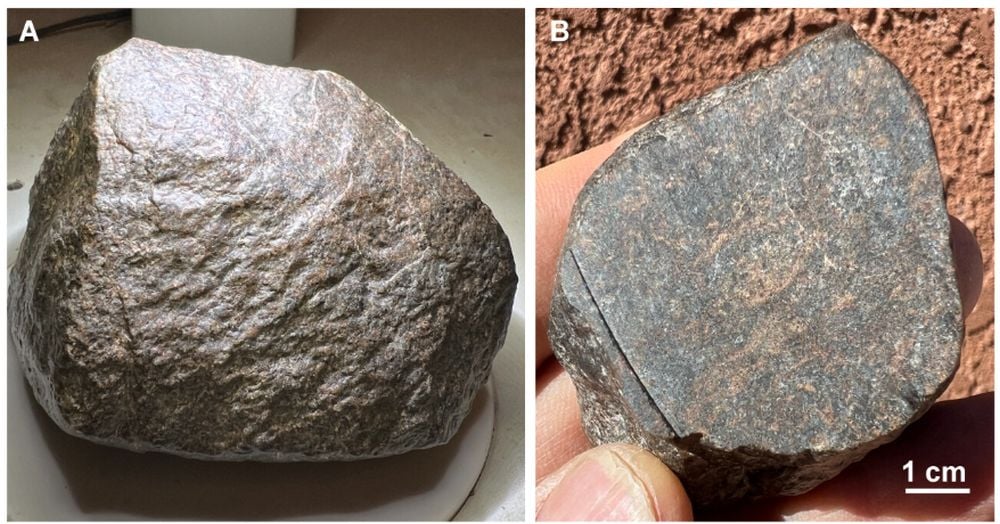 (A) shows the largest of the eight pieces of Teg001. (B) shows a cut section of a smaller chunk. Image Credit: Yang Liu et al., A Martian meteorite that formed ≳4.1 billion years ago samples Mars’ early crust and mantle. Science0,eadz5646DOI:10.1126/science.adz5646
Ancient meteorites are rare finds and they're extremely valuable scientifically.
"Martian meteorites provide a record of the planet’s geological history," the authors explain in their research. "However, most are geologically young samples that are not representative of Mars’ surface, which is dominated by ancient rocks."
Most meteorites are young just because of selection effects. Meteorites are launched into space by impacts, and that favours young rocks, which are stronger. So meteorites tend to come from younger, basaltic volcanic rocks. More ancient parts of Mars crust are weaker because they're fractured and brecciated by impacts. Some ancient rocks are also sedimentary or clay-bearing rock. These rocks are weaker and much less likely to survive an impact that can launch them into space.
Teghaza is one of the rare ancient Martian meteorites.
"We describe the Martian meteorite Teghaza 001 (Teg 001), a slowly cooled igneous rock that formed at least 4.1 billion years ago," the authors write. "Its composition, mineralogy, and texture are distinct from other Martian meteorites." Distinct from other Martian meteorites, but also similar to likewise ancient Black Beauty.
“I realized that this one was a little bit like Black Beauty, not exactly, but it resembled it in the oxygen isotope values,” Agee said in a press release. "I looked at it microscopically and found domains within it that had high levels of manganese oxide, a compound being looked for on Mars by the rovers as an indicator of environments conducive to life.”
MSL Curiosity found rock fractures in Gale Crater that were filled with material rich in MnO. It suggests, but doesn't prove, that the planet's atmosphere once had free oxygen and oxygen-rich groundwater. That's still being debated.
Lead author Yang Liu and other Caltech scientists used a dating technique to find the age of tiny zircon crystals in Teg 001. Zircon crystals are important finding the age of ancient rocks because they can survive geological processes. They also contain trace amounts of elements with long half-lives. This is how Liu determined that Teg 001 is 4.1 billion years old. "We conducted ten measurements of U and Pb isotopes, in six shocked zircon grains with different morphologies, to determine their U-Pb and Pb-Pb ages," the authors explain.
Though Black Beauty is also ancient, the pair of meteorites are quite different from one another.
“There are a few parts to Black Beauty that are around that age, but that whole meteorite itself is a conglomeration of many different rock types. Teghaza 001 is just one unadulterated rock type, and it's 4.1 billion years or older, so that was a big surprise,” said Agee. “It's the oldest Martian igneous rock ever found by a huge margin, but in addition to that, it seemed to have these clues in its composition that suggested it had been in an environment that had fluids and water coursing through it.”
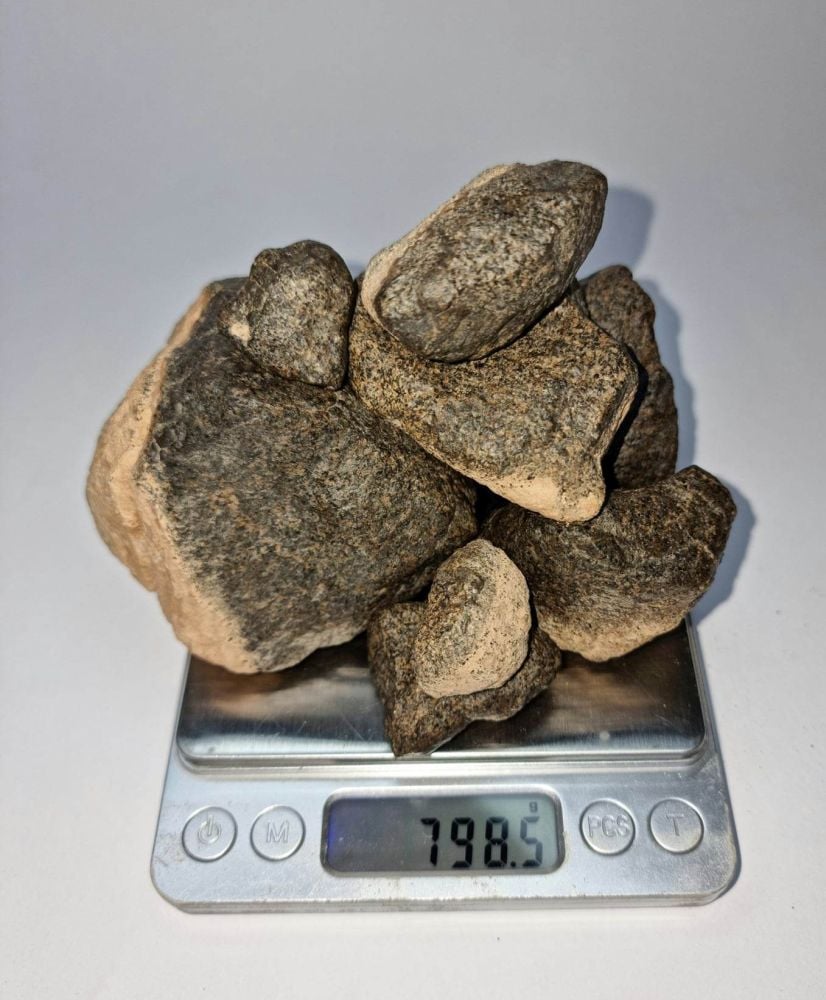 Teghaza 001 was found in several chunks adding up to almost 800 grams. Unlike Black Beauty, which is a congolomeration of different chunks, Teg 001 is a single rock type. Image Credit: UNM.
The isotope Oxygen-18 indicated that it had interacted with water in the past, most likely on the Martian surface. "The high δ 18O value of Teg 001 probably reflects assimilation of δ18O-rich crustal material that had interacted with surficial fluids, or direct reaction of the magma with high-δ18O fluids," the authors write. That finding supports the hypothesis that Mars was once warm and wet, a hypothesis supported by a growing body of evidence.
“We also had these anomalous oxygen isotopes, and these domains that had high manganese levels, Agee said. "All of that was consistent with it being from a time on Mars, from the very, very beginning when the Martian environment was different from the time in which most of the Martian meteorites that we see were formed and erupted a few 100 million years ago when Mars was a dry desert, just like it is now. This sample probably came from an environment on Mars that was more Earth-like.”
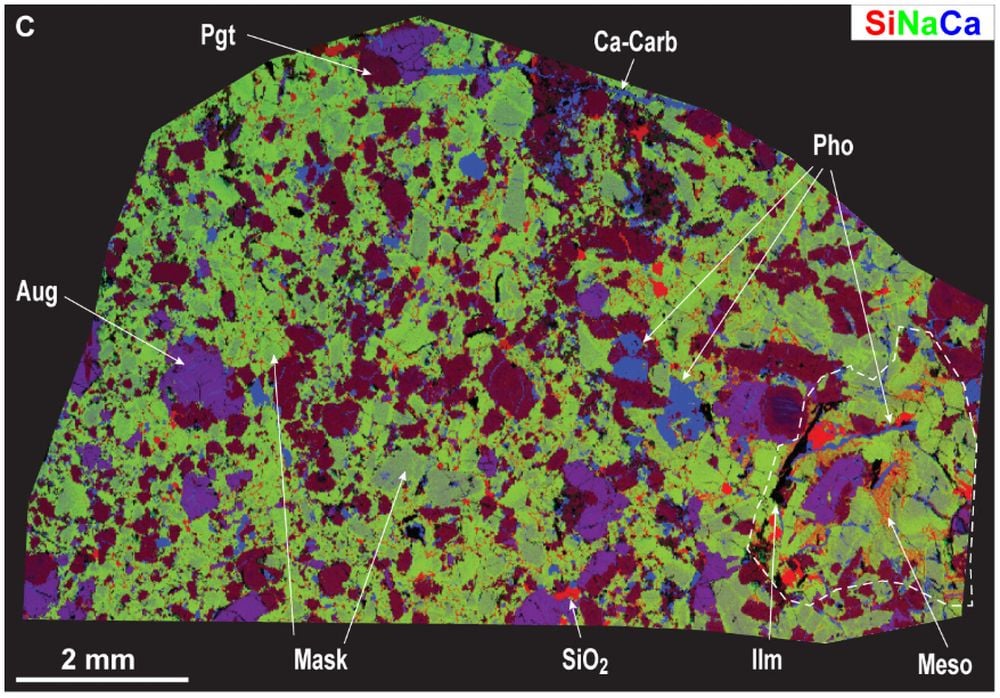 This image shows a cut section of Teg001, with some of its features and contents labelled. Pigeonite (PgT) is particularly relevant, because it hosts fluid-altered Magnesium. "The Mg-rich interiors of pigeonite have been heavily altered by reactions with a fluid phase," the authors write. Image Credit: Yang Liu et al., A Martian meteorite that formed ≳4.1 billion years ago samples Mars’ early crust and mantle. Science0,eadz5646DOI:10.1126/science.adz5646
Mars' early, potentially more Earth-like time period is called the Pre-Noachian period. Planetary scientists struggle to paint a clear picture of the Pre-Noachian because it was so long ago, and geologica processes and weathering have erased much of the ancient. Some research shows that Mars may have had global oceans during this period, a stunning difference from the frigid, dessicated planet it is today.
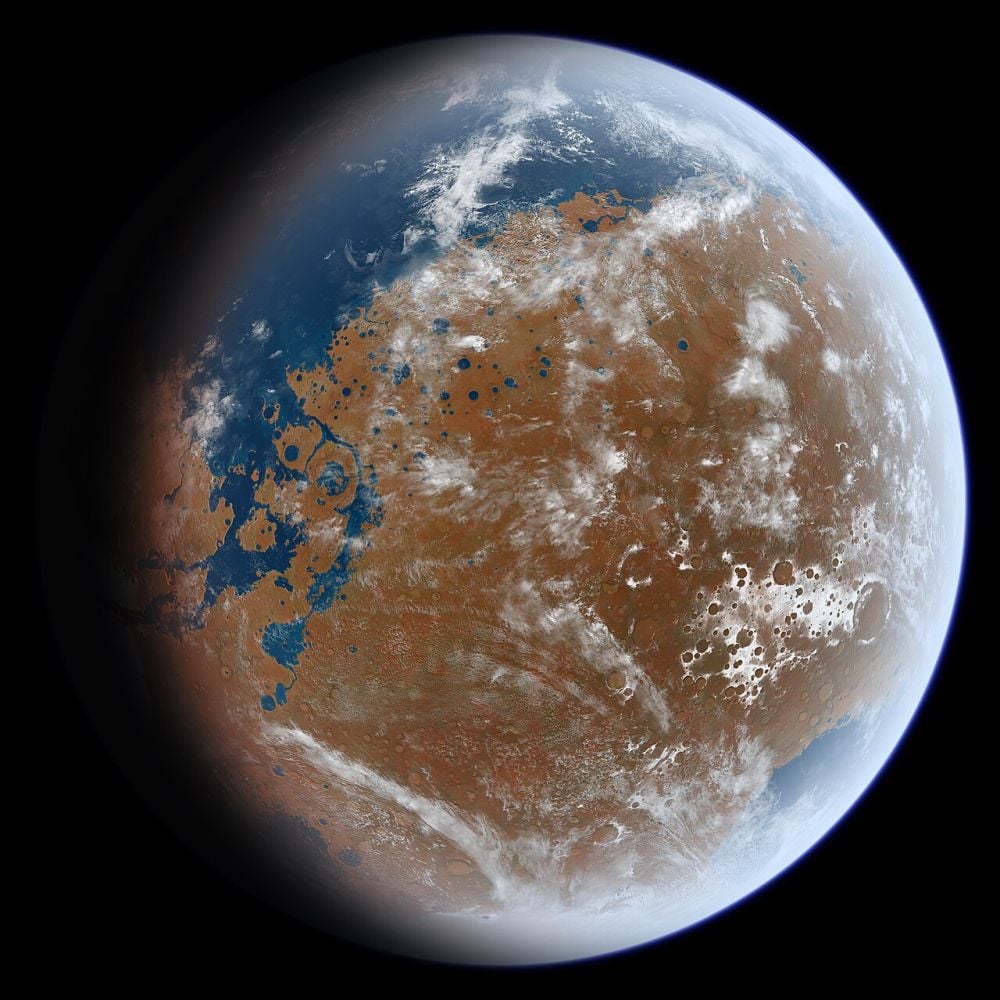 It's possible that billions of years ago, Mars had a global ocean, as shown in this illustration. That could explain the aqueous alteration in Teg001. Image Credit: By Ittiz - Own work, CC BY-SA 3.0, https://commons.wikimedia.org/w/index.php?curid=7861829
It's possible that Mars still has some simple, extant life. If it does, that life is hiding somewhere underground where the last of the planet's ancient water might be sequestered, away from the harsh radiation on the surface. But if the emerging picture of an ancient, warm and wet Mars is true, that would be the Pre-Noachian.
“If there was ever abundant life on Mars, on the surface, not sequestered away in some subsurface, that would be the time that you would be looking at, the Pre-Noachian period,” said Agee. “It's the very earliest time, and that was when maybe Mars still had a magnetic field, and it was shielded from radiation, and there were surface waters. There was a denser atmosphere. If primitive life was abundant in Mars. That is the time that is most likely for it to have happened.”
Most Martian meteorites are much younger than Teg001, only a few hundred million years old. It likely came from a place no rover has visited, possibly from Mars' southern highlands. Remote sensing shows that that ancient region has a similar composition to Teg001.
“This is just one single meteorite. It's like going out, going back in time and chipping off a hunk of an outcrop, 4 billion years ago on Mars, and then we have this example of what was actually happening,” said Agee. “That is why it's such a valuable sample. We’ve never found one like this before. The most exciting part about this find is its age, plus the alteration in the meteorite that indicates it has been in what I would call an Earth-like environment, with fluids coursing over the surface and volcanoes creating hydrothermal systems. There are surface waters and so on. And that's all reflected in the way that the meteorite has been sort of altered from its original state.”
"The presence of aqueously altered minerals, combined with bulk and mineral-specific oxygen isotope measurements, indicate that Teg 001 experienced reactions with fluids enriched in 18O, before ejection into space by an impact," the authors summarize in their paper.

