Universe Today
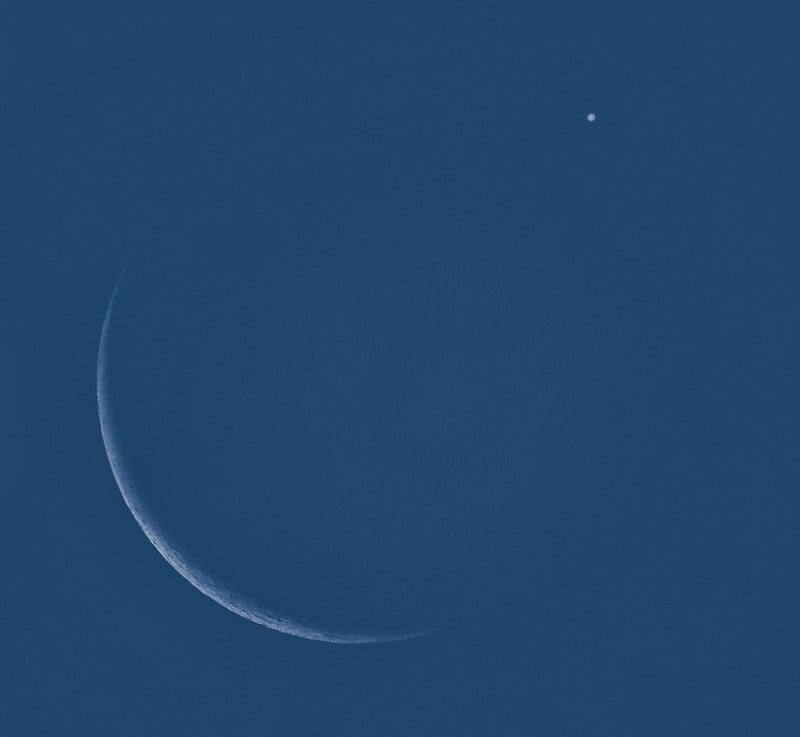
The Moon has a full dance card along the ecliptic this month.
The Moon is busy in September. Coming off of eclipse season in August, the Moon visits no less than two planets, two bright stars and one open cluster in September, as it heads towards the Full Harvest Moon of 2026 on September 26th. No matter where on Earth you happen to be observing from this month, chances are, there’s an occultation of a bright celestial object by the Moon coming to a sky near you.
Despite the esoteric-sounding name, an 'occultation' is simply an astronomical term for one celestial object passing in front of another. Usually the occulting foreground body is markedly larger than the background one, which is why we don’t generally refer to, say, a solar eclipse as an occultation of the Sun by the Moon.
But in a slow-moving Universe, occultations provide us with a sudden, split-second event. The Moon in particular carves out a half a degree wide path, as it bobs above and below the ecliptic plane on its monthly trek around the sky.
Even observing sites outside of a particular occultation path have a shot at seeing the Moon paired with a nearby planet or star, providing a very photogenic scene. You may even have a shot at daytime planet-spotting during the upcoming events, using the nearby Moon as a guide. Note that the dark nighttime limb of the Moon leads the way when it’s waxing, and trails behind it when it’s waning.
Here’s a snapshot of the celestial action coming right up this month:
First up, the -7% illuminated, waning crescent Moon occults Jupiter on September 8th. Northeastern Asia sees this transpire in the early dawn sky, while eastern North America will see the cover-up occur in the daytime, post sunrise. Alaska and western Canada will see this event occur in the late morning sky, while eastern Canada and the U.S. will have a tougher time to see the Moon and Jupiter in the early afternoon. Keep in mind, -1.8 magnitude Jupiter is an easy catch with binoculars or a small telescope, near the limb of the daytime Moon. This is also a good penultimate event leading up to the lunar occultation of Jupiter next month for the contiguous United States on October 6th. The meager Moon will take just over a minute to cover mighty 32” Jupiter during this month’s event.
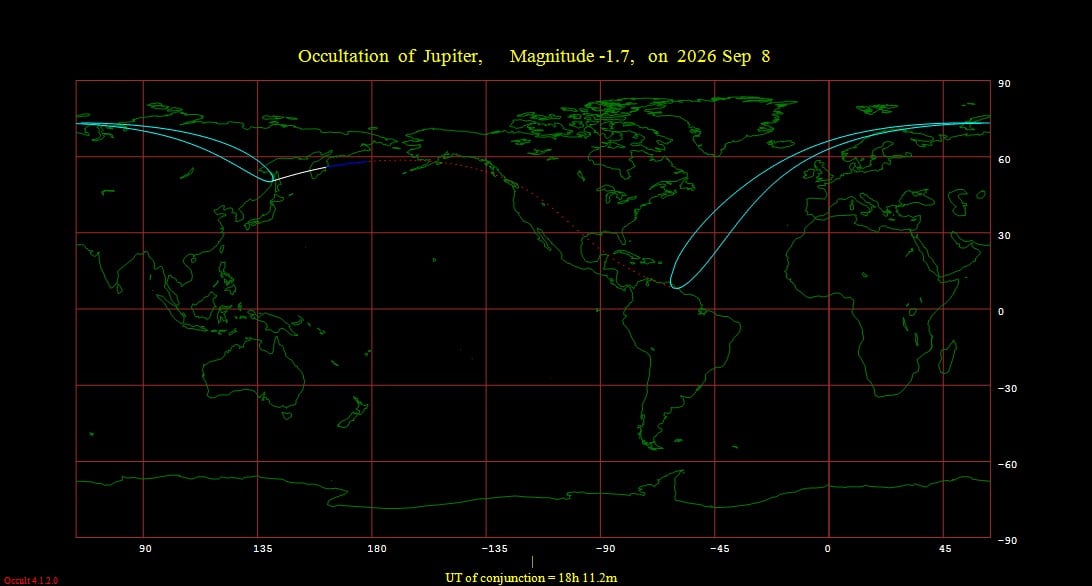 The visibility footprint for the September 8th occultation of Jupiter by the Moon. Note that solid lines show where the event occurs under dark skies, blue under twilight, and broken under daytime skies. Credit: Occult 4.2.
Jupiter and the Moon are 31 degrees west of the Sun on the morning of the 8th, and it’ll be possible to simply track the pair from predawn through sunrise up into the daytime sky.
Headed towards New on 11th, the slim -2% Moon occults the bright +1st magnitude star Regulus (Alpha Leonis) on September 9th. This is a remote one for the South Pacific. New Caledonia gets the very best view of the event. We’re currently in a cycle of Regulus lunar occultations worldwide, which finishes up late this year on December 27th.
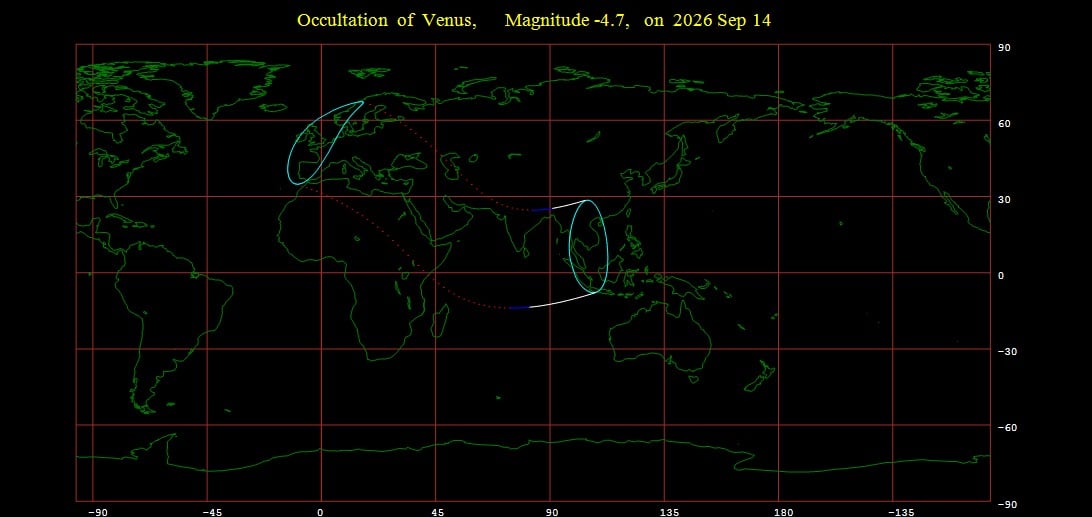 The occultation footprint for the September 14th occultation of Venus by the Moon. Credit: Occult 4.2.
Then another high-interest event occurs mid-month, as the +12% waxing crescent Moon occults Venus on September 14th for southeast Asia at dusk. Note that Europe, the UK, northeast Africa and the Middle East see this one go down under daytime skies, and Venus and the Moon are 41 degrees east of the Sun at the time. Venus is currently at magnitude -4.7, an easy catch in a blue daytime sky if you know exactly where to look for it. The Moon takes just over a minute to cover the sunlit portion the planet’s 37”, 29% illuminated crescent disk.
It could prove to be a unique sight, seeing the ‘horns of Venus’ peeking up above the dark lunar edge for a brief moment, before vanishing behind the Moon. The Moon occults Venus one last time for 2026 on November 7th, though it's a distant event over a remote patch of the southeastern Pacific Ocean.
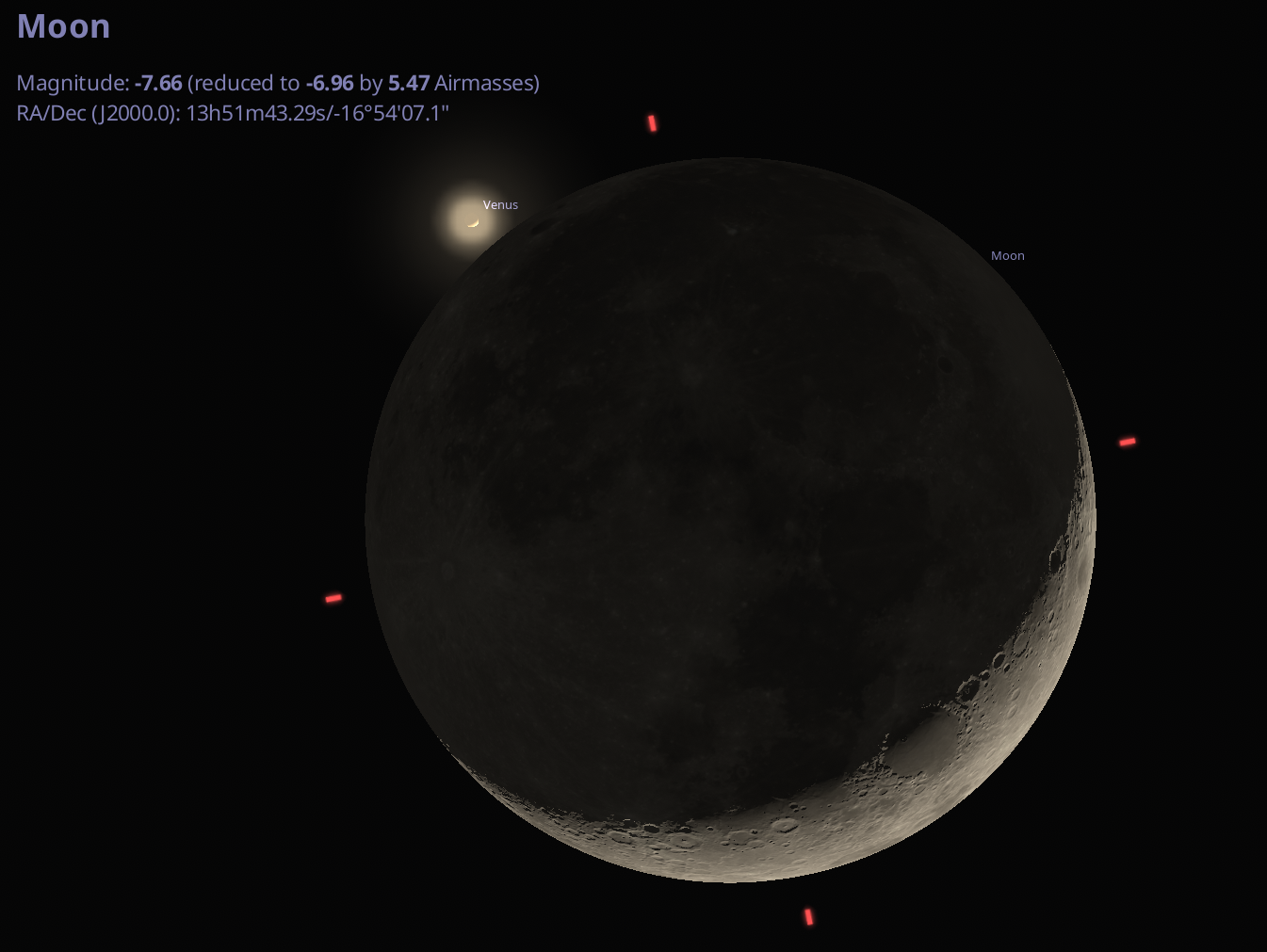 Venus meets the Moon on the 14th. Credit: Stellarium.
Next, the +38% waxing crescent Moon occults the bright star Antares on September 17th for the southern Indian Ocean region. Along with Regulus, Antares is one of four bright +1st magnitude stars the Moon can occult in the current epoch, the other two being Aldebaran and Spica.
Finally, the -80% illuminated waning gibbous Moon occults the Pleiades (Messier 45) on September 30th for the second time this month. This will be a fine event for observers across northern Europe. The Moon typically visits the Seven Sisters cluster on ‘hilly years’ in its 18.6 year cycle, when its path is wide-ranging from north to south.
Observing and recording an occultation is as simple as aiming and tracking the Moon at the right time. The IOTA has ingress/egress times for select locations for top planetary occultations. A better bet is to use a planetarium program like Stellarium to set your precise location and simulate a given occultation beforehand, to note precise ingress/egress times.
I like to acquire the Moon about 10 minutes prior to the event, set the contrast and focus so I can see both objects, and start video running about a full minute prior to ingress.
Don’t miss these celestial sights in September, as a prelude to even more celestial occultation action in October.