Universe Today
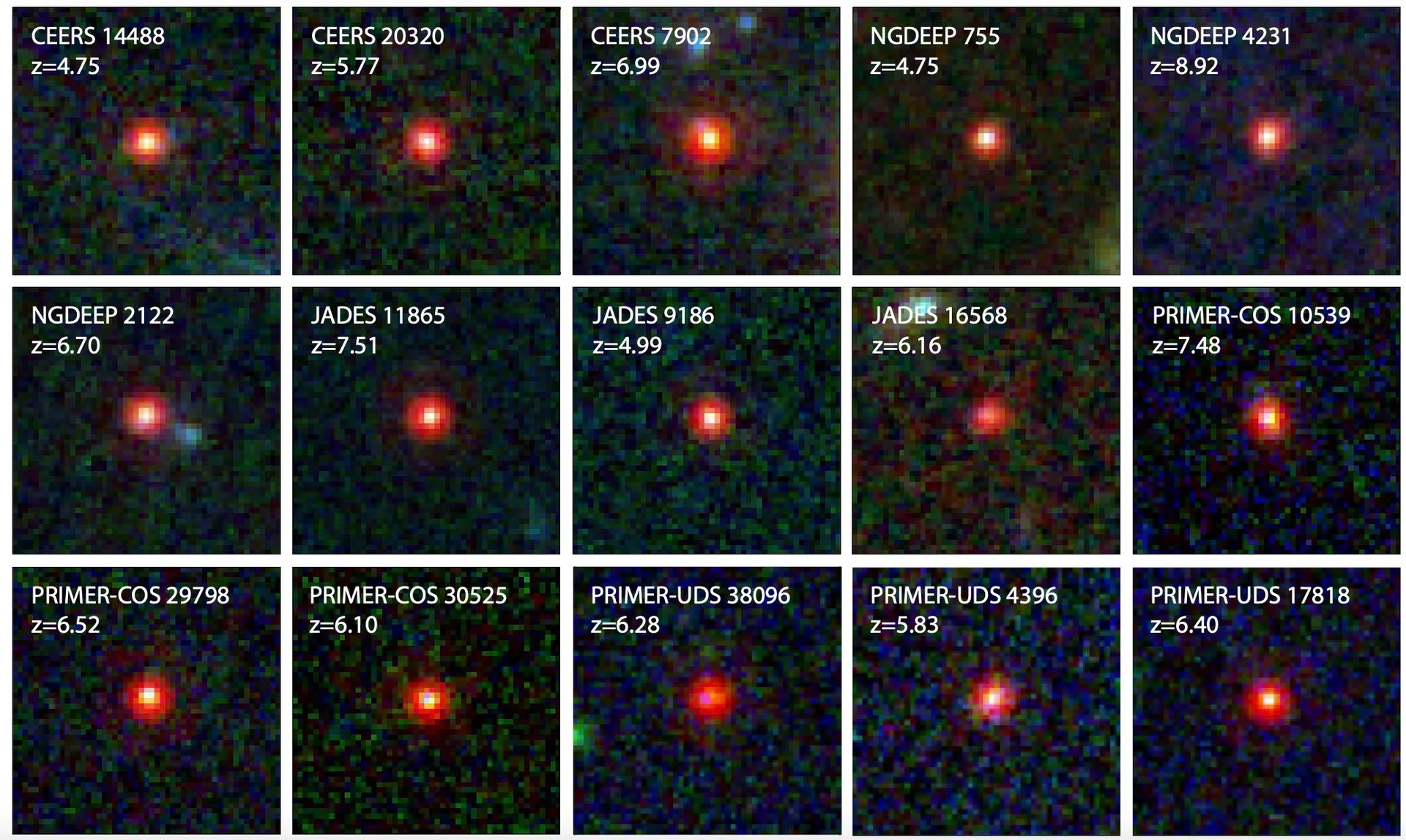
Shortly after the James Webb Space Telescope (JWST) became operational, it directed its sophisticated infrared optics towards the early Universe. There, it observed an abundance of small red objects that turned out to be high-redshift galaxies that existed between 0.6 and 1.6 billion years after the Big Bang. Based on their observations, researchers theorize that some of these objects, nicknamed "Little Red Dots," had growing supermassive black holes (SMBHs) at their centers, making them early quasars.
They further theorize that these SMBHs are embedded in gaseous envelopes, from which they formed directly after massive clouds of gas collapsed to form massive black holes (aka. direct-collapse black holes). According to a new study by an international team, this environment would be suitable for producing high-energy neutrinos. If correct, these neutrinos would be detectable today after making the ~13-billion-year trip to meet us.
The research was led by Riku Kuze, a Ph.D. student with the Center for Gravitational Physics and Quantum Information at the Yukawa Institute for Theoretical Physics (YITP). He and his colleagues were joined by researchers from the Center for Multimessenger Astrophysics at Penn State, the Frontier Research Institute for Interdisciplinary Sciences at Tohoku University, and the Kavli Institute for Astronomy and Astrophysics at Peking University (KIAA-PKU).
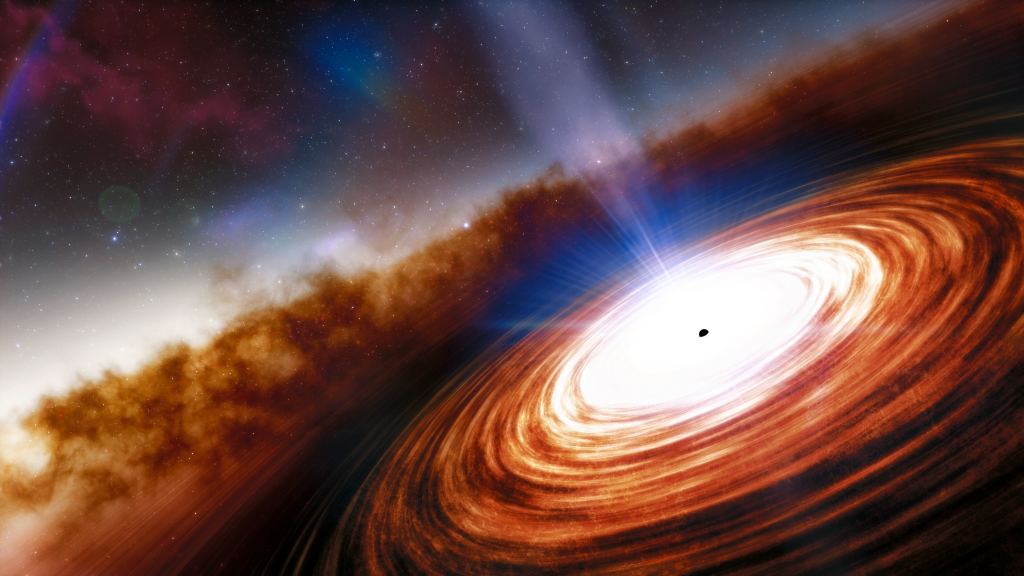 Artist's impression of an active supermassive black hole (SMBH) in the early universe. The Universe's early Pop III stars are likely the progenitors of SMBHs. Credit: NOIRLab/NSF/AURA/J. da Silva
Neutrinos, which are electrically neutral elementary particles, are produced when high-energy particles like protons collide with surrounding photons or matter. These particles can escape their environment if produced inside a thick envelope of gas, such as those that are thought to have contained early SMBHs. Scientists have detected high-energy neutrinos on Earth, but the origin of their all-sky energy background remains a mystery.
However, the same sources that produce high-energy neutrinos also produce gamma rays, but not always; otherwise, the gamma-ray background would be significantly stronger. This suggests that the source of neutrino background radiation must be hidden objects from which gamma rays cannot easily escape. The team theorized that LRDs could be this source based on certain features astronomers have observed, including their observed number density and luminosity.
Promising source candidates for these neutrinos must therefore be hidden objects from which gamma rays cannot easily escape. In addition, LRDs are not known to emit much of the radiation associated with jets or outflows that are known to occur with SMBHs. From this, the team conceived of a scenario in which the jets emanating from the black holes are concealed within the same dense gas envelopes.
To test their hypothesis, the team used the luminosity and number density of LRDs to estimate their contribution to the all-sky neutrino background. They then conducted numerical calculations to evaluate the neutrino spectrum produced by LRDs based on particle acceleration, secondary particle production, and their cooling processes. Their results showed that if particle acceleration can occur in concealed environments, LRDs could produce high-energy neutrinos while suppressing gamma rays.
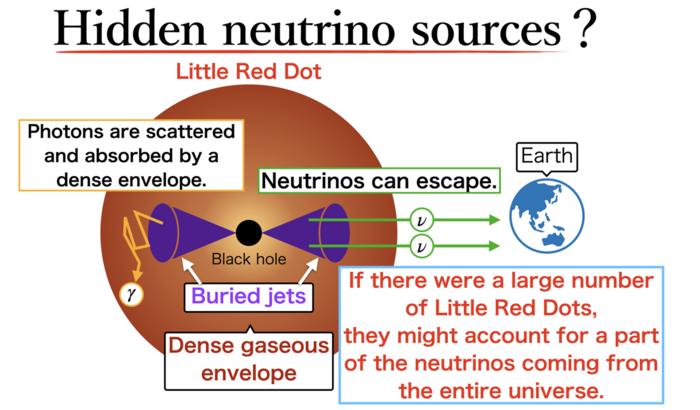 At the center of the Little Red Dot, there could be a black hole surrounded by a thick outer gaseous envelope. Credit: KyotoU/Riku Kuze
In short, the results indicate that LRDs could contribute a fraction of the high-energy neutrinos that make up the all-sky background that is visible from Earth. The next step will be to estimate the ratio of different neutrino "flavors" and investigate the conditions under which jets became concealed within gaseous envelopes. As Kuze explained in a Kyoto University press statement:
In the scenario we considered, abundant photons and dense gas are expected to exist around the central black hole in a Little Red Dot, which may allow such collisions to occur efficiently. Although it is difficult to observe the individual objects directly, we believe this study is significant because it is the first to demonstrate that, given their abundance, these little red galaxies could account for a part of the observed high-energy neutrinos.
Further Reading: Kyoto University