 Universe Today
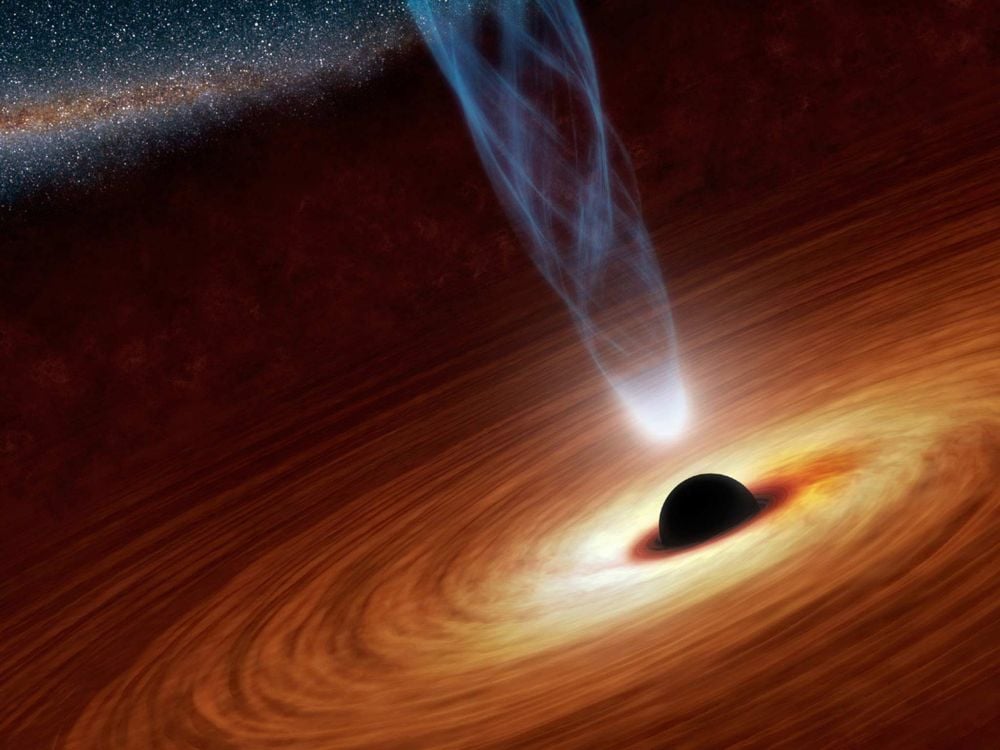
In this Universe, nothing can travel faster than light. Only light itself can reach lightspeed, as far as we know. But some things get awfully close to the speed of light, and when these things are detected, astrophysicists take note.
Researchers found electrons with extremely high energies travelling at close to the speed of light, coming from an unusual source. The source is a microblazar, the first one ever detected. What's a microblazar?
Understanding microblazars starts with understanding supermassive black holes (SMBH), active galactic nuclei, and quasars, which are all facets of the same thing.
When a SMBH in the center of a galaxy is actively feeding and drawing gas and dust toward itself, it's called an active galactic nuclei (AGN). The material gathers in an accretion disk rotating around the SMBH, where it heats up and emits energetic light. The brightest of these AGN are called quasars.
Not all of the gas and dust in the accretion disk finds its way into the SMBH. Some of the material drawn toward the SMBH is ejected in a pair of massive energetic jets that are emitted in opposite directions from the SMBH's axis of rotation.
When one of these jets is aimed at Earth, we call it a blazar. In this case, the object the researchers found is a microblazar, and the difference between it and a blazar is largely a matter of scale. A blazar is extragalactic, and powered by another galaxy's SMBH, while a microblazar is within the Milky Way.
A microblazar consists of a stellar-mass black hole rather than a SMBH. (Instead of a black hole, there could be a neutron star, another extremely dense astrophysical object.) In a microblazar, the black hole or neutron star has a companion star, which is the source of material that forms the accretion ring. The same type of high-energy jets are emitted as in a quasar, just on a smaller scale. To be a microblazar, one of the jets must be pointed at Earth, just like with a blazar.
Both blazars and microblazars are also called x-ray binaries. The system contains two bodies interacting with one another that produce powerful x-ray radiation, and even the more powerful gamma-rays.
Astrophysicists have theorized about the existence of microblazars, and now, new research in Astronomy and Astrophysics presents the first one ever detected. The jets from the microblazar could be powering the fastest particles in the Milky Way.
The research is titled "A Galactic microblazar as a potential accelerator of ultra-high-energy particles," and the first author is Jose Marti. Marti is a professor of astronomy and astrophysics at the University of Jaén in Jaén, Andalucía, Spain.
"Persistent jets from X-ray binaries that are aligned very close to the line of sight could be considered Galactic equivalents of blazars, or ‘microblazars’," the authors write. "They are also expected to power gamma-ray sources."
An object named IRAS 18293−0941 is a candidate microblazar. Astronomers first detected it back in 1989, when it was identified as an infrared source. More detailed study of the objects was held up for years. It's in the plane of the Milky Way, where gas and dust obscure its true nature. But as telescopes became more powerful and astronomical methods more advanced, they brought IRAS 18293−0941 into clearer view.
"We carried out an intense, multi-wavelength observational and theoretical study on our proposed candidate source," the authors write. They used MeerKAT, the VLA, and other telescopes, along with spectroscopes and x-ray observatories to examine the source more thoroughly.
Their results show that IRAS 18293−0941 has a black hole with about 10 solar masses, and a massive star, either a blue giant or a blue supergiant. It's about 11,700 light years away, in the constellation Scutum. The combined masses of the pair of objects classifies it as high-mass x-ray binary. At some point in the past, both objects were massive stars. But one of them exploded as a supernovae and became a black hole.
The powerful jets are a critical part of this discovery. The fact that they're long-lasting, continuous, and high-energy, rather than a short-term phenomenon, helps identify the object as a microblazar.
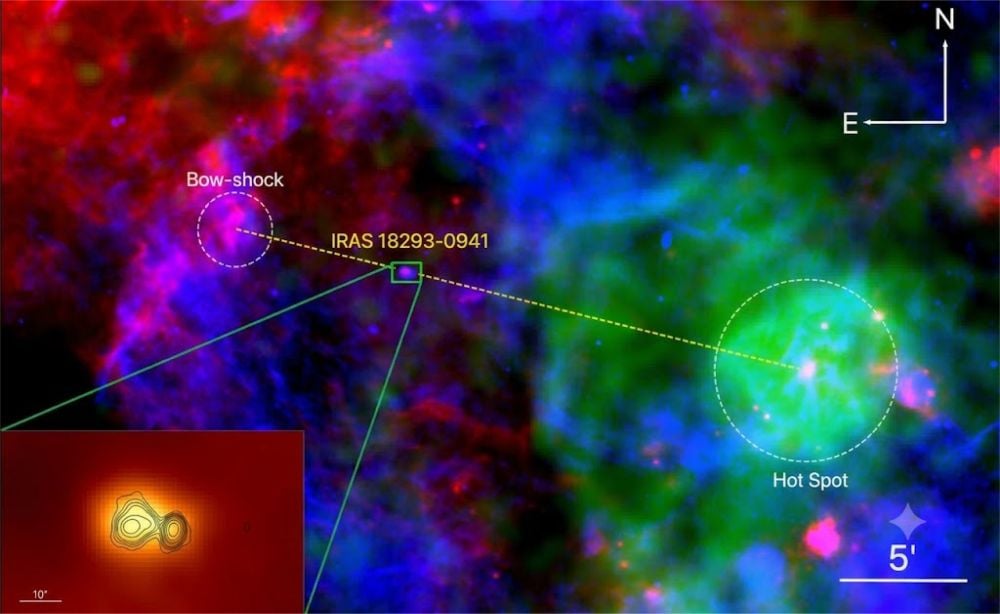 This image highlights how the jets terminate. The receding jet terminates in a star-forming molecular cloud, where it will affect star formation. It also creates a non-thermal hotspot, a sort of natural laboratory to study high-energy particles. Image Credit: Martí et al. 2026. A&A
"The inferred jet power and sustained activity imply that IRAS 18293−0941 is capable of accelerating particles to VHE and potentially UHE, in line with recent studies linking microquasars to Galactic PeVatrons," the authors write. VHE is very high energy, meaning the particles have tera-electronvolt (TeV) levels. UHE is ultra-high energy, meaning the particles have peta-electronvolt (PeV) energy levels.
Detectors have sensed PeV level particles for years, but their source has remained unclear. Tracing them to IRAS 18293-0941 is an important development. It confirms the existence of microblazars and microquasars, and the discovery helps build a better understanding of the range of astrophysical objects in the Universe, especially high-energy ones.
"Our reported identification not only helps fill a gap in Galactic taxonomy, it also potentially strengthens the role of the microblazar and microquasar families in our understanding of the most energetic Milky Way phenomena," the authors write.
There's more to discover about this object, and the researchers intend to study it more to tease out more details. Astrophysical jets alter their surroundings, especially the interstellar medium they slam into, and that is certain to affect star formation.
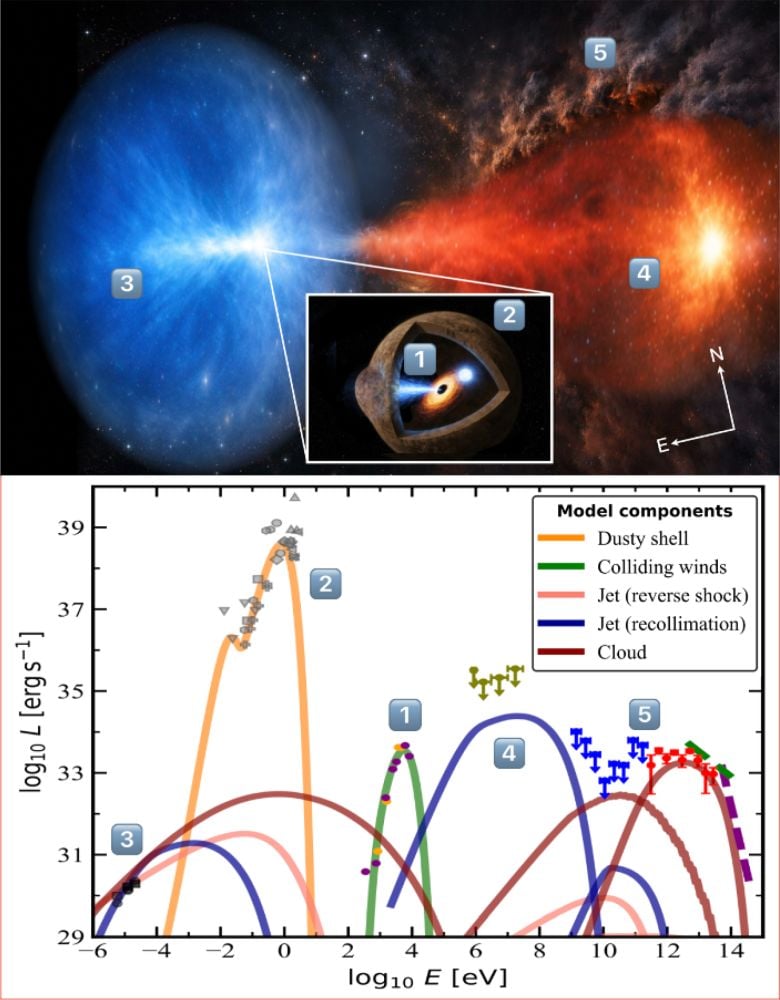 This illustration shows the complex environment around IRAS 18293−0941. "1). A dense circumbinary dusty shell surrounds the system (2) and is distorted by the approaching (blue) jet (3), which eventually breaks out and expands into the lower density ambient medium, inflating a cocoon. The receding (red) jet (4) propagates toward a dense molecular cloud (5), where it produces a radio hotspot and injects accelerated cosmic rays into the cloud, giving rise to high-energy emission through hadronic processes," the authors write. Image Credit: Martí et al. 2026. A&A
The receding jet from the black hole smashes into a molecular cloud, creating what astrophsyicists call a "non-thermal hotspot." That means it's not created by a star, but by high-energy particles spriralling through magnetic fields, called synchrotron radiation, or by particle collisions. This creates high-energy radiation, and in this case, the radiation lines up with a known hot spot or source. The hot spot is the key to this work.
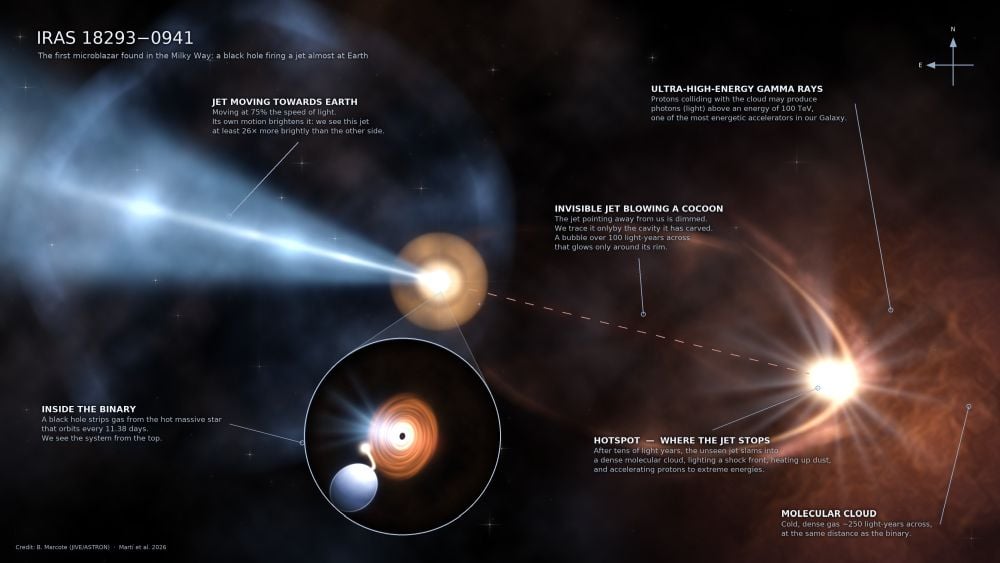 This artists impression shows the new microblazar (centre) creating two powerful jets, one directed at Earth (left) and the other hitting a molecular interstellar cloud (right). This is the first confirmed microblazar, and the discovery fills a hole in our understanding of the hierarchy of astrophysical objects. The receding jet slams into a molecular cloud, creating an opportunity to study high-energy particles in more detail. Image Credit: B. Marcote (JIVE/ASTRON)/Martí et al. 2026
Since the source of the jets and the hot spot the receding jet creates are so far apart—tens of parsecs away from each other—it creates a kind of natural laboratory where astrophysicists can study how galactic particles can be accelerated to such high energies.
“We are planning more observations on the area of the hotspot where the jet hits the interstellar medium," lead author Marcote said in a press release. “Better characterizing this region and how the material gets heated and ionized would have strong implications for the galactic formation of stars, that happens in molecular clouds. It can also teach us how microblazars impact the structure and evolution of galaxies like the Milky Way.”
“This discovery highlights the power of studying the Universe with different kind of telescopes at the same time, because none of the individual telescopes could have told the entire story," said study co-author Jakob van den Eijnden, from the University of Amsterdam. “It is a great showcase of the international team efforts that are at the core of modern astronomy.”