Universe Today
The current exoplanet census stands at 6,291 confirmed candidates across 4,709 systems, with tens of thousands awaiting confirmation. With so many planets available for study and improvements in both instruments and methods, the process is transitioning from discovery to characterization. This consists of studying exoplanet atmospheres via spectroscopy, which allows astronomers to determine their chemical composition. Beyond composition, there are efforts to better understand atmospheric dynamics and cycles on exoplanets.
Using the James Webb Space Telescope (JWST), an international team of scientists has developed a new method for studying cloud cycles on distant planets. The team tested their method on WASP-94A, a "Hot Jupiter" in a binary system about 700 light-years away in the constellation Microscopium. Their research is among the first to detect cloud cycles on a Hot Jupiter and has provided researchers with fresh insight into the planet's evolution and make-up. The method presents new opportunities for exoplanet studies and the search for habitable planets.
The team was led by Sagnick Mukherjee, a 51 Pegasi b Postdoctoral Fellow from the School of Earth and Space Exploration (SESE) at Arizona State University. He was joined by researchers from the Johns Hopkins University Applied Physics Laboratory (JHUAPL), the Max Planck Institute for Astronomy (MPIA), the Harvard & Smithsonian Center for Astrophysics (CfA), the Catalan Institute of Space Studies (IEEC), the Homi Bhabha National Institute, the Space Telescope Science Institute (STScI), the Gemini Observatory, and multiple universities. Their results were published on May 21st in the journal Science.
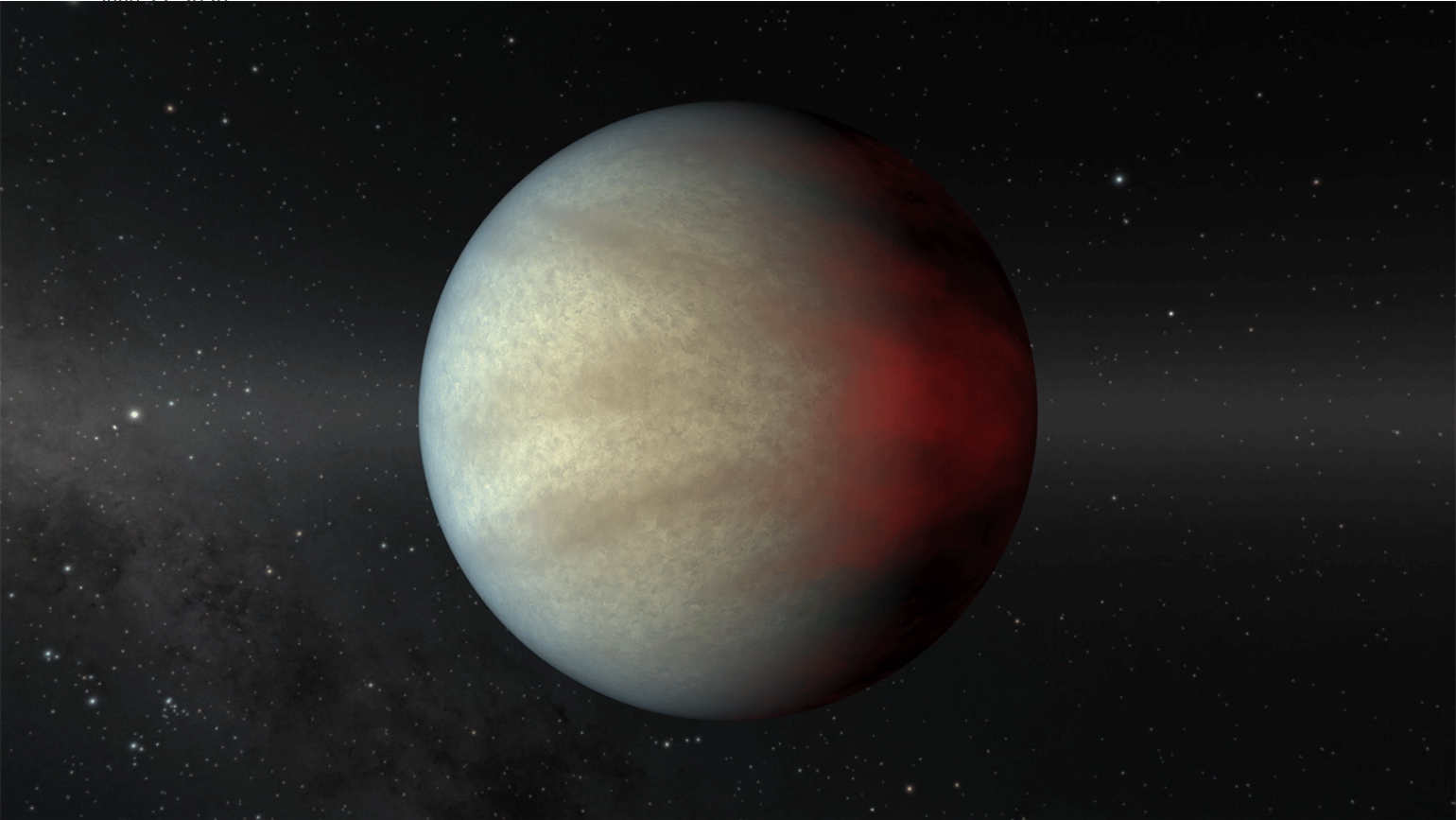 Animation of a hot Jupiter, a class of gas giant that orbits very closely to their star. Credit: NASA/JPL-Caltech
Because of the extreme heat and radiation they are exposed to, Hot Jupiters are good candidates for studying cloud dynamics and the physics and chemistry of their atmospheres. Using Webb, the team observed the planet as it passed (transited) in front of its star. Known as transit spectroscopy, this process allowed the team to examine light passing through the planet's atmosphere. Webb's optics also allowed the researchers to take separate measurements of WASP-94A b's leading edge as it crossed in front of the star and the trailing edge as it completed its transit.
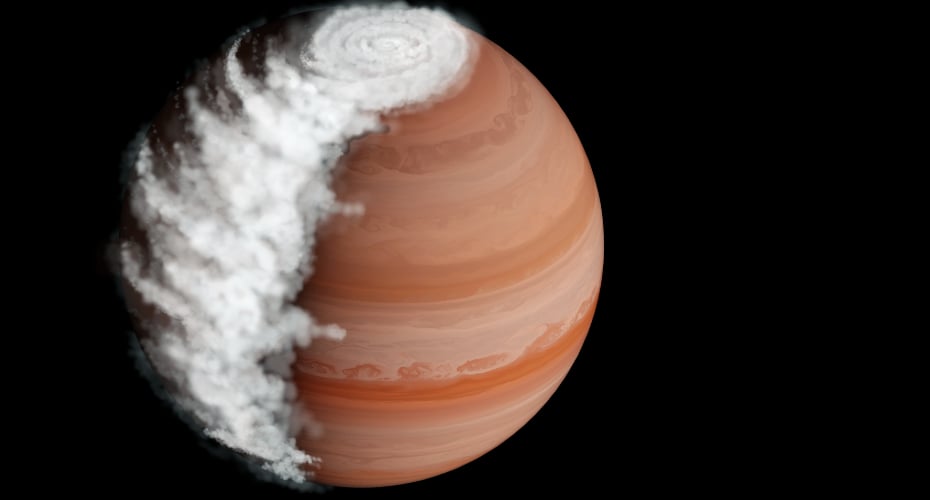
At the leading edge, they observed air flowing from the night side to the day side, then flowing in the opposite direction at the trailing edge. These observations revealed that WASP-94A b has very different weather patterns between morning and evening. Whereas the skies are filled with magnesium silicate clouds in the morning, there are clear skies in the evening. By isolating the clouds, the research team has provided one of the clearest pictures to date of the composition of WASP-94A b's atmosphere.
Said David Sing, a Bloomberg Distinguished Professor of Earth and Planetary Sciences at Johns Hopkins and the Principal Investigator of the observation program:
I’ve been looking at exoplanets for 20 years, and general cloudiness has been a thorn in our side. We’ve known for quite a while that clouds are pervasive on Hot Jupiter planets, which is annoying because it’s like trying to look at the planet through a foggy window. Not only have we been able to clear the view, but we can finally pin down what the clouds are made out of and how they’re condensing and evaporating as they move around the planet.
The researchers suggest two possible causes for these dynamics. One possibility is that powerful winds cause clouds to rise on the cooler side of the planet, then plunge on the hotter dayside deep into the planet's interior where they disappear before sunset. Another possibility is that the atmosphere experiences something similar to morning fog burning off in the sunshine, but on a much grander (and hotter) scale.
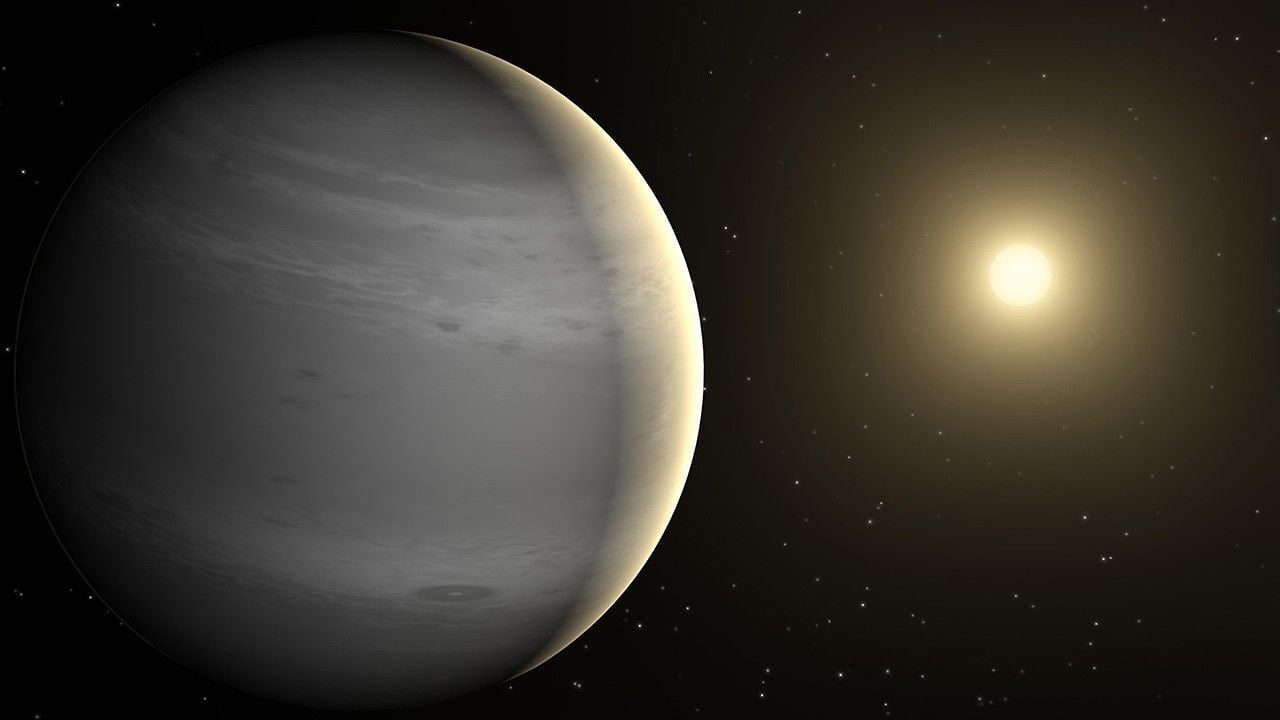 Artist's impression of WASP-94A b, the hot Jupiter located about 700 light-years from Earth. Credit: NASA/JPL-Caltech
In this latter scenario, clouds would form on the planet's nightside and boil away once they drift onto the dayside, where temperatures exceed 1,000 °C (1832 °F). The team's success was due in large part to Webb's sensitivity and resolution, which allowed the team to examine the trailing edge, where the nighttime skies were clear. This allowed them to see precisely what the planet's atmosphere looked like, something that wasn't possible with the venerable Hubble Space Telescope. Said co-author Harry Baskett, a PhD student from the University of Exeter:
JWST provides us with exquisite observations of hot Jupiters and has recently been able to isolate the signatures of both morning and evening limbs on WASP-94Ab, information which is inherently 3D. For our group in Exeter, this is especially pertinent, as we use and develop a state-of-the-art 3D model, in partnership with our very own Met Office, to simulate the winds and all sort of physical and chemical processes driving the 3D structure of planetary atmospheres.
It is really exciting to be able to combine observations and 3D simulations to distinguish weather patterns on exoplanets, infer the presence of clouds and constrain their formation mechanisms. Going forward, I hope that we can continue to combine observations and 3D simulations, to reveal more secrets about hot Jupiters.
Examining the clear evening sky revealed that WASP-94A b was much more Jupiter-like than they thought. In previous studies, the data suggested WASP-39A b's composition had much more oxygen and carbon than Jupiter, a finding that could not be explained by our current models of planet formation. The new findings, in contrast, show the planet to have only five times the amount of oxygen and carbon, which fits with these models.
Using their results as a benchmark, the team examined eight other hot gas giants. In two cases, WASP-39 b and WASP-17 b, they noticed the same distinctive cloud cycle. As a next step, the team will be using data from one of Webb's observation programs to study the cloud cycles across a wide variety of exoplanets. Said Professor Nathan Mayne, also from Exeter’s Department of Physics and Astronomy:
This exciting project shows the power of combining the exquisite observations from JWST with cutting-edge theoretical and numerical modeling of planetary atmospheres. We have been able to determine what the clouds are made of in the atmosphere of a planet 700 light-years from Earth, which is crazy! This work also helps us to test, develop, and improve our modeling approaches, leading to improvements in Earth weather and climate prediction.
Further Reading: University of Exeter, Science