Universe Today
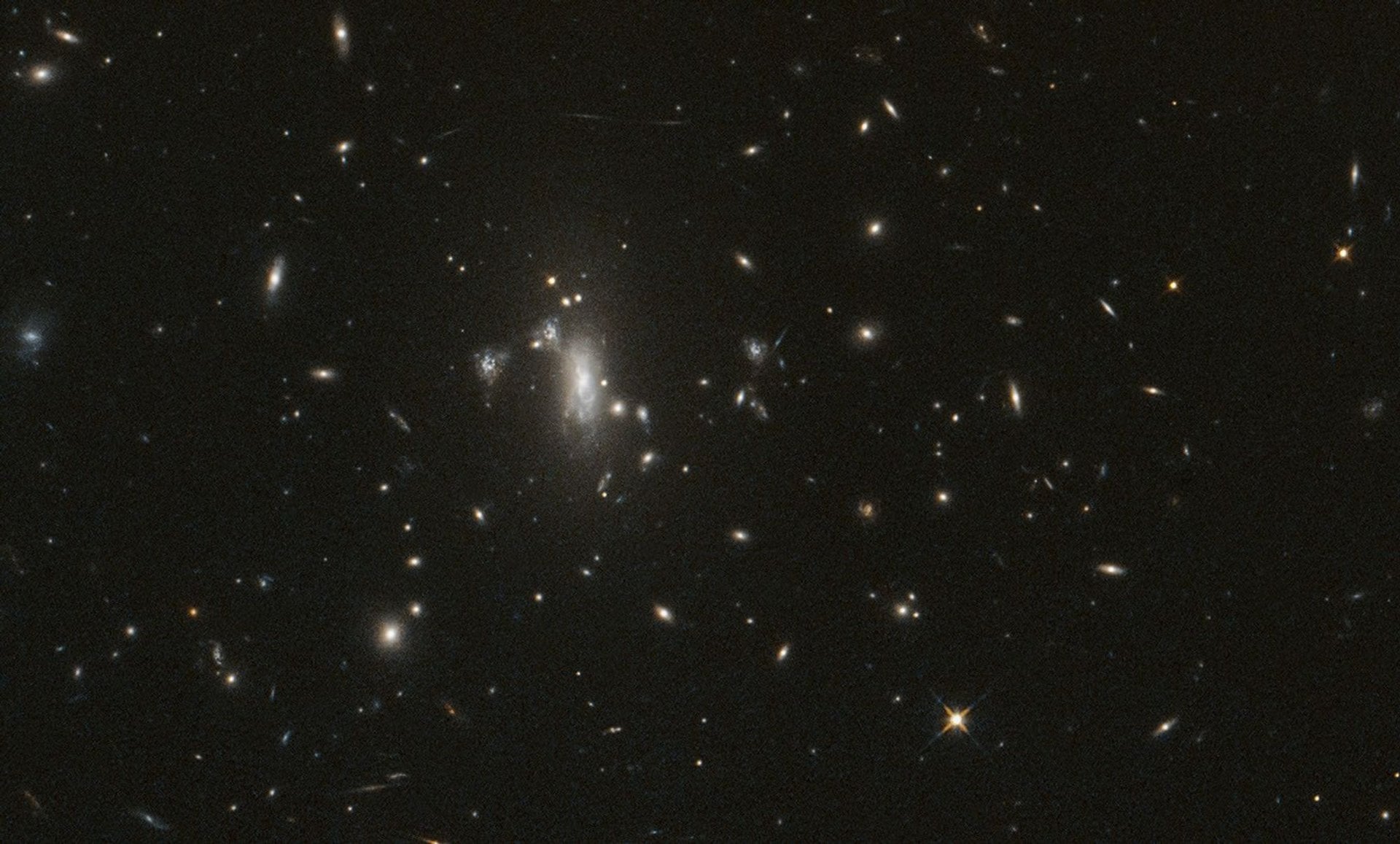
On Saturday, September 19th, the Hubble Space Telescope completed its 200,000th orbit of Earth, marking yet another milestone for this venerable observatory. In addition, Hubble has traveled more than 8 billion km (5 billion mi) and gathered more than 1.7 million observations of the Universe. And earlier this year, Hubble celebrated its thirty-sixth year of continuous service, exceeding the International Space Station by about nine years.
The observation it took on the day of its 200,000th orbit was characteristic of the very scientific objective for which Hubble was named: measuring the expansion rate of the Universe - aka. the Hubble Constant. The target of these observations, visible in the upper left corner of the image above, was MACS J0417, a massive galaxy cluster located about 4.65 billion light-years from Earth in the constellation Eridanus.
Specifically, astronomers hope to reacquire the supernova Athena, which the James Webb Space Telescope (JWST) discovered last year. These bright explosions are used as "standard candles" to measure cosmic distances in the hundreds of millions to billions of light-years. After a two-year hiatus, Athena is expected to be visible again thanks to the gravitational lens created by MACS J01417's powerful gravitational field, which distorts and amplifies light from more distant sources.
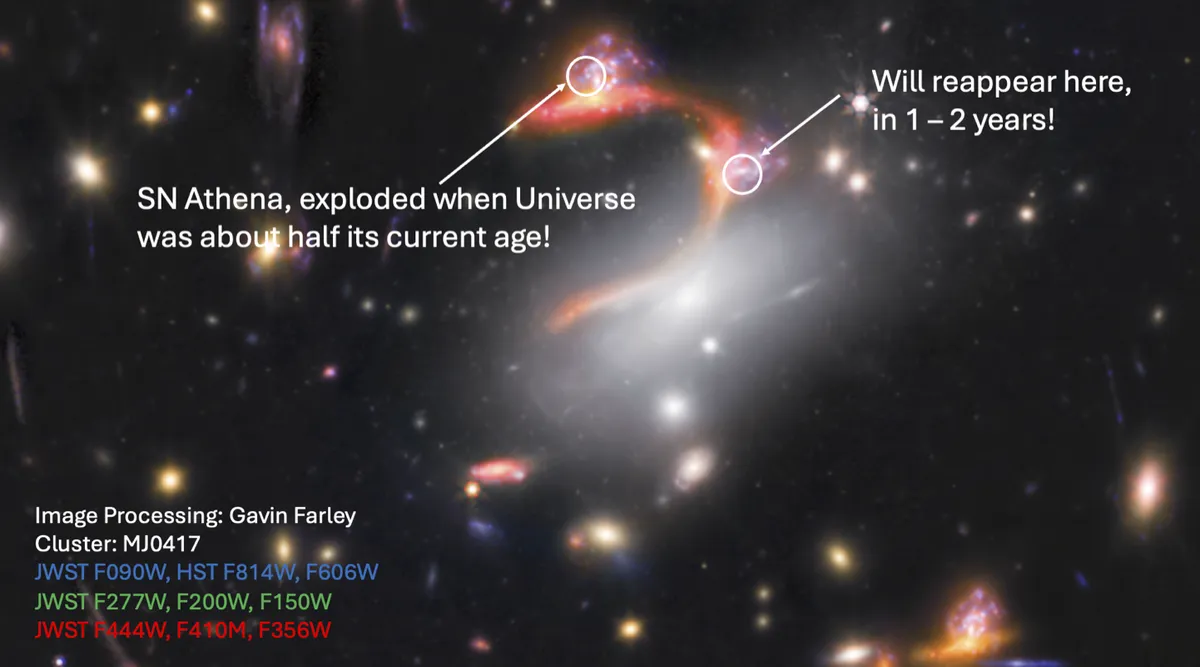 Where the JWST detected Supernova Athena and where it will appear again in the near future. Credit: NASA/ESA/CSA/Gavin Farley (image processing)
Gravitational lenses can also cause light to reach Earth along different paths, making an object appear in multiple places and at different times. Scientists expect it to be visible again between now and early March 2027. Hubble will watch MACS J01417 until then, hoping to find the supernova in a different location (see image above). Measuring the timing of its reappearance will help astronomers determine the galaxy cluster's mass distribution.
Through parallax measurements of the supernova, scientists will also be able to measure the galaxy's recessional velocity, or the speed at which it is moving away from us. Measurements like these help astronomers, astrophysicists, and cosmologists refine estimates in the Cosmic Distance Ladder and place more accurate constraints on the Hubble Constant. After more than three and a half decades of service, Hubble continues to make breakthroughs in our understanding of the Universe.
What's more, Hubble's unique ability to observe objects in visible and ultraviolet light complements Webb's ability to gather light in the infrared spectrum. This symbiotic relationship will extend further when next-generation missions like the Nancy Grace Roman Space Telescope commence science operations in early 2027.
Further Reading: NASA