Universe Today
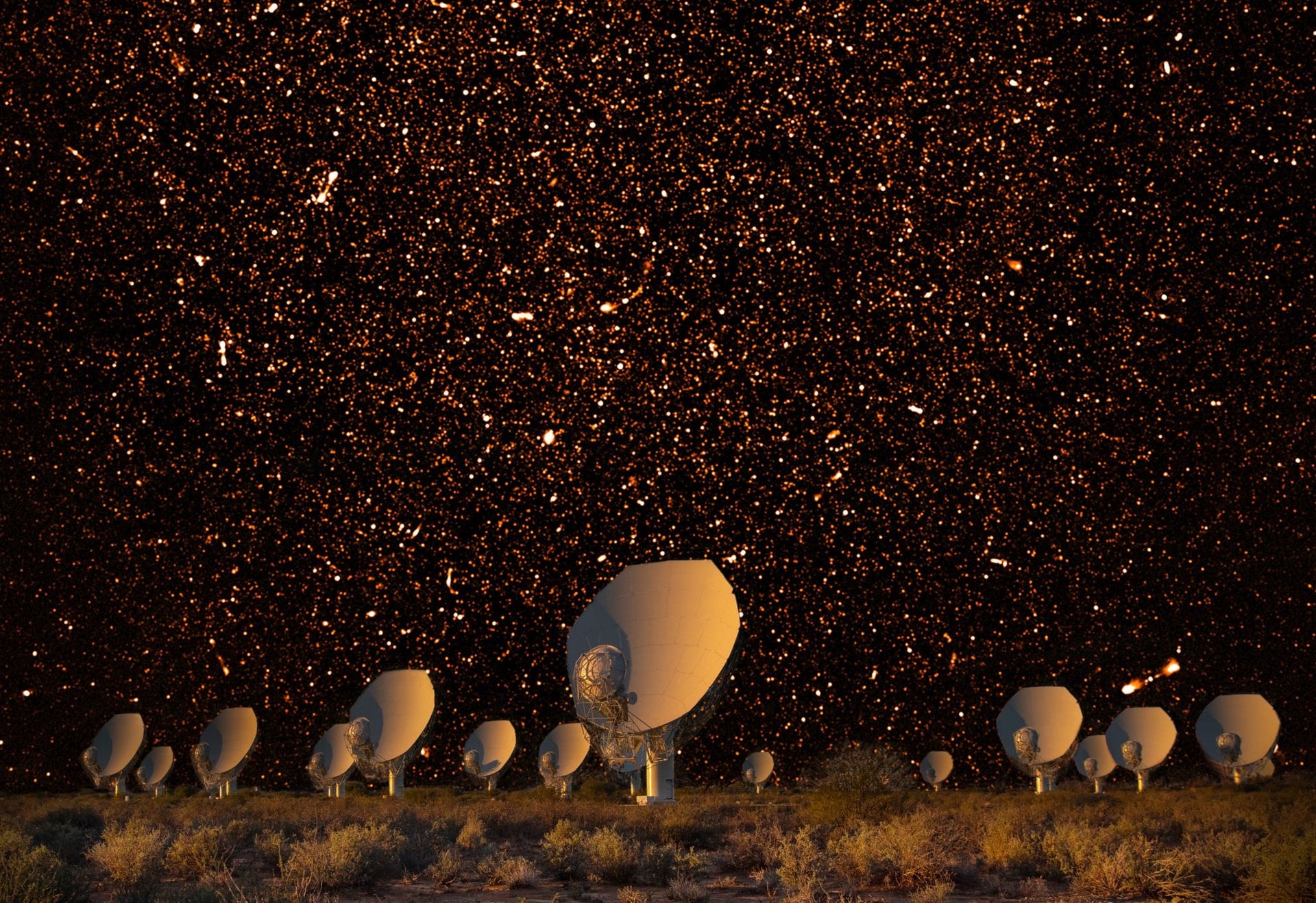
The MeerKAT radio telescope, composed of 64 dish antennas located in South Africa's Northern Cape province, was built to study cosmic hydrogen, galaxy formation and evolution, and transient radio sources. As the precursor to the planned Square Kilometer Array telescope, its scientific goal is to map the radio sky in preparation for more ambitious campaigns that combine light from the arrays in South Africa and Australia.
In a recent study, a team of astronomers from the University of Manchester in Britain and the University of the Western Cape in South Africa announced the direct detection of an extremely faint radio signal from hydrogen gas billions of light-years from Earth. Their findings demonstrate the potential of Hydrogen Intensity Mapping, a technique that allows astronomers to study vast regions of the cosmos with extreme efficiency.
The team behind the work comes from the Jodrell Bank Center for Astrophysics at the University of Manchester, the University of the Western Cape, the Royal Observatory's Institute for Astronomy at the University of Edinburgh, the South African Radio Astronomy Observatory (SARAO), and McGill University in Montreal. Sourabh Paul, a Research Associate at the University of Manchester, was the lead author on the paper.
As he and his colleagues explain in their study, which appeared in The Astrophysical Journal Letters, the team detected the faint signal of neutral hydrogen (the 21-cm line) at redshifts of roughly z = 0.32 and 0.44, which correspond to distances of 3.67 and 4.76 billion light-years. In other words, the hydrogen they detected existed as observed when the Universe was about 10 and 9 billion years old, respectively.
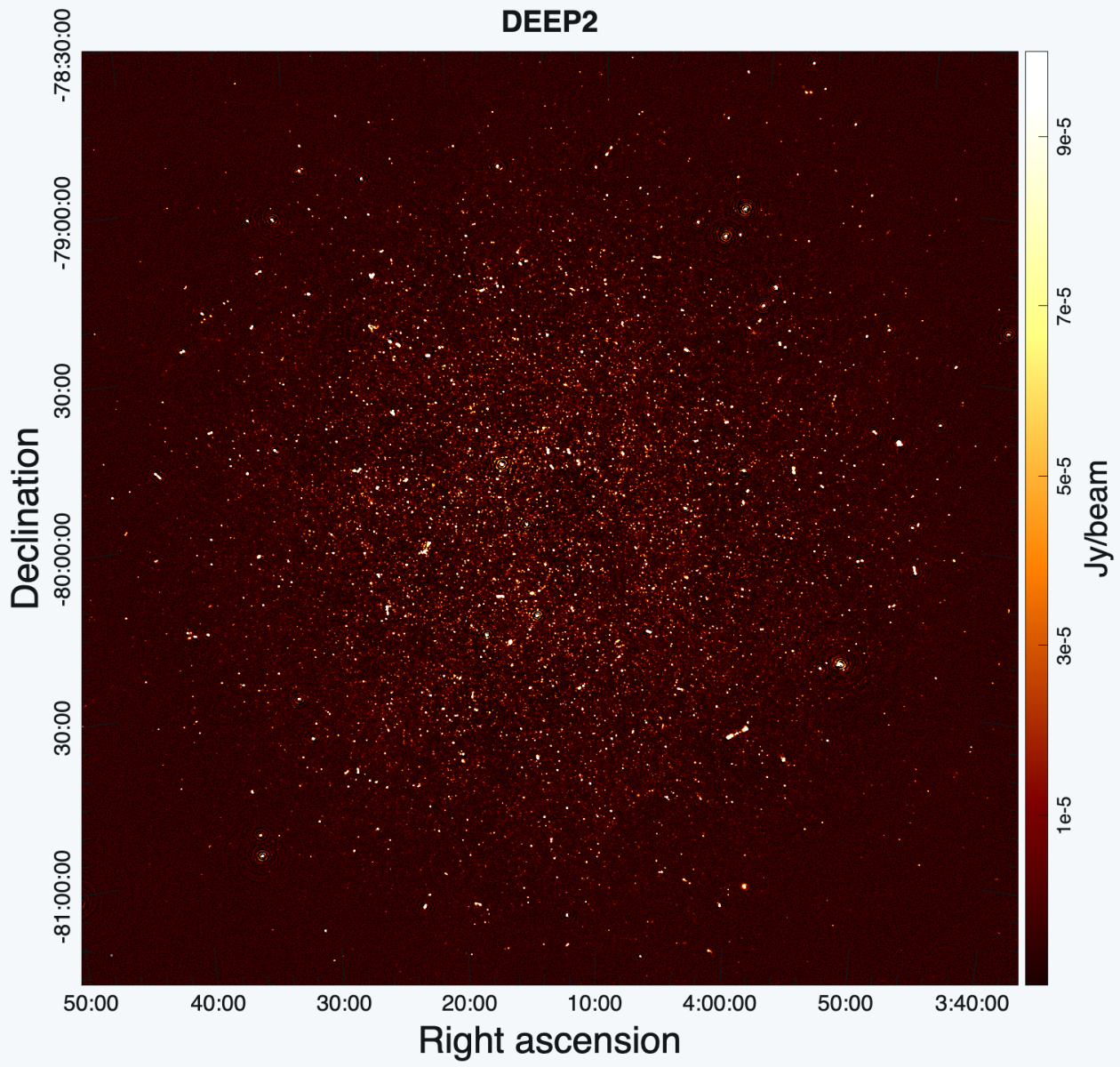 Visualization of the radio data observed by MeerKAT. Credit: Paul, S. et al. (2026)
Hydrogen Intensity Mapping (HIM) consists of detecting and measuring neutral hydrogen, which naturally emits a faint radio signal known as the 21-cm line. As the Universe expands, the wavelength of this signal is lengthened, thus allowing astronomers to study the Universe at different periods of cosmic history. This technique has been used by instruments like the Canadian Hydrogen Intensity Mapping Experiment (CHIME) to measure the Universe's expansion history and constrain the influence of Dark Energy.
Rather than detecting individual radio sources, HIM measures the combined radio emission of many galaxies - including those that cannot be fully resolved by optical telescopes. The team analyzed 96 hours of MeerKAT data collected back in 2018 and detected two signals that traveled approximately four and five billion years to reach Earth. This study was the first time astronomers directly detected cosmic hydrogen using a single observatory, rather than combining radio and optical data from multiple observatories. As Paul said in a University of Manchester press release:
This is a very exciting milestone. Hydrogen intensity mapping has long been seen as a promising way to map the Universe efficiently, but the signal is extremely faint and difficult to isolate from foreground emission, human-made radio-frequency interference, and instrumental effects. Detecting it directly with MeerKAT shows that this technique is becoming a practical tool for cosmology.
What is especially impressive is that the data was obtained nearly a decade ago when MeerKAT had just commenced science operations. This early discovery suggests there could be many more valuable signals in the observatory's archival data, which astronomers could use to extend their mapping efforts of the cosmos. The process was also challenging, requiring that the team account for the many sources of radio contamination that could obscure the faint signal.
“MeerKAT continues to open new windows for cosmology," said co-author Professor Laura Wolz from the Jodrell Bank Center for Astrophysics. "The fact that this signal can be extracted from observations that were not originally designed for hydrogen intensity mapping is very encouraging. It shows the enormous scientific value of MeerKAT data and points the way to future observations with SKAO.”
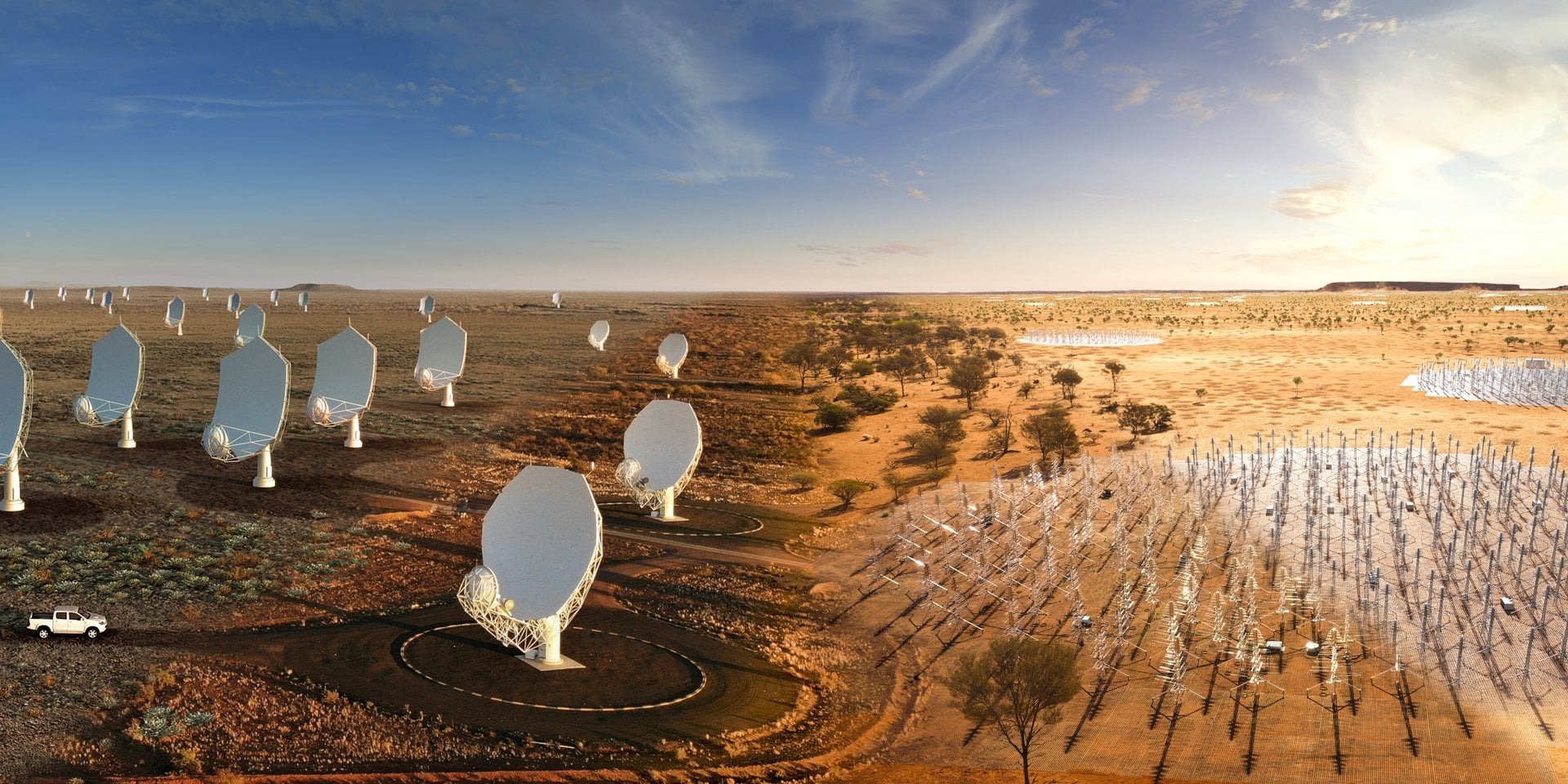 Artist's impression of the MeerKAT telescope dishes in South Africa and the Inyarrimanha Ilgari Bundara (MRAO) in Western Australia. Credit: SKAO
The work presents new opportunities for studying how galaxies form and evolve over cosmic time in a way that is much more efficient than individual studies. It also has significant implications for future cosmological surveys, which will include HIM studies performed using the Square Kilometer Array Observatory (SKAO). This array will combine data from MeerKAT and the Inyarrimanha Ilgari Bundara - also known as the Murchison Radio-astronomy Observatory (MRAO) - in Australia, which is expected to gather its first light sometime next year.
Future observations performed by this and other next-generation observatories will cover larger areas of the sky for longer periods, enabling astronomers to perform HIM in greater detail. These efforts will provide additional clues as to how galaxies formed, the role of Dark Matter and Dark Energy in shaping the cosmic web, and allow astronomers to track cosmic evolution since the early epochs of the Universe. Said co-author Dr. Zhaoting Chen, a postdoctoral researcher from the University of Edinburgh:
Neutral hydrogen is one of the key ingredients for understanding how galaxies form and evolve. With intensity mapping, we do not need to detect every individual galaxy. Instead, we can measure the collective signal from hydrogen across large cosmic volumes, giving us a new way to study both galaxy evolution and the underlying matter distribution of the Universe.
Further Reading: University of Manchester, Astrophysical Journal Letters.