Universe Today
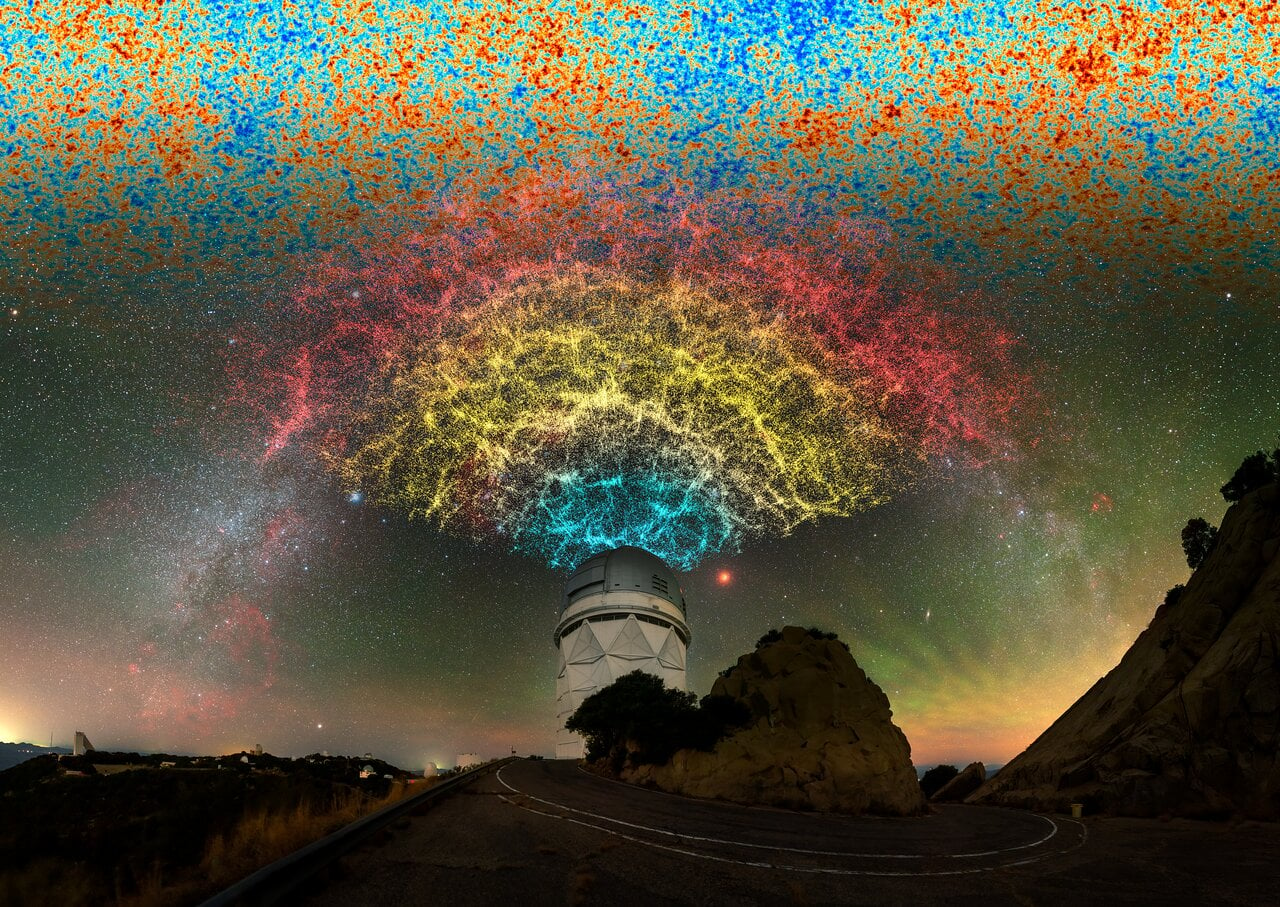
In 2012, the Dark Energy Spectroscopic Instrument (DESI) was commissioned to measure the effect of Dark Energy, the mysterious force that is driving the expansion of the cosmos. Since then, the DESI Legacy Imaging Surveys has obtained optical spectra for tens of millions of galaxies and quasars using the NOIRLab’s Nicholas U. Mayall 4-meter Telescope at Kitt Peak National Observatory (KPNO). In recent news, the DESI Legacy Imaging Surveys team made its eleventh data release (DR 11), constituting the largest-ever 2D map of the Universe.
The 5.6-trillion-pixel map contains nearly four billion celestial objects, including stars, galaxies, black holes, and asteroids. It covers roughly 75% of the sky in visible and near-infrared light, providing a deep view of the extragalactic Universe, and is available to the public through the Legacy Survey Sky Viewer.
"It’s part of the fabric of astronomy research now," said David Schlegel, a co-lead of the Legacy Surveys and a scientist at the Lawrence Berkeley National Laboratory (Berkeley Lab), in a press release. "When you're working with astronomical objects today, you often start by pulling up the Legacy Imaging Viewer to see what you’re looking at."
More than 160 scientists contributed to the project, including those associated with the Dark Energy Camera Legacy Survey (DECaLS), the Mayall z-band Legacy Survey (MzLS), and the Beijing-Arizona Sky Survey (BASS). The data provided was gathered by the Dark Energy Camera (DECam), the Nicholas U. Mayall 4-meter Telescope and UA Bok 2.3-meter Telescope at the NSF Kitt Peak National Observatory (KPNO), the University of Arizona's Steward Observatory, and complemented by NASA's Wide-field Infrared Survey Explorer (WISE).
Said Arjun Dey, co-lead of the Legacy Surveys and an astronomer at NSF NOIRLab:
Explorations of our Universe always start with images of the night sky. The DESI Imaging Legacy Surveys are just one step in this venerable human tradition. For our team, these data are fundamental to the investigation of the expansion history of the Universe and the formation of our galaxy. But the skies belong to everyone, and this survey gives everyone the chance to marvel at their wonders.
The map builds on earlier versions of the DESI Legacy Imaging Surveys, which completed its originally planned five-year mission earlier this year, mapping more than 47 galaxies and quasars in the local Universe out to 11 billion light-years. By providing the location and brightness of galaxies and stars, the 2D map enables DESI to select objects and measure their light in different wavelengths to determine their distances.
This will fulfill DESI's purpose of creating the largest high-resolution 3D map of the Universe, which scientists will use to map and study how galaxies have clustered across different ages of the Universe. From this, scientists hope to constrain the effects Dark Energy has had on cosmic evolution, a mystery that first emerged when the venerable Hubble Space Telescope conducted the deepest views of the Universe at the time.
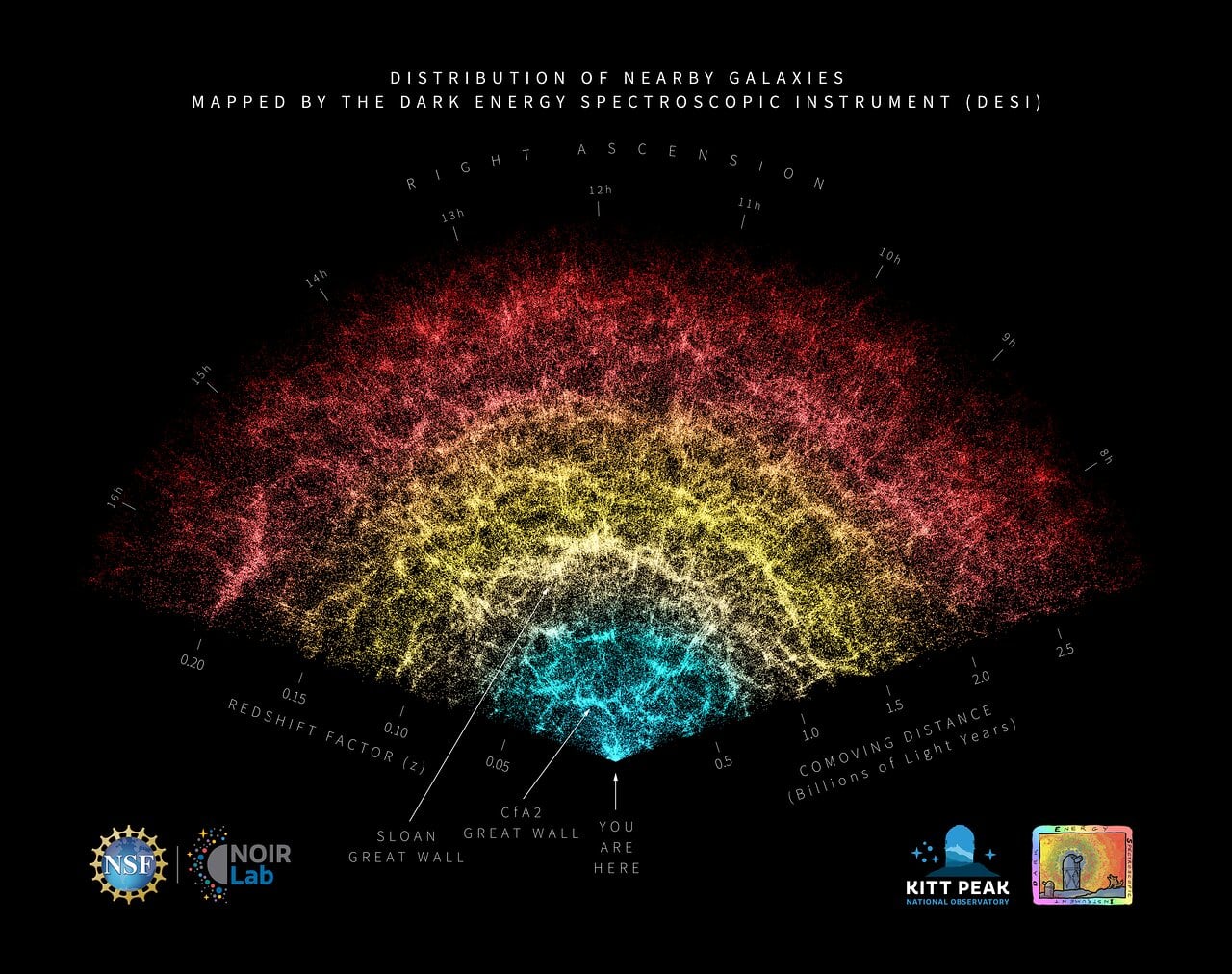 A slice of the 3D map of galaxies collected in the first year of the Dark Energy Spectroscopic Instrument (DESI) Survey. Credit: DESI Collaboration/NOIRLab/NSF/AURA/R. Proctor
The early results from the DESI Legacy Imaging Surveys hint that the impact of Dark Energy may be weakening over time. This contradicts previous findings that suggested Dark Energy is accelerating, which has profound implications for cosmological models. Instead of expanding infinitely until all stars in the Universe die out, the Universe may cease expanding in the distant future and achieve a state of equilibrium.
The map will also benefit astronomers and citizen scientists studying gravitational lenses, transient events like supernovae, fast radio bursts (FRBs), gamma-ray bursts (GRBs), and other rare phenomena. It will also help scientists investigate Dark Matter, the mysterious substance that accounts for 85% of the mass in our Universe. It will also help scientists train machine learning and AI tools to analyze petabytes of raw astronomical data.
This includes the volumes of data gathered by next-generation observatories like the Vera C. Rubin Observatory and NASA's Nancy Grace Roman Space Telescope. As part of its ten-year Legacy Survey of Space and Time (LSST), Rubin will gather about 10 terabytes of data every night. Similarly, during its five-year primary mission, Roman is expected to generate roughly 20 petabytes (2,500 terabytes) of data.
DESI expects to publish improved results from its first five years of operations in 2027, and will continue to conduct observations into 2028. DESI Legacy Surveys’ full catalog is also available as a searchable database via the Astro Data Lab at the Community Science and Data Center (CSDC).
Further Reading: NOIRLab