 Universe Today
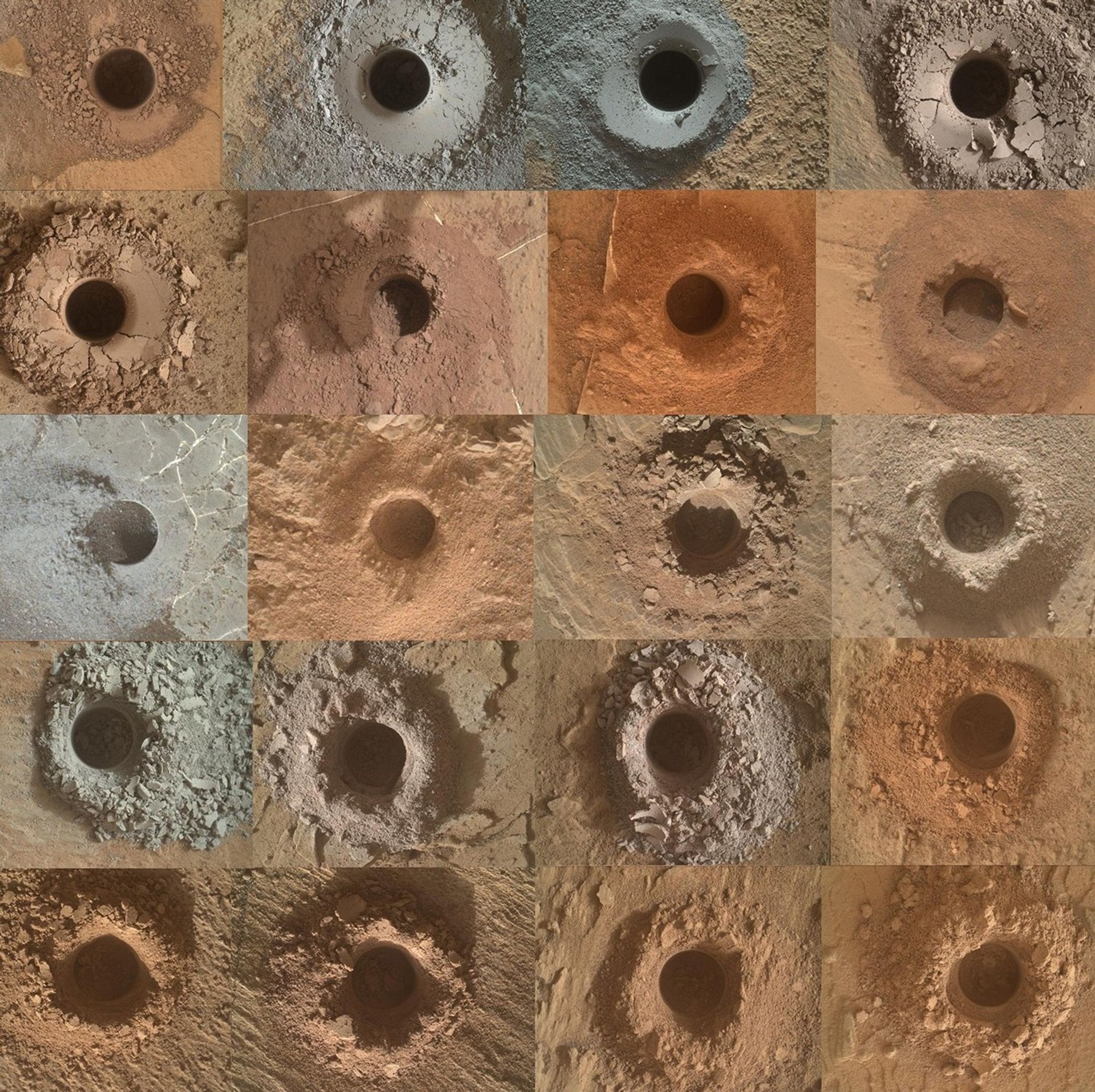
The search for any sign of life on Mars continues. In the latest update, a new data release from Curiosity’s Chemistry and Mineralogy (CheMin) - essentially the rover’s portable X-ray diffraction lab - and published in a paper in Science, analyzes 20 different rock samples from various elevations of Mount Sharp, the mountain in the center of Gale Crater that Curiosity has been slowly climbing. In the paper, the researchers describe how the size of the crystals in those samples could help scientists determine where to look for evidence that life might have evolved on the Red Planet.
To understand how, first it's best to understand the geology of Gale Crater. Curiosity has been exploring it for a long time at this point, but one important aspect is how the age of the rock changes as the rover ascends. The deep layers at the bottom of the crater are representative of ancient Mars, while the higher elevations are relatively young rock from a period when the planet was rapidly losing its water.
While exploring samples from all different elevations of the crater, the researchers noticed that the crystals of a mineral called hematite were incredibly tiny (less than 10 nm) high up in elevation, whereas the hematite crystals were huge in comparison (up to 65 nm) down at the bottom of the crater. Hematite is an iron oxide material that the researchers think can be used as a type of “time machine” - all thanks to a process known as Ostwald ripening.
Fraser talks about what the Curiosity rover has discovered.Under warm, neutral-to-alkaline conditions, another mineral, known as goethite, which the researchers found in the upper reaches of the crater, but not the lower ones, naturally transforms into hematite. Over a long period, if those conditions persist, the smaller crystals of hematite dissolve and their atoms re-form onto larger crystals like the ones seen at the bottom of the crater.
In other words, the Red Planet environment at the top of the crater had a freezing surface where liquid water didn’t stick around long. Whereas the environment when the crystals at the bottom of the crater formed in deep groundwater that remained warm even as the surface was freezing over. According to the researchers, this warm, wet groundwater could have remained chemically active for up to 4.7 million years.
That might not be a long enough time for life to evolve, but it potentially could be, adding yet another nuance to the search for Martian life. But this research isn’t happening in a vacuum - we’re getting plenty of other updates about the Martian climate transition from a blue, potentially habitable world, to the barren red desert we see today.
Fraser discusses how liquid water can hide on Mars.Recent data from the Perseverance rover in Jezero crater show massive deposits of carbonates, indicating that early Mars underwent a runaway carbon sequestration event, pulling the CO2 out of the atmosphere and eliminating the heating provided by the planet’s greenhouse effect. Oxygen isotope studies from other instruments on Curiosity also show heavy evaporation, capturing the exact moment when the planet’s lakes started boiling away into its thinning atmosphere.
But even after that evaporation event, liquid water retreated underground where deep aquifers could act as a thermal refuge for any burgeoning ancient life. It’s a strong indication that, if we want a chance to find any evidence of life on Mars, we’re likely going to have to look underground, where the water held on the longest in the deep, warm, mineral-rich dark. Anybody up to designing a Martian tunneling mission?
Learn More:
NASA - NASA Uses Mineralogical Marker to Understand Ancient Martian Climate
M. Szczerba et al. - Hematite is a mineralogical marker of ancient climate change on Mars
UT - Mars Could Have Been Warm and wet, While Earth was Still a Glowing Ball of Molten Rock
UT - Ancient Underground Water Suggests Mars May Have Been Habitable Longer than Previously Thought

