 Universe Today
When NASA's Juno spacecraft reached Jupiter in 2016, its observations took some of the guesswork out of understanding the massive gas giant. It showed us that the planet's magnetic field, already known to be powerful, was far more powerful than we thought. It showed us that its cloud bands extended much deeper into the atmosphere than we thought. It also exposed the chaotic polar regions that each host multiple cyclones in strange yet stable geometric configurations.
Nobody should feign surprise, then, that new research based on Juno's Microwave Radiometer (MWR) found that lightning on Jupiter, already known to be powerful, could be up to one million times more powerful than terrestrial lightning.
These findings are in new research in AGU Advances titled "Radio Pulse Power Distribution of Lightning in Jupiter's 2021–2022 Stealth Superstorms." The lead author is Michael Wong, a planetary scientist at UC Berkeley’s Space Sciences Laboratory.
Prior to Juno reaching Jupiter and entering its polar orbit, most of what we knew about the giant planet was based on observations from a more equatorial viewpoint. The study of the planet's lightning was also based on observing the nightside, where lightning was easily visible. Almost every spacecraft that passed by the planet also saw lightning, including New Horizons.
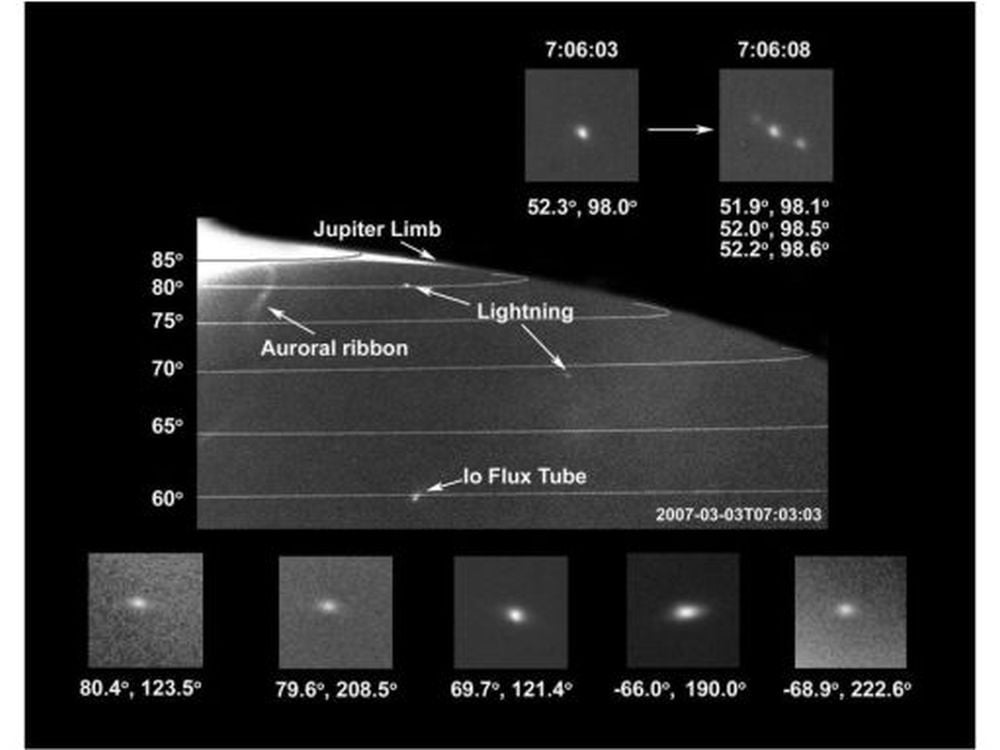 NASA's New Horizons spotted lightning on Jupiter when it passed by the planet in 2007. Each blob in the image is actually several lightning flashes, blurred into one by the exposure time. Detecting lightning at polar latitudes was a significant finding. Image Credit: NASA / JHUAPL / SwRI
"The Juno spacecraft—now in its 10th year of science operations at Jupiter—has detected lightning signals in both optical and radio bandpasses," the authors write. "We focus here on data from the Microwave Radiometer instrument, which has two key advantages for surveying lightning statistics."
The Microwave Radiometer Instrument (MWR) is very effective at studying Jovian lightning for a couple of reasons.
The first reason concerns ionospheres and their effect on electromagnetic waves. Planetary ionospheres are like plasma, and plasma is a problem. Plasmas have a certain frequency, and electromagnetic waves below that frequency can't propagate through the plasma. Think of AM radio waves that are mostly propagated back toward Earth by its ionosphere. But the MWR detects pulses that have higher frequencies than Jupiter's plasma frequency. That means the pulses can propagate directly from the lightning source to the instrument.
The second reason concerns the MWR's multiple antennas. It has six antennas, and each one is dedicated to a specific range of frequencies. One of them detects microwaves at the high frequency range of the radio spectrum. The instrument detects the radio pulses from lightning, not the optical pulses. Optical pulses are blocked by Jupiter's deep, thick atmosphere, while radio is not. This means that MWR is measuring a more reliable indicator of the lightning's strength, too. "The MWR thus measures typical pulse power in the storms, rather than high-power outliers," the authors explain.
MWR's capabilities let the researchers probe Jupiter's lightning more deeply.
In a press release, lead author Wong said that lightning on Jupiter “tells us about convection, which is how the atmosphere churns and transports heat from below. Convection operates a little bit differently on Earth and Jupiter because Jupiter has a hydrogen-dominated atmosphere, so moist air is heavier and harder to bring upward.”
This means that for a storm to rise up through Jupiter's atmosphere, it has to be more powerful than a comparable storm on Earth. When it reaches the top, that energy is released as powerful lightning jumping from cloud to cloud. It also generates extremely powerful winds.
Our understanding of Jupiter's lightning leans heavily on nightside observations. But the problem is that in the optical, clouds can block light and make the lightning's true strength difficult to determine. Questions arose when Juno spotted numerous weaker lightning flashes similar to Earth's with a star-tracking camera.
That's when Juno's MWR got involved. Though it wasn't designed to study lightning, it ended up being very effective.
One of the issues in studying Jupiter's lightning is that it's almost continuous along belts that loop around the planet. That makes it difficult to pin down the exact location of the storm, which is critical to understanding its strength. Luckily, in 2021-22, there was a pause in between storms on Jupiter's north equatorial belt. Wong was able to pinpoint a single large storm at a time with images from the Hubble, Junocam, and amateur astronomers, and measure it with the MWR.
Wong found what he calls "stealth superstorms" which lasted for months and transformed Jupiter's cloud structure. They're stealth storm because unlike other superstorms, they only reach modest heights.
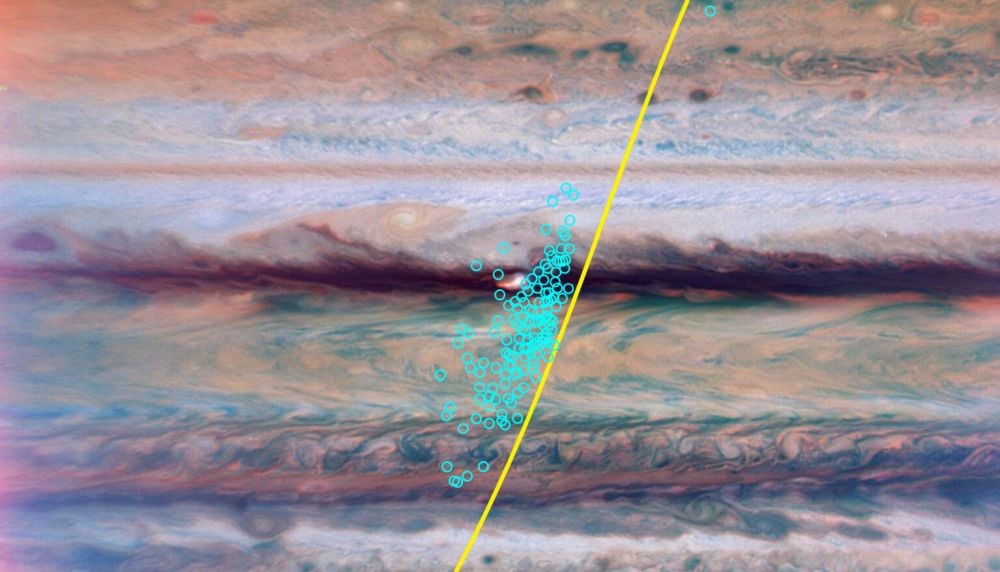
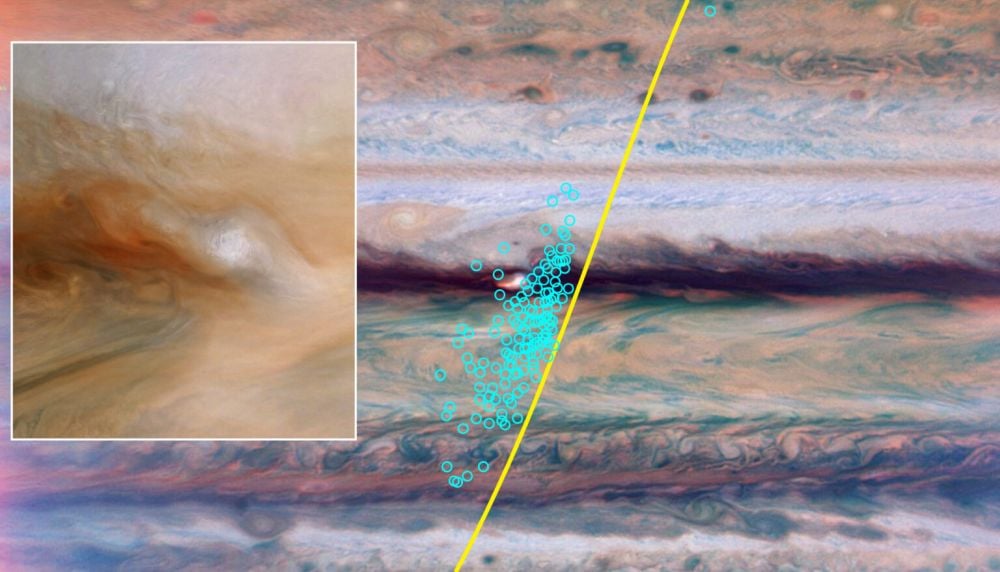 This image shows Juno's track over Jupiter and a cluster of radio pulses from lightning. The inset image is a Junocam image of a stealth superstorm plume from January 12th, 2022. Image Credit: NASA/JPL-Caltech/SwRI/MSSS/Björn Jónsson (JunoCam); Wong et al. (2026, AGU Advances; HST and Juno MWR)
“Because we had a precise location, we were able to just say, ‘OK, we know where it is. We’re directly measuring the power,’” Wong said.
Juno passed over the region 12 times and each time it flew over a different isolated storm. For four of them, Juno was close enough to measure the microwave static from the lightning. There were an average of three lightning flashes per second for each of the four. Juno detected 206 separate pulses of microwave radiation over one of them.
"The isolated nature of these storms (as lightning sources) resolved the degeneracy between pulse location and pulse strength, allowing measurement of a pulse power distribution with statistical median values ranging from 27 to 214 W over the MWR bandpass, well within the observational sensitivity range.
In all, Juno detected 613 lightning pulses. The researchers calculated their power and found that the weakest were comparable to Earth lightning, and the strongest may have been 100 times more powerful," the authors write.
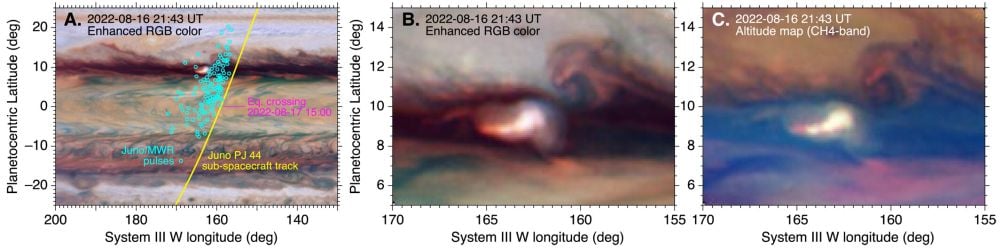 This figure shows what Juno saw during one orbit above Jupiter in August 2022 and observed a cluster of lightning signals with its MWR instrument. (a) shows the spacecraft's track and the pulses, and (b) shows a zoomed-in view of the storm system in enhanced RGB from the Hubble. (c) is an altitude map of the storm system, with color indicating vertical level and brightness indicating cloud opacity. It shows deep clouds as red, high clouds and hazes as blue, and very thick clouds reaching high altitudes as white. Image Credit: Wong et al. 2026, AGU Advances; HST and Juno MWR.
But measuring lightning strength is difficult. In this work, the researchers are dealing with apples and oranges. They're comparing Earth lightning on one radio wavelength to Jupiter lightning on a different radio wavelength. One study said that Jupiter's lightning could be one million times more powerful than Earth's.
When measuring microwaves from lightning, researchers are only sampling a part of its power, making the whole endeavour complicated. Lighting emits at optical and radio, but also generates chemical, thermal, and acoustic energy. It's a complex expression of energy.
"Jovian stealth superstorm lightning at in the 600-MHz MWR bandpass may be similar in strength to radio pulses from terrestrial lightning, or up to 106 times stronger, depending on the uncertain powerlaw slope used to extrapolate different measurements over a large frequency range," the researchers write. "The wide range leaves open the possibility that Jovian lightning is strong enough to fall within the terrestrial radio superbolt range, but refining the terrestrial/Jovian relative power comparison requires future data with more closely matched observational radio frequencies."
A single bolt of Earthly lightning releases an estimated 1 gigaJoule of total energy, or a billion Joules. That's enough to power 200 average homes for one hour. But Jupiter's lightning dwarfs that. Wong estimates that a single bolt of lightning on Jupiter ranges up to 500 times, possibly even 10,000 times that of an Earth bolt.
The gas giant's powerful lightning indicates that the voltage level in clouds is much higher, but that's based on how lightning works on Earth. Scientists can't assume that the process is the same on other worlds, especially a gas giant like Jupiter.
“This is where the details start to get exciting, where you can ask, ‘Could the key difference be hydrogen versus nitrogen atmospheres, or could it be that the storms are taller on Jupiter and so there’s greater distances involved?’” he said. A storm on Earth is about 10 km tall, while Jupiter’s storms breach the 100 kilometers mark.
“Or could it be that greater energy is available because with moist convection on Jupiter, you have a bigger buildup of heat needed before you can generate the storm to create lightning?” he added. “It’s an active area of research.”
Note that the statement that Jupiter's lightning could be on million times more powerful than Earth's lightning is at the extreme range of estimates. A single study arrived at that number. But whether it's one million times more powerful, or some lesser number, Jupiter's lightning is a powerful natural force that begs to be understood.
"Pulse power in the stealth superstorms may be comparable to terrestrial lightning radio emission, or up to a million times more powerful, depending on uncertainties in unresolved pulse duration and lightning spectral energy distributions. Future studies may determine whether the lightning pulse power in stealth superstorm is typical or anomalous of Jupiter's lightning in general," the researchers conclude.

